TLDR Tracy AI Interviewer gives every founder who applies a first interview from one link on your apply page, so partner hours go to the strongest applications and not to whoever wrote the best form.
Techstars and Y Combinator both run an application, then an interview. Techstars says staff read every application, so the first look decides who is met.
Tracy starts on click at any hour and follows up on what each founder says. A person decides from a recording, a timestamped transcript and an assessment for each question.
Next step: send us one programme.
We make Tracy AI Interviewer.
A founder submits an application at 11 p.m. on the last day of the call. The form is complete, the deck is attached and the one-line description is sharp. Three weeks later it sits in a long list, and the partner who could have asked the one question that shows what this founder knows has no hours left to ask it. That is how accelerators select startups in practice. They decide who gets a conversation, and weigh the rest from the form.
This page shows where that decision happens and what a first look has to capture. It also shows how Tracy AI Interviewer gives every applicant that first conversation: one link in your form, any hour, no calendar, follow-ups on what each founder says. Your partners then read the result and choose. If you run an accelerator, a fellowship or a VC programme, the sections below end in a pilot you can start with one cohort. Our guide to running the accelerator interview covers what to ask, and the applications use case shows the flow.
The cut happens at the first look, before anyone is met
Techstars and Y Combinator both describe an application followed by an interview. Techstars says its staff review every application, and Y Combinator's interviews are 10-minute conversations with partners who have read the application. In our view the biggest cut comes earlier, when a form and a deck decide who is invited to talk. A form cannot ask a follow-up, so it rewards the founder who writes well and can miss the one who builds well. A first conversation for everyone stops the form being the filter.
Programmes publish how accelerators select startups, and every stage uses partner hours
Programmes describe their own process in public. Three facts show where the hours go:
- Reading. Techstars says that "thousands of companies apply to Techstars, and our staff personally review every application that comes in" (its post on the application and interview process, dated 12 January 2026).
- Founder effort. The same post says most teams need one to four hours to complete a first application. A form that no conversation follows costs founders that time too.
- The conversation. Y Combinator's interview guide describes 10-minute conversations over Zoom with two to three partners who have read the application. Techstars managing director Andres Barreto says the first interview tries to understand a company "well enough to write a strong investment memo" (post dated 22 January 2026).
Put together, the first conversation is short, scarce and built on what the founder already wrote. That suits a programme with a small cohort. It becomes a bottleneck for one that gets thousands of applications, because reading an application does not meet the founder.
A first look has to capture five things a form cannot
A first look that is fair to a founder captures five things:
- The founder in their own words, describing the customer and the problem without a field to fill.
- Customer and pain, with a source. Techstars lists it first of the four things it asks founders to be ready on.
- What they built first and what they skipped, which shows judgement about speed.
- How they handle a question they cannot answer yet. Techstars tells founders that saying "I don't know" is as relevant an answer as any.
- A record a second partner can read without having been there.
None of these fit a form field.
Give every founder a first interview from the form
You add a link in your application form to an apply page where each founder takes the interview, as a step after the short form or instead of a long answer. Each founder starts when they click, at any hour, in a browser, with no calendar and no partner present, and is told on the join screen that the conversation is recorded and transcribed. The interview is ready in under 10 seconds, and a founder whose connection drops can rejoin within 10 minutes (a setting each customer configures).
She asks your questions, or questions drafted from a description of your programme that you edit. Then she does the part that does not scale: she listens, waits for the end of the thought and asks about what the founder said. A founder who says two of six pilots renewed gets asked what those two had in common. Our guide to how AI interviews work walks through a session.
Your partners get a recording of both sides, a timestamped transcript and a written assessment for each question with its reasoning. Strong founders are ranked above the others and flagged to your team. A partner can override a rejection, move a founder forward or invite them to interview again, and the history stays on the record. See what a good AI interview report shows. See what Tracy does and what a founder sees.
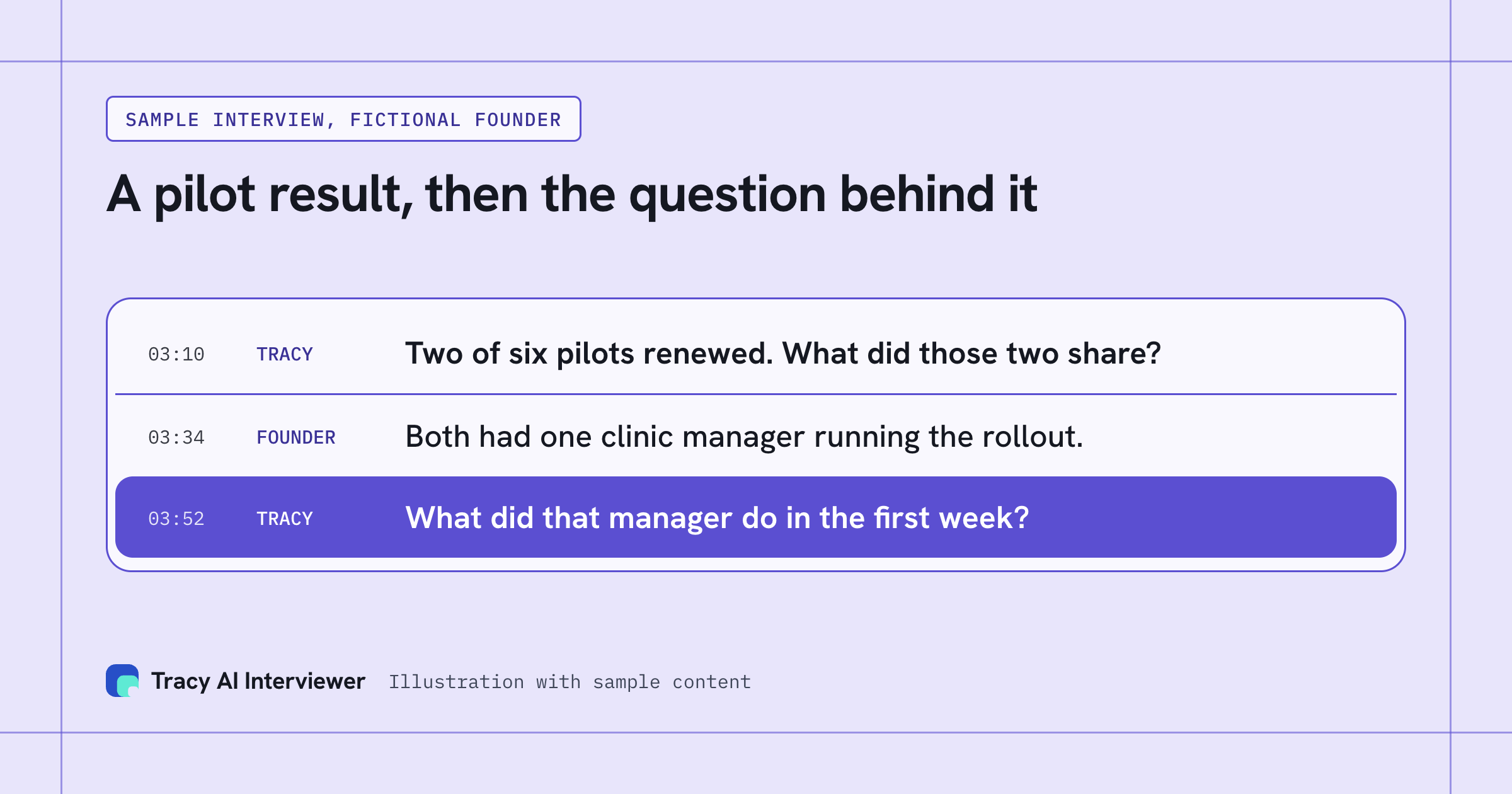
Tracy asks the follow-up a partner would ask about a founder's own pitch.
Cost is small enough to cover the whole list
You pay for results, not seats: $1 per credit, one credit per started 20 minutes of an interview that produced a result. One hundred founders at 20 minutes each cost $100, and the first three results are free with no card. See the pricing page.
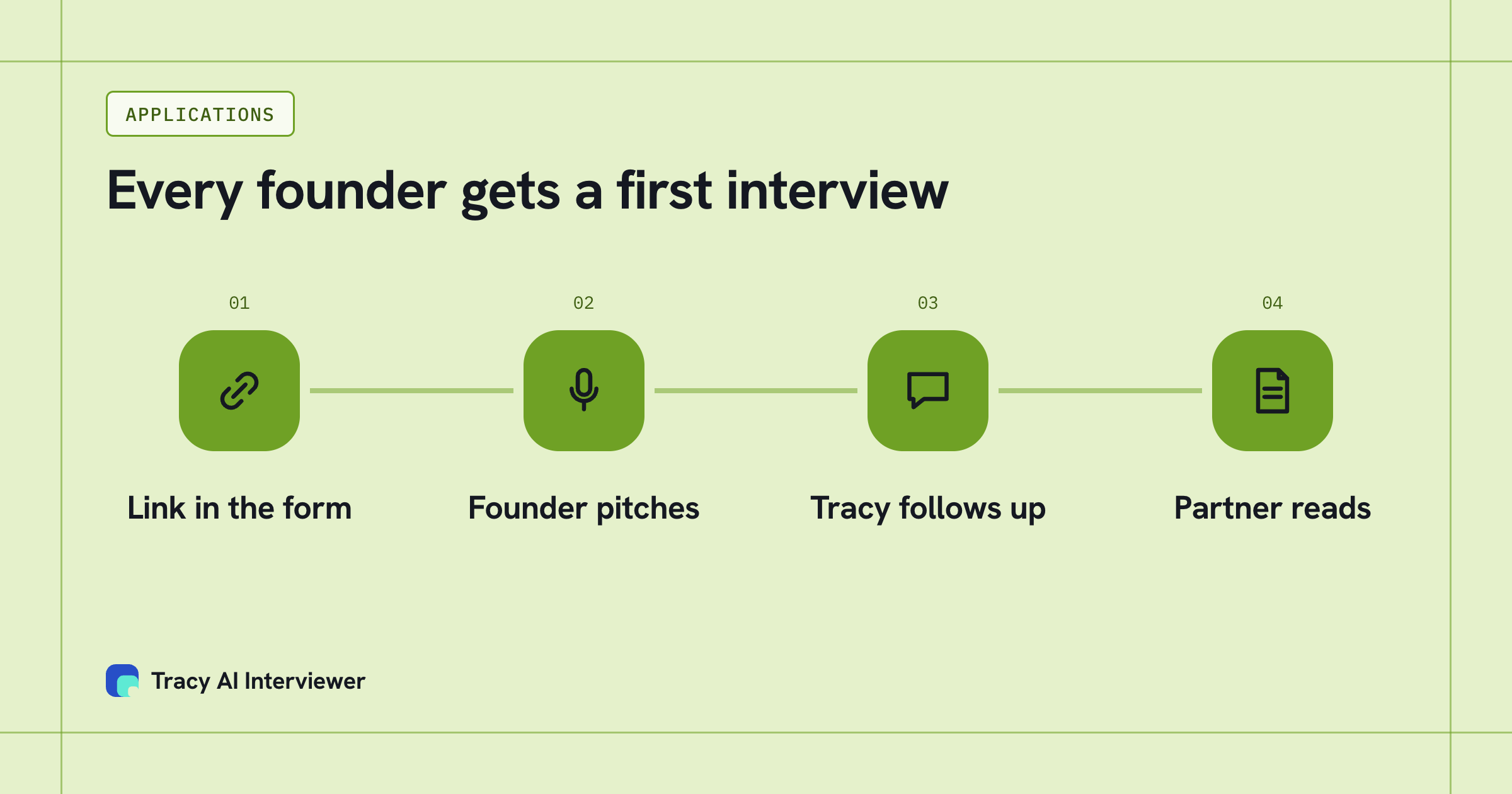
Every founder gets a first interview from the form, and a partner reads the result.
What Antler Korea saw when it moved first interviews to Tracy
Roy Junyoung Jang, Director, Residency & Investment at Antler Korea, describes the before. "Initially, we conducted 30-minute, one-on-one Zoom interviews with every founder." Some days held "eight 30-minute interviews scheduled back-to-back". With preparation, note-taking and review, "I was effectively spending around six hours a day on screening." An earlier AI interviewing tool still took "about an hour to go through their answers."
The after, in his words: "With Tracy, I can now review and assess those candidates in approximately 1.5 hours. That's a time saving of more than 50%, and in practice, closer to 75%." He also notes: "For borderline candidates who are difficult to evaluate based on quantitative scores alone, Tracy makes it much easier to share their responses and assessment results with other team members for further discussion." The advice: "spend time designing the depth and structure of your interview questions during the initial setup."
Keep these calls with your partners
A first interview does not make the selection. These stay with people:
- Who moves to the next round. Tracy ranks and flags. A partner decides, and can override.
- Fit with your thesis. That is a judgement about your portfolio.
- Checking the claims. A founder says two pilots renewed. A partner, or diligence, confirms it.
- Anything about the founder's circumstances. Visa, funding and availability are conversations, not scores.
A form is enough when your cohort is small enough for partners to meet every applicant. Once it is not, the first look is where you lose people.
Pilot on one intake before you change the programme
Run one intake and decide first what would make you stop. Have two partners read the same ten results and say who they would advance, then compare with the form-only shortlist.
Stop condition. If the partners agree no more often than they did from forms alone, or many founders abandon the interview step, rewrite the questions and run the next intake before widening the pilot. Want it set up for you? Send us one programme and we will build the interview plan in days.
Measure whether every founder was met, not how many applied
Applications received is the number everyone reports and the one that tells you least, so set it aside. Five measures show whether the process works:
- Share of completed forms with a first interview. The target is all of them.
- Partner hours per founder advanced.
- Founders advanced who were not on the form-only shortlist. This is the real test of whether the interview adds information.
- Interview completion rate. A low rate points at the questions or the join step, not at the founders.
- Agreement between two partners reading the same result.
Read them after the first intake. If the third is zero, the interview adds nothing and you can stop.
Questions
How do accelerators select startups?
What do accelerators look for in a founder?
Can an AI interviewer interview founders?
How long should a first founder interview be?
Create an interview for your own programme: send us one programme and we will build the interview plan in days, with a recording and report you can check. The first 3 results are free, with no card. Try it free · Book a demo
Sources
- Techstars, Inside a Techstars Accelerator: The Application & Interview Process, 12 Jan 2026, retrieved 3 Nov 2026.
- Techstars, How To Prepare for Your First Techstars Interview, 22 Jan 2026, retrieved 3 Nov 2026.
- Y Combinator, interview guide (undated), retrieved 3 Nov 2026.
- Tracy AI Interviewer pricing, retrieved 5 Nov 2026.
- Tracy AI Interviewer home page, testimonial from Roy Junyoung Jang, Antler Korea, retrieved 9 Nov 2026.