Accelerator Interview: How to Meet Every Founder Who Applies
TLDR
- Give every founder a first conversation before the application cut. Tracy AI Interviewer asks your programme's questions, follows up on each answer and gives partners a concise record in the founder's own words.
- Strong founders with plain applications get a chance to be heard, while partners spend live calls on teams worth exploring. Partners still choose whom to meet and fund.
Contents
- How do programmes run the first accelerator interview today?
- What can't an accelerator application show you?
- How does Tracy give every founder a first accelerator interview?
- What accelerator interview questions should the first round ask?
- When are partner first calls the better choice?
- How do you set it up before your next intake?
- Questions
- Sources
If you run a programme, the accelerator interview is where you hear what a founder is building and how far they want to take it. Partner hours limit how many founders get that first interview, so many programmes judge most applicants on the form alone. This guide shows how to give every applicant a first conversation and let partners choose who to meet from what each founder said. (Preparing for an accelerator interview as a founder? Skip to the Questions.)
How do programmes run the first accelerator interview today?
A typical funnel looks like this:
- An application form, sometimes with a short founder video.
- A first call with a partner, a venture partner or an alum.
- A longer interview with the partners who decide.
- An offer.
The second step is the expensive one. In a 2019 guide, 500 Global described the start of its process as "a 30 to a 45-minute phone screen", followed by "two twenty-minute group interviews". Multiply a 30-minute call by every applicant and the hours run out, so a programme with thousands of applications can only call a share of them.
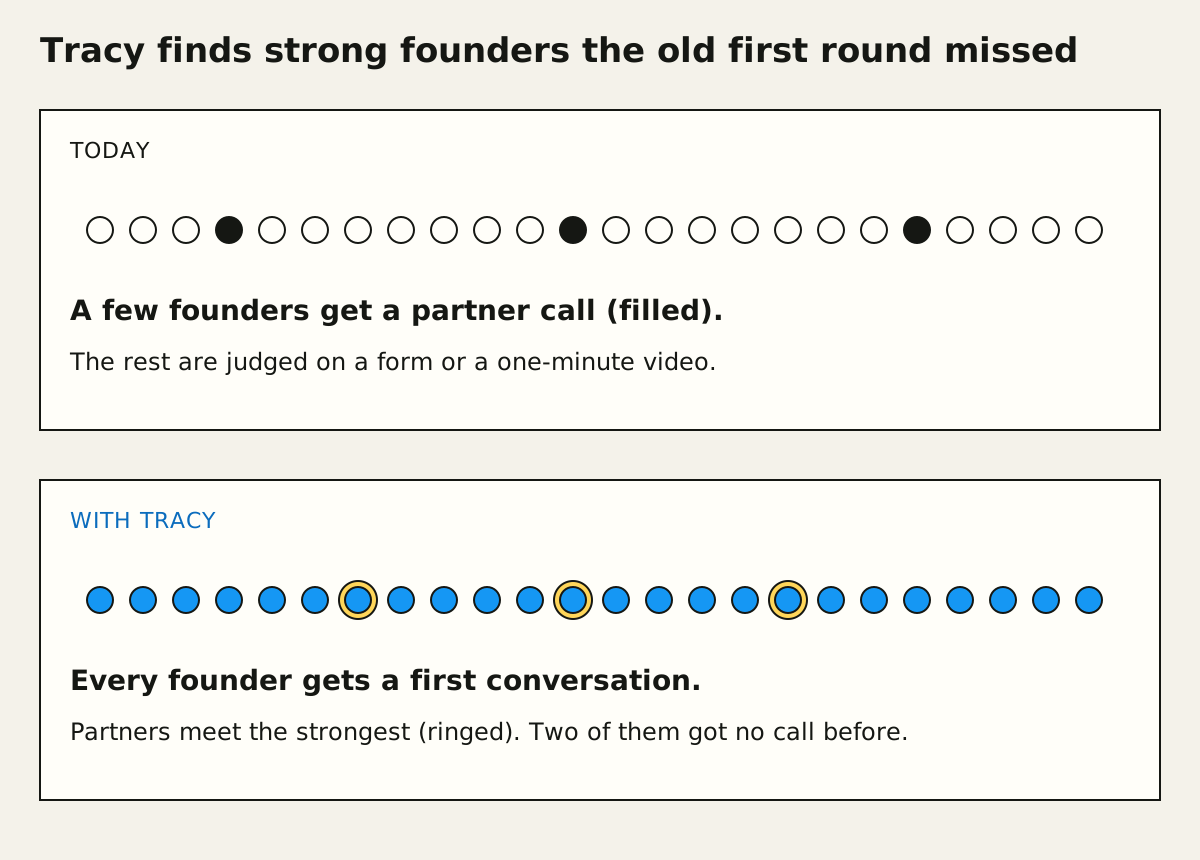
A founder with a sharp insight and a plain application can miss that call, while partner hours go to calls that were a clear no in the first five minutes.
What can't an accelerator application show you?
A form shows how well someone writes about their company. A one-minute video shows how well they pitch to a camera. Neither can ask the second question, which is where a founder's story comes out.
Ask "What are you building?" and you get the one-line pitch. Ask "Who was the first person you saw with this problem?" and you hear how they found it. Ask "Where do you want this company to be in five years, and what has to be true for that?" and you hear the ambition, and whether they've thought about what stands in the way.
How does Tracy give every founder a first accelerator interview?
Tracy AI Interviewer interviews like your best partner on a first call. It runs natural two-way video interviews, asks your questions, then "follows up on vague answers, digs into the interesting ones": the customer behind a claim, the reason behind a pivot, the plan behind an ambition. Partners walk into their calls already knowing each founder's story. For a technical co-founder, Tracy can "introduce a coding task, and probe the trade-offs behind an answer", so you learn whether the team in front of you can build the product. Our page on AI technical interviews shows how.
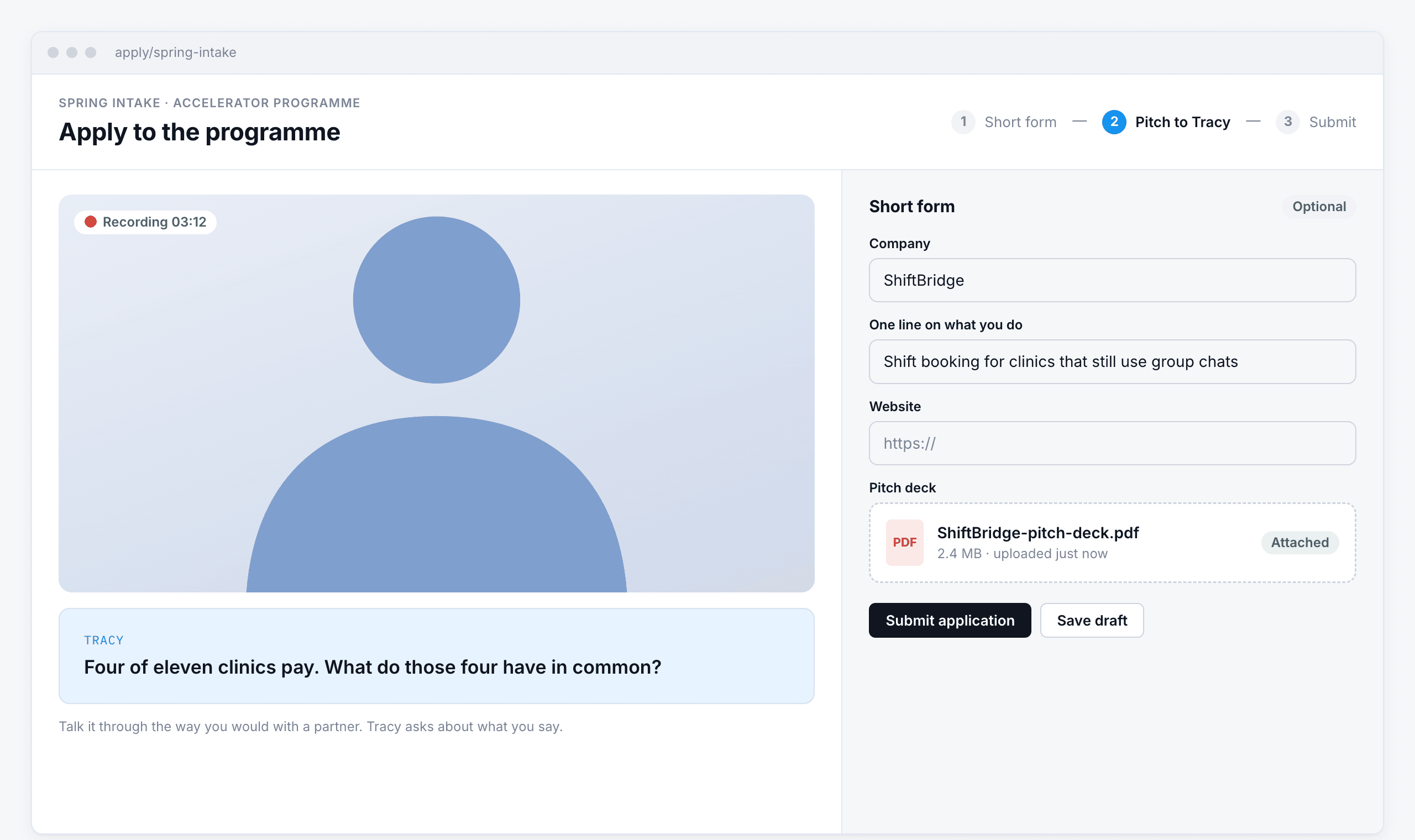
Tracy meets every founder. Each one opens a link in their browser and joins with no sign-up, whenever it suits them, so the whole intake can get a first conversation without adding a reviewer. Our guide on how to interview every applicant in depth covers the volume side.
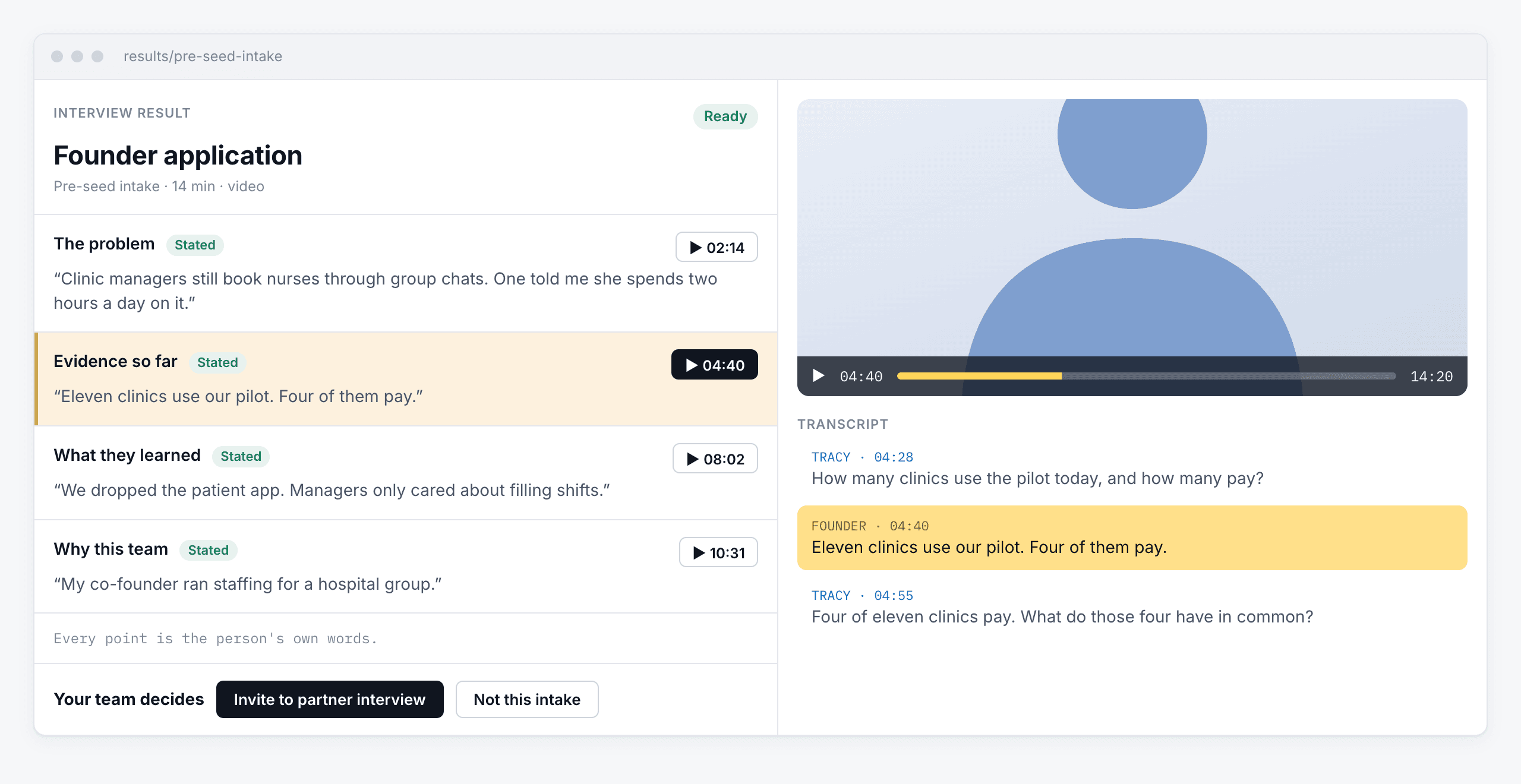
Partners read instead of scheduling. Each founder's result is a readable summary "with the participant's own words attached", with every answer organised around the fields you define and the video and transcript beside it. The AI explains each answer score, so a partner can check a strong answer and invite that founder the same day.
What accelerator interview questions should the first round ask?
Here is a first round we would set up for a pre-seed programme. Tracy adapts each follow-up to the founder's answer. For why the follow-up carries the weight, see our AI trainer interview questions, written for expert vetting but built on the same idea.
| Question | Tracy follows up on |
|---|---|
| What are you building, and who needs it most? | The last time they spoke to one of those people, and what they heard |
| How did you come to this problem? | What they saw or lived through that made them start |
| What do those people use today instead? | Why they haven't switched to something better already |
| What's the most important thing you've learned from users, and what did you change? | Evidence that the change worked |
| Where do you want this company to be in five years? | What has to be true to get there, and what they'd do first with the programme |
| Why is your team the one to build this? | The experience behind the answer |
Example: an illustrative follow-up chain from the same demo intake, with test data, not a real founder.
Tracy: How many clinics use the pilot today, and how many pay?
Founder: Eleven clinics use our pilot. Four of them pay.
Tracy: Four of eleven clinics pay. What do those four have in common?
Founder: They're the bigger ones, with night shifts. Night cover is where the group chat breaks down, so that's where we save managers the most time.
Tracy: Where do you want this company to be in five years?
Founder: Booking shifts for clinics across the region. To get there we need payroll too, because managers won't run two systems.
Three questions in, a partner knows who pays, why, and what the founder plans to build next. A form would have shown "11 pilot clinics".
When are partner first calls the better choice?
Partner calls still win on relationship. Pick them for the first round instead if:
- Your partners can call most of your applicants each intake.
- The programme is small enough that every founder already gets a conversation.
Once applications outrun partner hours, Tracy works best as the step before the partner call, so the relationship starts with the founders most worth meeting. If you use one-way video today, our list of HireVue alternatives shows what changes when the tool can follow up. For the wider category, see the best AI interview software.
How do you set it up before your next intake?
- Write down what partners want to know after a first call. Three to five fields is enough: what they're building, how they found the problem, evidence, learning and ambition.
- Turn those fields into questions. Bring your own, or describe who you're interviewing and let Tracy draft them; "your questions are drafted for you", and you add the questions that matter.
- Take the interview yourself, the way a founder would, and change anything that feels off.
- Add the link to your application confirmation, or send it to everyone who applies.
- Read the results each week and invite the strongest founders to a partner interview. Keep the recording for the partner who meets them.
- Tell applicants that an AI runs the first interview and that partners make every decision.
You pay for results, not seats, and a session with no answers is never charged. Enterprise pricing is custom, based on your volume, as low as $1 per credit, so the cost follows the size of each intake.
Questions
Does an AI interview replace the partner interview? No. It gives every applicant the first conversation that only a few get today. Partners still run the interviews that decide.
Will founders find it impersonal? Tracy follows up on vague answers and digs into the interesting ones, so it plays out as a conversation, and candidates rate Tracy 4.7 out of 5 on average. A separate study involved about 70,000 job applicants; among those offered a choice, 78% chose the AI interviewer. The study did not involve founders, so watch your own completion rate in the first intake.
How long should the first-round interview be? Five or six questions with follow-ups make a good first round. One credit covers up to 20 minutes.
Do these work as startup incubator interview questions too? Yes. Incubators, fellowships and grant programmes use the same steps and change only the fields, for example research plan, motivation and track record.
Can partners see why a founder was ranked high? Yes. The AI explains each answer score, and the summary has the founder's own words attached, with direct quotes, the interview video and transcript.
I'm a founder with an accelerator interview coming up. How should I prepare? Know your story in your own words: who has the problem, how you found it, what users taught you and what you changed, and where you want the company to be in five years. Expect a follow-up on every answer, so bring the specifics behind each claim, such as the customer, the number or the date. 500 Global's own interview guide walks through its stages.
Read next: How to screen candidates when you want to interview every applicant in depth
Watch Tracy run a founder's first-round interview: See how it works
Sources
- 500 Global, "Startup accelerator interview: how to ace your interview with 500 Global", 5 Mar 2019, 500.co, retrieved 29 Oct 2026: "You'll begin the startup accelerator interview process with a 30 to a 45-minute phone screen"; "There will be two twenty-minute group interviews with around three to five people".
- Jabarian and Henkel, "Voice AI in Firms: A Natural Field Experiment on Automated Job Interviews", Aug 2025, abstract at Luohan Academy, retrieved 29 Oct 2026: "70,000 applicants were randomly assigned to be interviewed by human recruiters, AI voice agents"; "when offered the choice, 78% of applicants choose the AI recruiter". Full paper: SSRN 5395709.
- Qode, qode.world/tracy, retrieved 29 Oct 2026: "4.7/5 average candidate rating across interviews".
- Qode, qode.world/pricing, retrieved 29 Oct 2026: "Video & chapter breakdown", "Transcript", "Answer summary & score", "Explain answer score by AI Agent"; Enterprise "Custom based on volume".
- Qode, 28 Oct 2026: enterprise pricing can go as low as $1 per credit, custom based on volume.
- Tracy AI Interviewer, tracyinterview.ai, retrieved 29 Oct 2026: "Tracy AI Interviewer runs natural two-way video interviews, follows up on vague answers, digs into the interesting ones"; "Tracy AI Interviewer can ask role-specific questions, introduce a coding task, and probe the trade-offs behind an answer"; "Your questions are drafted for you." and "add the questions that matter"; "Each person opens a link in their browser and joins with no sign-up."; "People join in their browser whenever it suits them."; "Each interview becomes a readable summary with the participant's own words attached"; "Direct quotes for context"; "your own repeatable interview, with every answer organized around the fields you define."
- Tracy AI Interviewer pricing, tracyinterview.ai/pricing, retrieved 29 Oct 2026: "$7 per credit, in USD. Credits never expire."; "1 credit for each started 20 minutes, charged when the result is ready."; "You pay for results, not seats."; "A session with no answers is never charged."