In short
Recruitment automation is widespread but partial: in June 2026, 34% of US employers said AI had sped up their recruiting, and 48% said it had raised the number of applications per role (ZipRecruiter).
Tracy AI Interviewer automates the first-round interview. Each applicant starts the moment they click the link, Tracy follows up inside the applicant's own field, and your team gets the recording, a time-stamped transcript and each person's answers by question, then decides. An API and an MCP server let your own system or an AI chat start interviews.
One Tracy customer went from a 44-day average hiring cycle to a 7-day one; over one month Tracy covered the workload of 53 full-time recruiters.
Use the figures below to see where your own team sits.
How many recruiters use automation?
About two thirds of US recruiters say they already use AI in their workflows: 65% in Employ's 2025 Recruiter Nation Report (15 October 2025), whose release does not state the sample size. Other 2026 surveys ask what AI changed rather than whether it is used. TestGorilla surveyed talent professionals in the US (1,428, fielded August 2026) and the UK (483, fielded 10 September to 7 October 2026); 72% of the US group and 58% of the UK group said AI had made finding candidates faster. In ZipRecruiter's survey of more than 1,000 US talent acquisition professionals and hiring managers (11 to 18 June 2026), 34% said AI had sped up their recruiting process and 40% used it to write job descriptions.
Older surveys give the baseline. LinkedIn's Future of Recruiting 2025, a September 2024 survey of 1,271 recruiting professionals in management roles or higher across 23 countries, found 37% of organisations "actively integrating" or "experimenting" with generative AI, up from 27% a year earlier. Resume Builder's October 2024 survey of 948 US business leaders found half of companies using AI in hiring and 68% expecting to by the end of 2025. Its sample was managers at companies of more than 21 employees with household incomes of $75,000 or more, so read it as a sample of managers and not of all employers, and read the 68% as a 2024 expectation.
For a plain-language start, see recruitment automation.
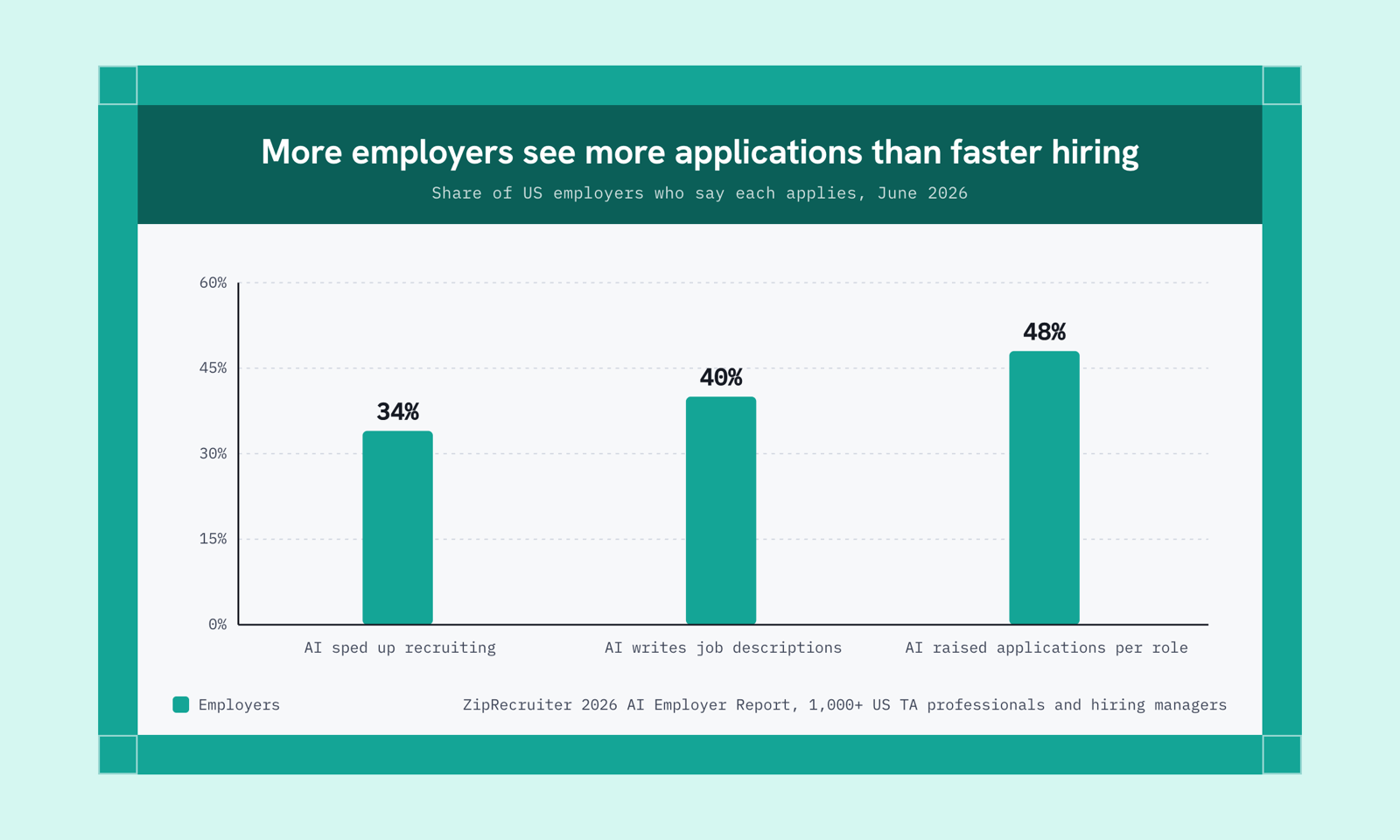
In ZipRecruiter's June 2026 survey, more employers said AI had raised applications per role (48%) than said it had sped up recruiting (34%).
What do recruiters automate first?
Reading resumes, in the one survey that asked. Resume Builder's October 2024 report puts resume review first, at 82% of companies, followed by review of candidate assessments (64%), chatbots that talk to candidates (40%) and interviews (about 23%). Its text does not make clear whether the base is all companies surveyed or only those using AI, so read the shares as that report's own. It adds that 1 in 4 companies using AI for interviews rely on it for the entire interview process. In June 2026, ZipRecruiter found 40% of US employers using AI to write job descriptions.
LinkedIn asked where the saved time goes. Of talent professionals already using generative AI, 35% put it toward candidate screening and 26% toward skills assessments.
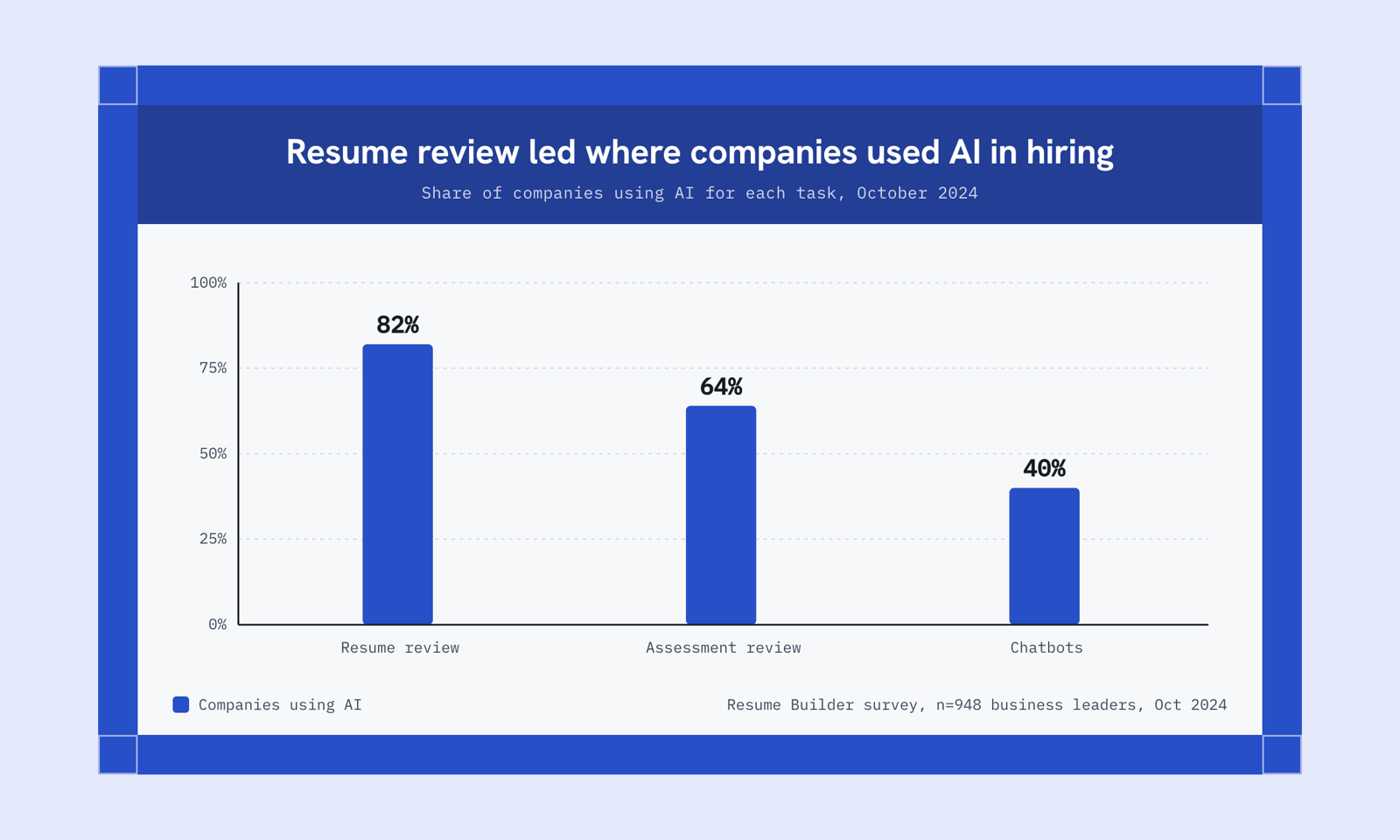
Resume review was the most common automated task in this survey, so most automation started before any conversation with the applicant.
What does recruitment automation save?
Time, where anyone has measured it. LinkedIn's survey found that talent professionals integrating or experimenting with generative AI saved about 20% of their work week, roughly a full workday. Ashby customers using automatic scheduling confirmed interviews 26% faster than those scheduling by hand: 3.7 hours at the median against 5 hours, across data from January 2021 to March 2026.
The one study of hiring outcomes is a randomised field experiment by Jabarian and Henkel (working paper, 18 August 2025) that followed 70,884 applications for entry-level customer service roles in the Philippines. When AI voice interviews replaced human-led ones, job offers rose 12% (8.70% to 9.73%), job starts 18% and 30-day retention 17%, while human recruiters still made the decisions. It covers one country and one job family.
Is automation creating more work too?
For some teams, yes. In the ZipRecruiter survey above, 48% said AI had raised application volume per role. Robert Half surveyed more than 2,000 US hiring managers in November 2025: 65% said skills are harder to verify on AI-polished resumes, and 38% respond with more interviews per candidate. Both are effects of automation on the applicant side.
Where should a person still decide?
In Resume Builder's report, 21% of companies reject candidates automatically at every stage with no human review, 50% limit AI rejections to the first resume screen, and 29% keep a person in every rejection decision. GDPR Article 22(1) protects people in the EU from being subject to a decision resting solely on automated processing where it has legal or similarly significant effects. For checking a tool's scores, see how AI interview scoring works.
Which recruiting steps a high-volume team can hand to Tracy
Tracy AI Interviewer takes over the first-round interview and leaves the decision with your team. An applicant opens the link in a browser and starts on click, at any hour, so nobody books a slot. Tracy asks each next question in that person's own field and lets a thought finish before it asks for a missing detail. Reviewers then read a recording of both sides, a time-stamped transcript and the person's answer to each question, each point with its evidence. The decision stays with your reviewers; Tracy neither scores nor ranks, and rejects no one.
Your own systems can start interviews too. Tracy has an API for a customer's system and a remote MCP server, so an AI chat such as ChatGPT or Claude can create an interview, send invitations and pull the results. For the setup, see recruiting MCP and AI agents for recruiting; for the scheduling step, interview scheduling.
A reviewer's view of one answer looks like this, in invented sample data:
Q1. How do you prepare before calling a new prospect? Reads the company's latest news and new hires for about ten minutes, then drafts one opening line from what stands out. "I spend ten minutes on their news and hires, then write one line that proves I did." (02:40)
Follow-up asked: What was the last opening line you wrote?
Field, preparation per prospect: about 10 minutes. Evidence: Q1, at 02:40.
The join screen also says that the conversation is recorded and transcribed.
How big is the AI recruitment market?
Grand View Research valued the global AI recruitment market at USD 4.8 billion in 2025 and forecasts USD 9.6 billion by 2035, a compound annual growth rate of 7.2% from 2026 to 2035. Those are market estimates, not survey results, and other analysts size the category differently.
Common questions
How many recruiters use automation?
What does recruitment automation save?
How big is the AI recruitment market?
What should stay with a person?
Hand one step to Tracy
Tell Tracy about the role, adjust the questions it drafts and read each person's answers. First 3 results free.
Try it free (opens in a new tab) Book a demo (opens in a new tab)
Your first 3 results are free. No card needed.
Sources
- LinkedIn, The Future of Recruiting 2025, retrieved 19 Nov 2026.
- Resume Builder, 7 in 10 companies will use AI in the hiring process in 2025 (Oct 2024), retrieved 23 Nov 2026.
- Ashby, Recruiting Operations Benchmarks, 2026 Talent Trends Report (7 May 2026), retrieved 19 Nov 2026.
- Jabarian and Henkel, Voice AI in Firms: A Natural Field Experiment on Automated Job Interviews (18 Aug 2025), retrieved 19 Nov 2026.
- ZipRecruiter Economic Research, More Jobs, Higher Bar: The 2026 AI Employer Report, retrieved 19 Nov 2026.
- Robert Half, survey of HR leaders on AI-generated applications (10 Mar 2026), retrieved 19 Nov 2026.
- GDPR, Article 22, retrieved 19 Nov 2026.
- Grand View Research, AI Recruitment Market (Aug 2026), retrieved 19 Nov 2026.
- Employ, 2025 Recruiter Nation Report (15 Oct 2025), retrieved 18 Nov 2026.
- TestGorilla, Recruiting in the AI era (2026), retrieved 18 Nov 2026.