AI in Hiring Statistics: 15 Numbers to Know in 2026
The short version
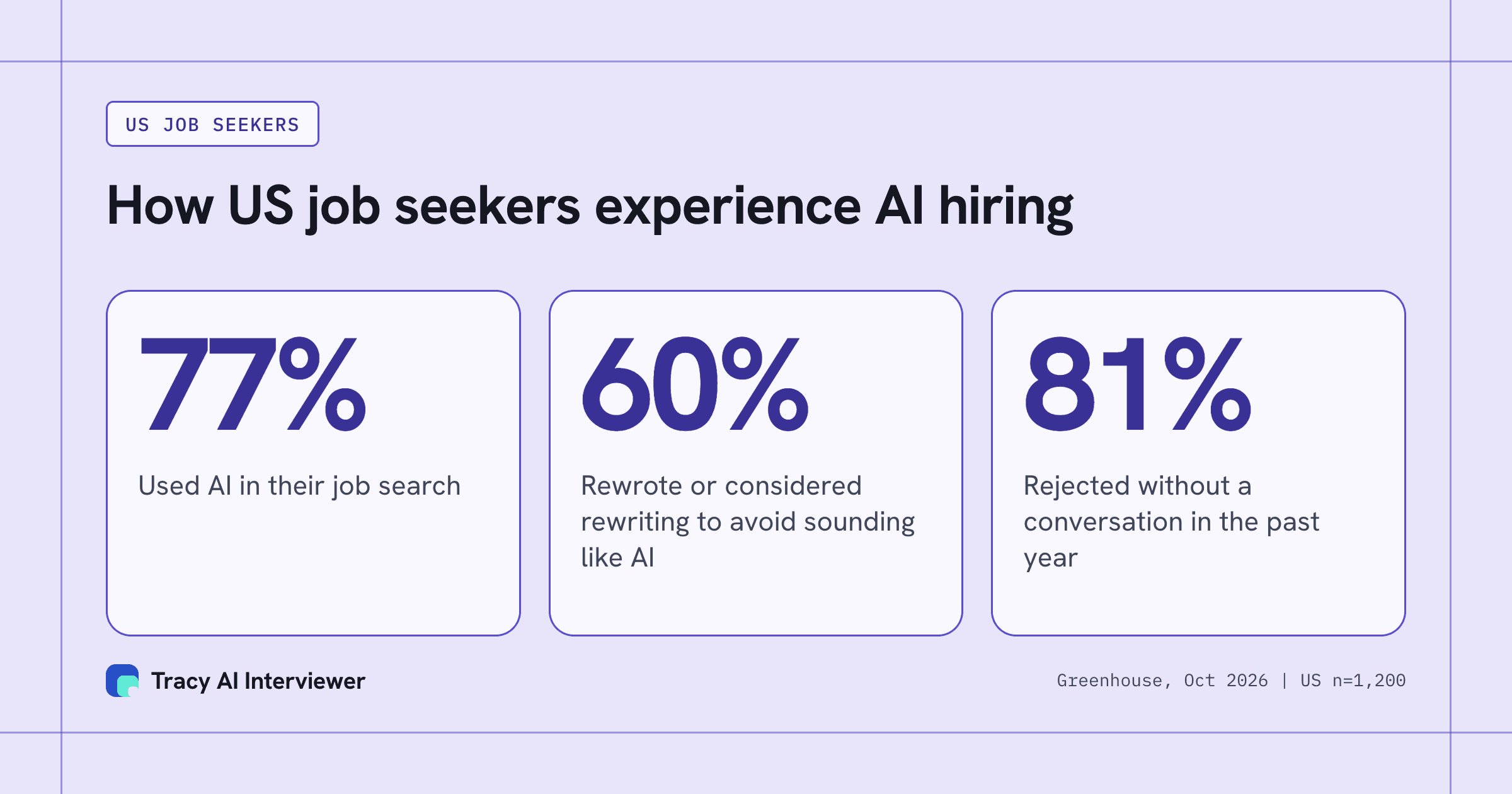
- AI is now present on both sides of hiring. Separate Greenhouse surveys found 77% of US job seekers had used it and 63% had faced an AI interview.
- Disclosure and human review are the fault lines. In one Greenhouse survey, 70% of people who faced an AI interview said they were not told beforehand.
- Application volume is not the same as applicant quality. Robert Half found 67% of US hiring managers said AI-generated applications were slowing hiring.
These are the most useful AI in hiring statistics we could verify as of 2 November 2026. Each figure keeps its source, population and fieldwork context. A survey of active job seekers cannot tell you what percentage of employers use AI, and a fraud rate from proctored coding assessments cannot be relabelled as an interview cheating rate.
AI use by job seekers
1. 77% of US job seekers had used AI in their search
Greenhouse surveyed more than 2,800 job seekers across the United States, United Kingdom, Ireland, Germany and Australia for a report released in October 2026. Among US respondents, 77% said they had used AI in their job search.
The same release found 60% had changed or considered changing how they write to avoid sounding like AI. The split was 39% who had already rewritten material and 21% who had considered it. Recruiters are therefore reading applications in which genuine candidates may deliberately sand off polished language to look more human.
2. 81% of US job seekers had been rejected without a conversation
In that October Greenhouse survey, 81% of US respondents said they had been rejected without speaking to a person. The survey does not attribute those rejections to AI. It records the experience against which candidates judge automated screening.
3. 71% took extra steps to get noticed
Greenhouse reported that 71% of US job seekers took an extra step to get noticed, such as seeking a referral or paying for a resume service. Separately, 62% tried tactics to get past automated screening. These figures describe candidate actions; they do not measure how many employers added hiring stages.
AI interview adoption and candidate experience
4. 63% of US job seekers had faced an AI interview
Greenhouse's release on 1 May 2026 describes a survey of 2,950 active job seekers across the US, UK, Ireland, Germany and Australia. Its methodology says the reported findings refer to US respondents, n=1,200, unless otherwise noted. Sixty-three percent of that US group said they had experienced an AI interview.
"AI interview" covered more than one format. Respondents could be describing recorded video scored by AI, a text exchange or a spoken AI interviewer. Buyers should name the actual format when comparing tools.
5. 38% of US candidates had left a process because it included an AI interview
Among US respondents, 38% said they had withdrawn from a hiring process because it included an AI interview, while another 12% said they would consider doing so. That is a warning about implementation, not proof that every candidate rejects the format.
Greenhouse also reported that nine in ten job seekers were open to an AI interview in its later October survey. The figures can coexist: people may accept a useful, disclosed conversation and reject a confusing or impersonal format.
6. 70% said the employer did not disclose the AI interview beforehand
Among respondents who had faced an AI interview, 70% said they were not told in advance. Twenty-one percent said they learned only after the interview had begun. Disclosure belongs in the invitation, before a candidate spends time preparing or starts recording.
7. 33% named AI-scored prerecorded video with no human present as a reason to withdraw
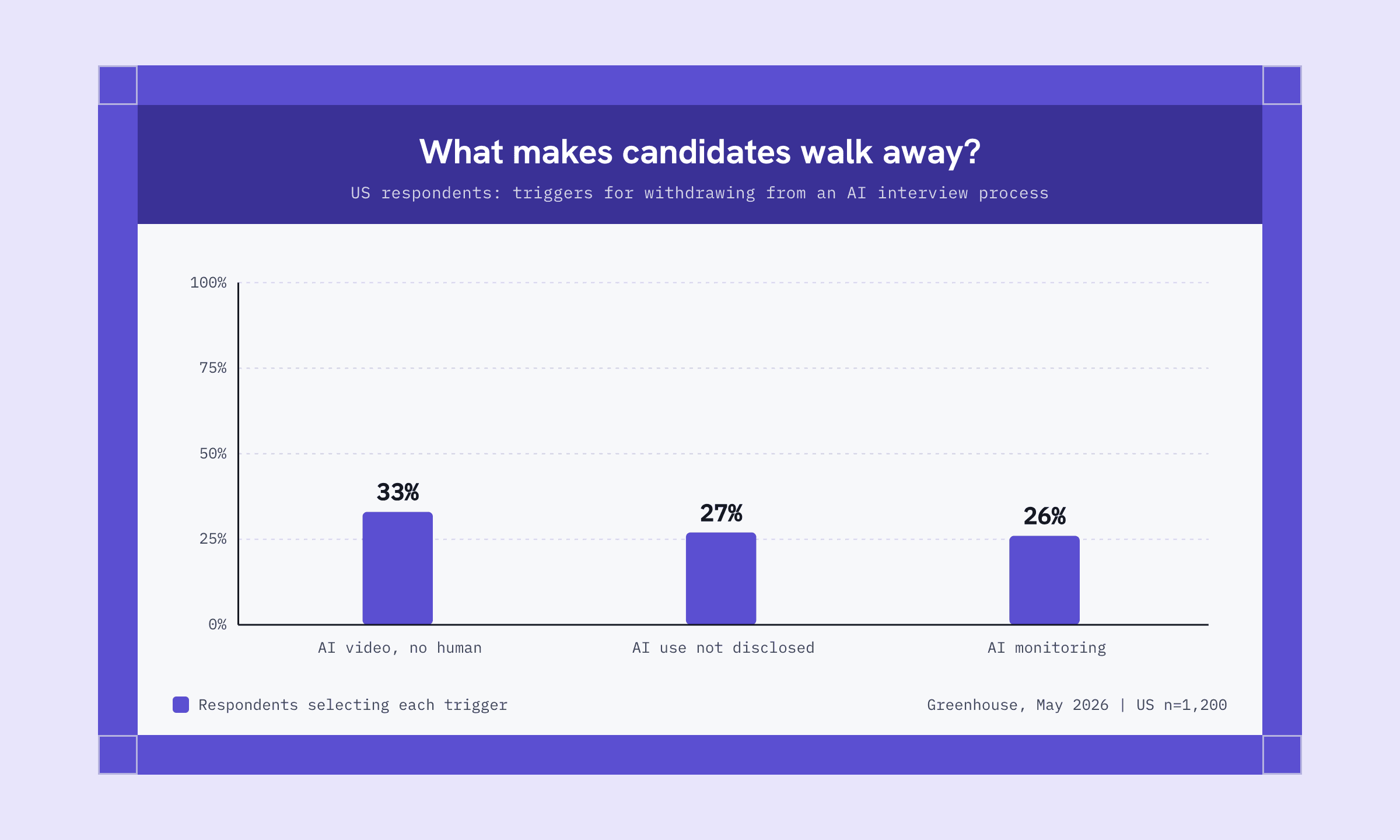
Greenhouse asked US candidates what would make them leave an AI interview process. Thirty-three percent selected prerecorded video scored by AI with no human present. Other triggers included failure to disclose how AI would be used at 27% and monitoring during the interview at 26%.
Those percentages describe stated triggers, not market share. They should guide the candidate experience: explain the format, the data collected and who reviews the result.
8. 51% said they never heard back after an AI interview
Greenhouse reported that 51% of US candidates who completed an AI interview said they never heard back. Twenty-eight percent reached the next round and 13% received a rejection. The missing share reflects other outcomes in the survey.
Automation does not excuse silence. If a team can send an interview link at scale, it can send a clear outcome at scale too.
Application quality and verification
9. 67% of US hiring managers said AI-generated applications were slowing hiring
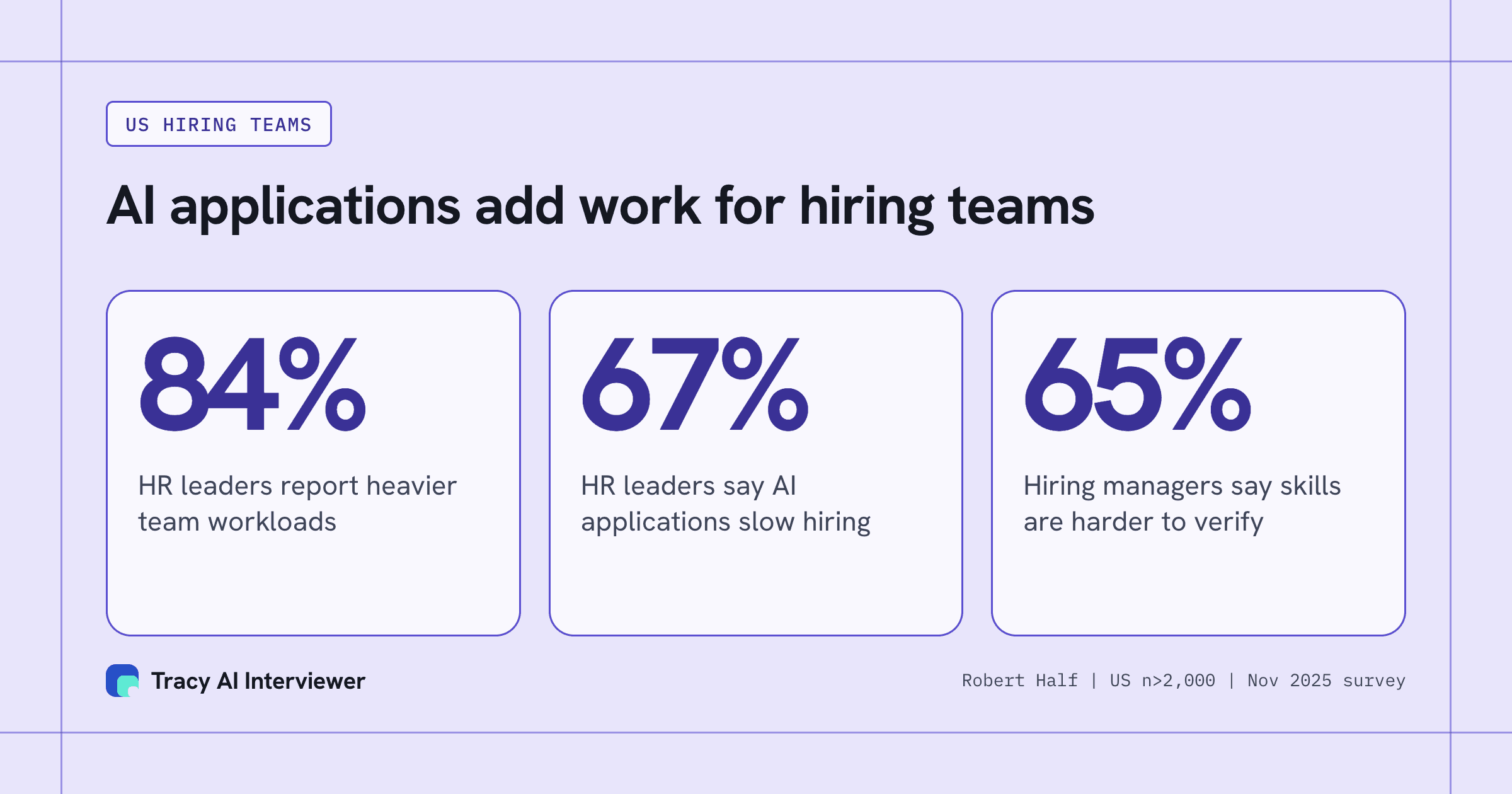
Robert Half surveyed more than 2,000 US hiring managers in November 2025 and released the results in March 2026. Sixty-seven percent said AI-generated applications were slowing the hiring process. Twenty percent reported delays longer than two weeks.
This was a manager perception survey, not a timed audit of hiring systems. It is still useful evidence of the operational pressure teams feel.
10. 65% said verifying applicant skills had become harder
In the same Robert Half survey, 65% said it was harder to verify whether candidates had the skills they claimed. Eighty-four percent said AI-generated applications increased workload.
The reported responses included reviewing applications more closely at 42%, adding interviews at 38%, and updating job descriptions at 32%. Adding interviews only helps if those conversations produce evidence a reviewer can check.
11. Suspicious attempts in CodeSignal assessments rose from 16% to 35%
CodeSignal reported that attempts flagged by its detection systems rose from 16% in 2024 to 35% in 2025. This is vendor data from proctored skills assessments. It does not establish that 35% of candidates cheat, and it is not an AI interview statistic.
Use the figure narrowly: assessment providers are seeing more behaviour their systems classify as suspicious. Any integrity signal should prompt review, not an automatic verdict.
Human oversight and public attitudes
12. 71% opposed AI making the final hiring decision
Pew Research Center surveyed US adults in December 2022, before the current wave of generative AI hiring tools. Seventy-one percent opposed employers using AI to make a final hiring decision, 7% favoured it and 22% were unsure.
The age of the fieldwork is part of the citation. It remains a useful baseline for a durable principle: tools can collect and organise evidence, while a person remains accountable for the decision.
13. 41% opposed AI reviewing job applications
In the same Pew survey, 41% opposed using AI to review applications, 28% favoured it, and 30% were unsure. Public opinion was less negative about assisting the review than making the final decision, but it was far from settled.
14. 38% wanted confirmation that a person reviews AI output
Greenhouse's 2026 candidate research found 38% of US candidates wanted confirmation that a human reviews AI output before decisions are made. This is an implementation requirement a team can act on immediately: say who reviews the result and where the final decision sits.
15. 27% would withdraw if AI use was not disclosed
In the same Greenhouse research, 27% named nondisclosure as a reason to withdraw. Disclosure is therefore not a legal footnote or a line buried in a privacy policy. It affects whether candidates continue.
How to use AI hiring statistics without misleading readers
- Name the population. "63% of US job seekers surveyed" is accurate. "63% of interviews use AI" is not.
- Keep the fieldwork date. Pew's attitudes were measured in 2022, even though its report was published in 2023.
- Separate formats. A prerecorded video, a chatbot and a two-way spoken interview create different experiences.
- Separate interviews from assessments. CodeSignal's 35% relates to suspicious attempts in its assessments.
- Do not combine ratings or percentages. Different sources asked different questions of different groups.
- Link to the original. A reader should be able to inspect the method and wording.
For teams choosing a format, one-way vs two-way video interviews explains the practical difference. What is an AI interviewer? covers the category without treating every automated step as the same product.
Questions
How common are AI interviews in 2026? In Greenhouse's May 2026 release, 63% of US job seekers surveyed said they had faced an AI interview. The release reports US findings, n=1,200, from a study of 2,950 candidates across five countries.
Do candidates want a human to review AI interview results? Yes. Greenhouse reported that 38% of US candidates wanted confirmation that a person reviews AI output before a decision. A separate Pew survey fielded in 2022 found 71% opposed AI making a final hiring decision.
How many job seekers use AI in their search? Greenhouse's October 2026 survey reported that 77% of US job seekers had used AI in their search.
Is AI-generated application fraud increasing? Employers report more difficulty verifying skills, and CodeSignal reported suspicious attempts in its proctored assessments rose from 16% in 2024 to 35% in 2025. That CodeSignal figure is about assessments, not job interviews.
Can I cite these statistics? Yes. Cite the original source, fieldwork date, sample and population shown beside each number rather than citing this summary alone.
See how Tracy works when you want a disclosed two-way first interview with a person making the decision.
Sources
All sources retrieved 2 Nov 2026.
- Greenhouse, 2026 Candidate AI Interview Report release: 2,950 active job seekers, interview exposure, withdrawal, disclosure and outcome figures.
- Greenhouse, October 2026 job-seeker survey release: more than 2,800 job seekers, US AI use, writing changes and hiring experience.
- Robert Half, AI-generated applications survey: more than 2,000 US hiring managers surveyed in November 2025.
- CodeSignal, 2025 assessment fraud release: vendor detection data for proctored assessments.
- Pew Research Center, AI in hiring and evaluating workers: US adult attitudes from a December 2022 survey.