In short
Krisp is the stronger tool for calls your team runs: noise and accent handling, and notes without a bot. Tracy AI Interviewer covers the calls nobody has time to run. Each applicant starts on click, at any hour, Tracy follows up in their own field, and a reviewer gets a recording, a timestamped transcript and what the person said to each question. Your team decides who moves on.
Krisp vs Tracy comes down to who holds the call. Krisp makes the calls your team runs clearer, with noise cancellation, accent conversion and bot-free notes, and for those calls it is the stronger tool. It leaves the recruiter's hour in place: every applicant still costs a recruiter an hour on a call. Tracy AI Interviewer holds the interview itself, asks follow-ups in the person's own field and gives a reviewer a recording, a transcript and what the person said to each question. On Enterprise Tracy can also take notes on calls your people run.
What Krisp does well
Krisp's pages describe a meeting assistant that works at the audio level on your device. It lists noise, echo and cross-talk removal, which it calls #1 AI noise cancellation, and real-time accent conversion for the speaker and the listener (1 hour a day on Core, 4 hours a day on the speaker side of Advanced). It writes notes, summaries and action items for Zoom, Microsoft Teams, Google Meet and Slack Huddles, covers in-person meetings, and can join with or without a bot. Transcription runs on the device in English, with 15 more languages on its servers.
It connects to Slack, Notion, Zapier, HubSpot, Pipedrive and Affinity, with Salesforce and ConnectWise on Advanced, plus MCP and API access. Krisp states SOC 2 Type II, GDPR and HIPAA, and a 7-day free trial needs no card.
On interviews your own people run, that is hard to beat. Interviews and hiring are not mentioned on the Krisp pages reviewed, so scorecards and applicant tracking sync are not stated.
Krisp works inside the call your team already holds. The interviewing, and the recruiter hours it takes, stay with your people.
Krisp vs Tracy: which one should you choose?
Choose Krisp when
- your recruiters and engineers run the interviews and the audio is the problem: noise, echo or accents on a call
- you want notes, summaries and action items from every kind of meeting, from $8 per user per month on annual billing
- you need Salesforce or ConnectWise sync, or SOC 2 report access on Enterprise
Choose Tracy when
- applicants outnumber the calls your team can hold
- the first round must go deeper than a form, with follow-ups in each person's own field
- you want to pay per interview, with no seats
Is Krisp an AI interviewer?
No, going by its pages. Krisp listens to a meeting and writes it up. Asking candidates questions and following up on what they said is not stated on the pages reviewed, so the interviewer is still a person, and that person's hours and depth set the limit.
Say 400 people apply: that is more calls than a panel of five can hold. Tracy AI Interviewer takes that call: the applicant opens a browser link at any hour, with no account and no scheduling, and Tracy interviews them by two-way video. For technical roles a coding task can sit inside the same interview, with follow-ups on approach and trade-offs. See AI technical interviews for how that runs, or how AI interviews work for the mechanics.
Tracy vs Krisp: buyer criteria side by side
Source: Krisp's own pages and approved Tracy product records, Nov 2026. Prices are list prices in USD.
| Criterion | Tracy AI Interviewer | Krisp | Who leads |
|---|---|---|---|
| Who runs the call | Tracy runs it, with no recruiter present. | Your people run it; Krisp listens and takes notes. | Krisp if your team keeps the call; Tracy if it should not. |
| Interview depth | Two-way video, follow-ups in the person's own field, a coding task inside the interview, questions from your brief or your own list. | Transcript, summary and action items of the call; asking interview questions is not stated. | Tracy, for every applicant. |
| Call audio | Not Tracy's job; the applicant joins from a browser. | Noise, echo and cross-talk removal; accent conversion. | Krisp. |
| Volume | Starts on click at any hour, no scheduling. | Per-user seats; unlimited transcription on paid plans. | Tracy for applicant waves; Krisp for steady team calls. |
| Stack | API and MCP (ChatGPT, Claude, Mistral, Gemini, Copilot Studio), Slack, WhatsApp, Workable, Breezy HR and Zapier. | Slack, Notion, Zapier, HubSpot, Salesforce on Advanced, MCP and API. ATS not named. | Krisp on CRM depth; Tracy on chat tools and API. |
| Evidence | Recording of both sides, timestamped transcript, what the person said to each question, integrity signals shown to a person. | Transcript, notes and action items; recording presets for transcript only, audio or video. | Tracy, with the words behind each question. |
| Security | SOC 2 Type II attested; report on request. | States SOC 2 Type II, GDPR, HIPAA and PCI-DSS. | Krisp on the regimes it lists. |
| Oversight | A person decides; integrity signals go to a reviewer and are not proof. | Not stated on the pages reviewed. | Not compared; Krisp's side is not stated. |
| Price | $1 per credit, first 3 results free, no seats. | Core $8 and Advanced $15 per user per month on annual billing; Enterprise custom. | Different units: interviews against seats. |
Scroll the table sideways to see all 4 columns.
What Tracy adds to interviewing
- Reach every applicant. Each person starts on click, at any hour, with no scheduling and no recruiter on the call. The first round stops waiting for a calendar.
- Ask the next question. Tracy follows each answer in the person's own field and waits for it to end. The second question comes from the first answer, even for a role the recruiter does not know.
- Keep the evidence. Every result has a recording, a timestamped transcript and a written assessment per question with its reasoning. A reviewer can open the moment behind a result.
How the published workflows differ for the same technical role
Take one invented role: a backend engineer for a payments team. The table sets Krisp's published description of its meeting assistant beside an illustration of how a Tracy interview would run. The Tracy column is an illustration, not a recording.
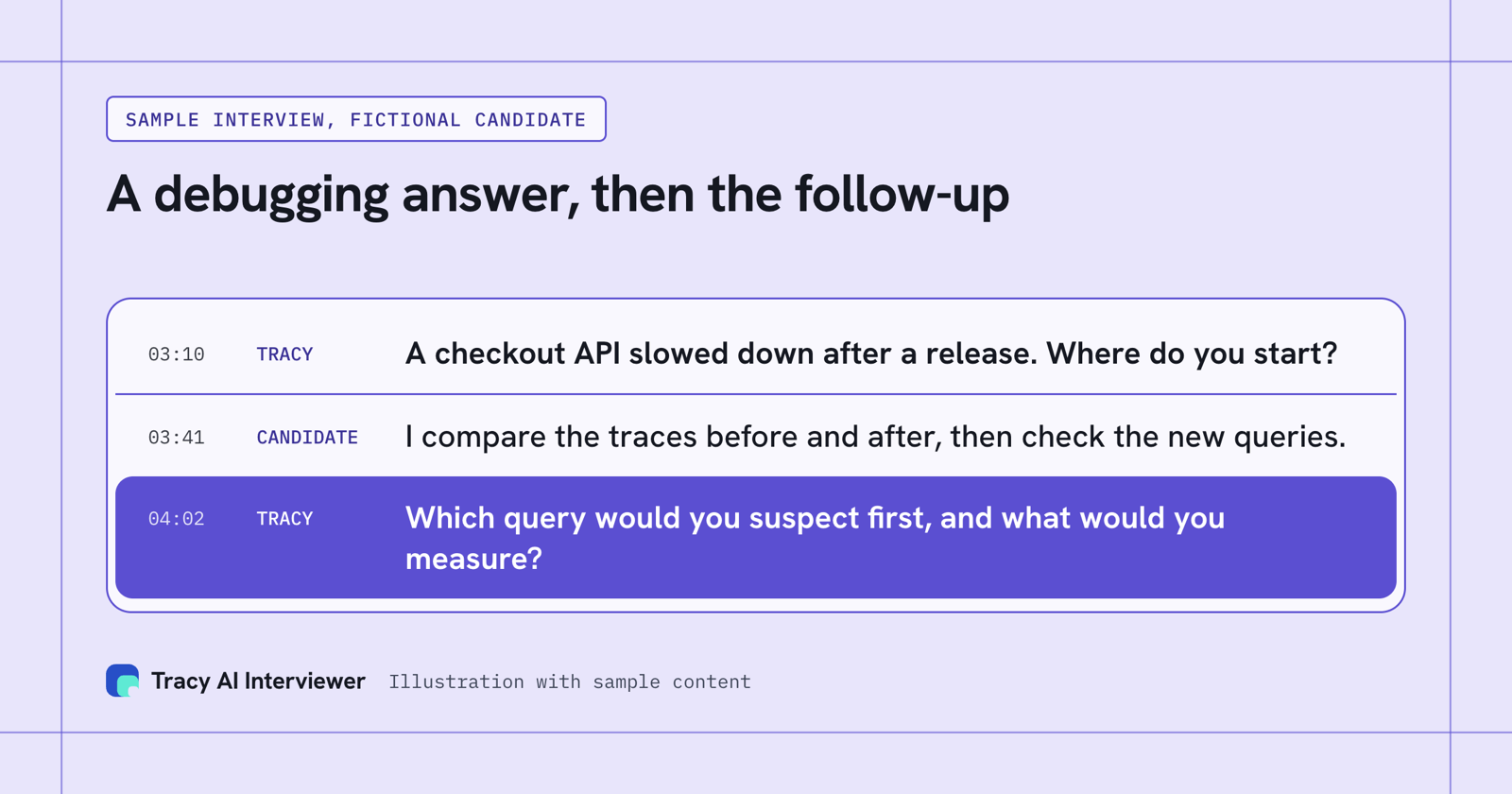
Tracy asks the next question herself, from what the candidate just said.
The same role, step by step
How the published workflows differ. The Krisp column comes from its pages; the Tracy column is an illustration.
| Step | Krisp (from its pages) | Tracy (illustration) |
|---|---|---|
| Setup | Install the app and connect your calendar; it works with Zoom, Teams and Meet at the audio level. | You describe the role and Tracy drafts the questions. You edit them or bring your own. |
| Who is on the call | An interviewer from your team. Krisp joins with or without a bot. | Tracy and the applicant. No recruiter is present. |
| Questions | The interviewer chooses them; Krisp does not set them. | Tracy asks from the brief, then follows up on each answer. |
| After the call | A transcript, a summary and action items, with optional recording. | Recording, transcript and what the person said to each question. |
Can a reviewer check a Krisp note or a Tracy result?
Both can leave a reviewer something to check, in different ways. Krisp keeps a transcript, notes and, if you choose, audio or video of a call. Tracy leaves the recording of both sides, a timestamped transcript and what each person said to each question, so a reviewer can open the moment behind a result. See what the interview report holds and transcripts vs reports.
Integrity works as a signal. Tracy shows tab changes, gaze, face detection, delays before answers, fullscreen exits and external screens to a person as evidence, never as proof, and nothing is decided in the interview. Candidates are told on the join screen that the conversation is recorded. See AI interview cheating detection.
What 1,000 applicants cost in live calls
Say each interview is a live 20-minute call. 100 applicants take about 33 hours of someone's time, 400 take about 133 and 1,000 take about 333, which is over two months of one person working about 160 hours a month, before scheduling and note-writing.
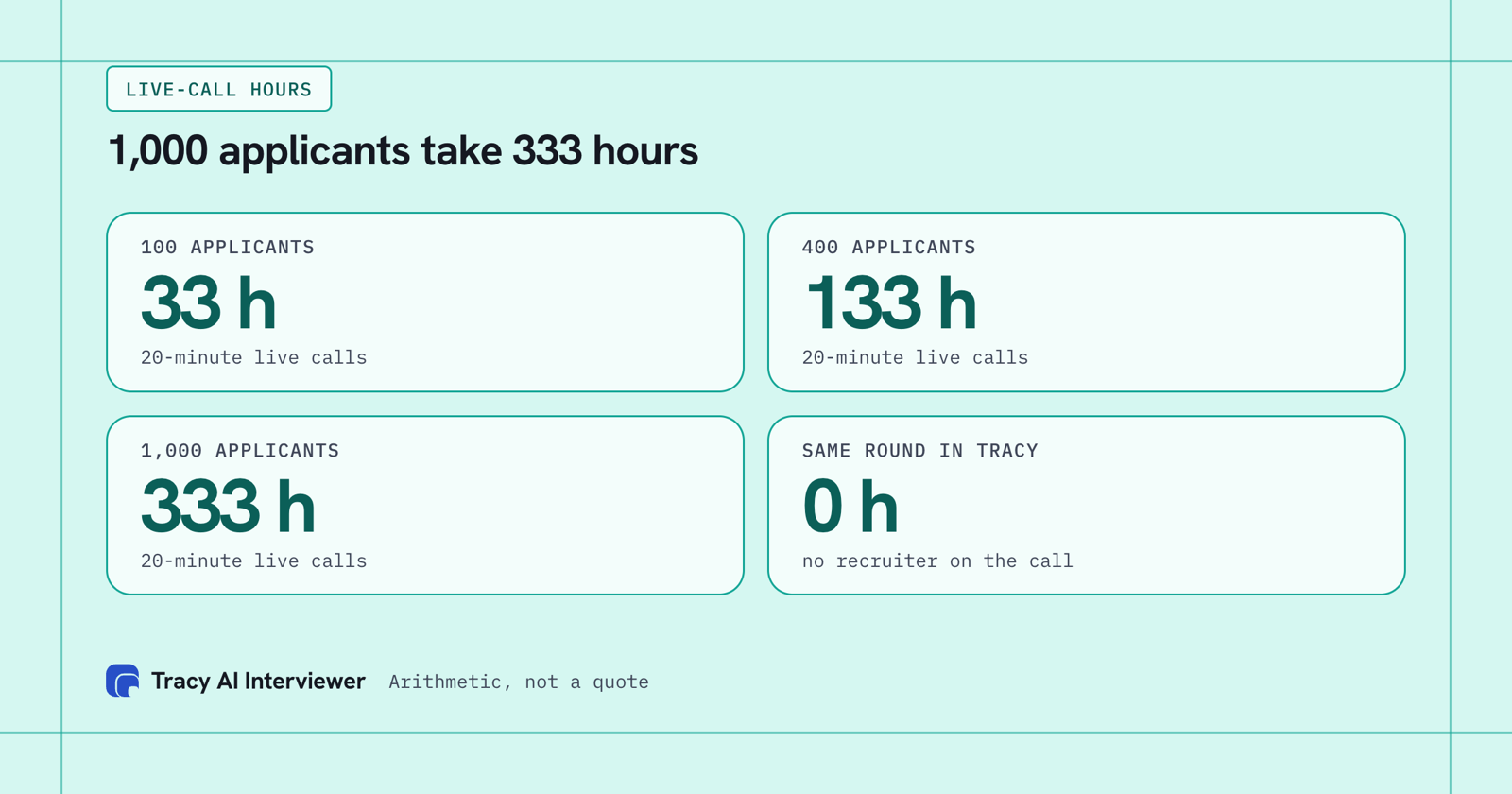
Live 20-minute calls take about 33, 133 and 333 hours at 100, 400 and 1,000 applicants.
Krisp makes each of those hours clearer. It does not remove them. With Tracy each applicant starts on click and nobody sits in the call. One customer cut its average time to hire from 44 days to 7, and Tracy did the work of 53 full-time recruiters in one month. See volume hiring.
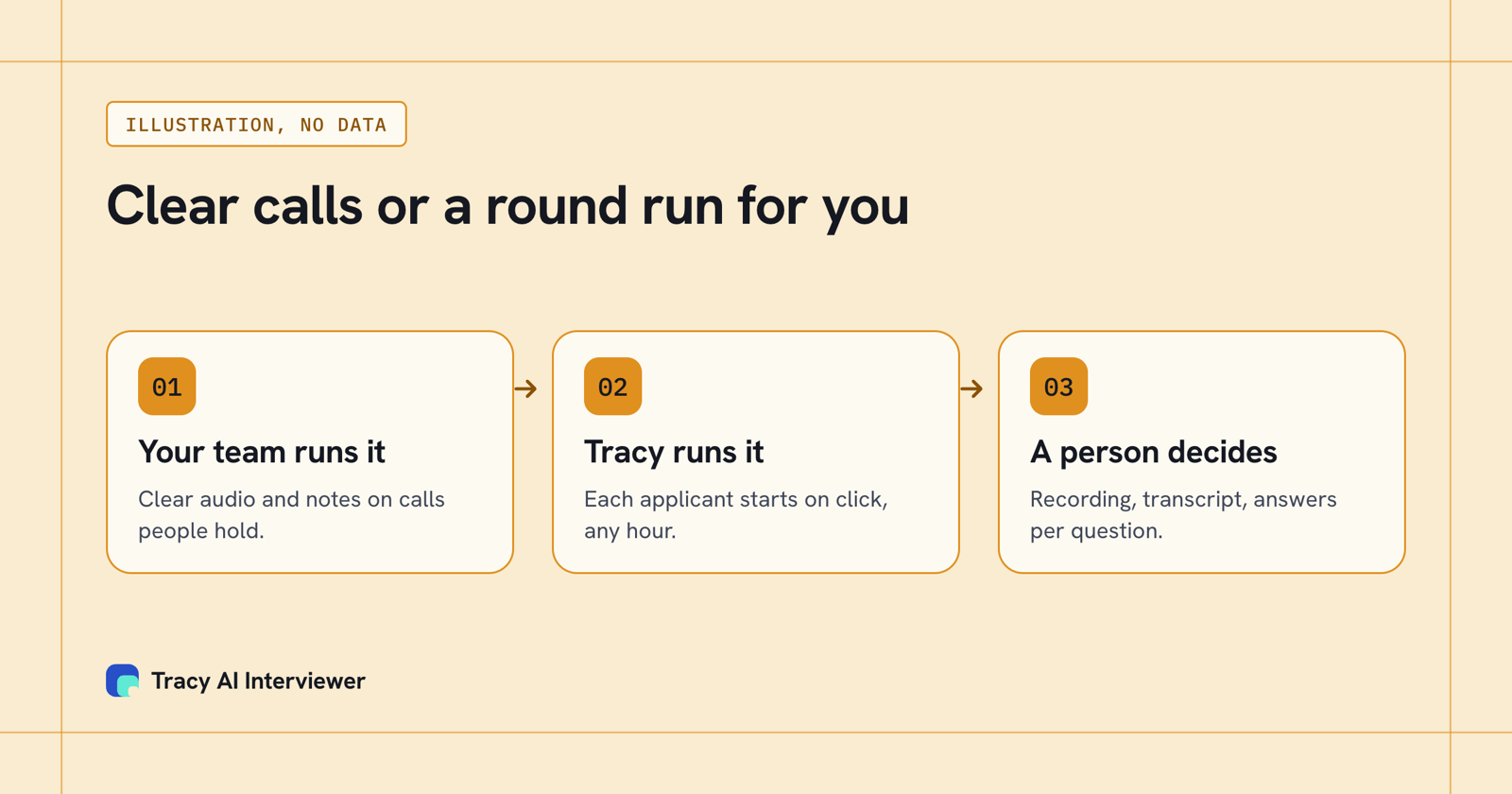
Krisp covers calls your team runs; Tracy runs the first round. A person decides in both.
What do Krisp and Tracy cost?
Krisp prices per user. Core is $16 per user per month on monthly billing and $8 on annual billing; Advanced is $30 and $15; Enterprise is custom. The Free Trial lasts 7 days with no card.
Tracy prices per interview, not per seat, and a session with no answers is never charged. The table above has the rate, and Tracy's pricing has worked examples. Krisp is the lower number for a small team because it does a different job: seats track interviewers, credits track interviews.
Which path fits you?
- Technical hiring: technical interviews covers role-specific interviews with follow-ups.
- High-volume hiring: volume hiring covers applicant waves.
- Other notetakers: compare Tracy with Otter.ai, Fireflies.ai and Granola, or see the best AI note takers for interviews.
- Integrations: Connect lists what Tracy connects to.
Common questions
What is Krisp used for?
Does Krisp need a bot to join the call?
Krisp vs Granola: which is better for interviews?
Can I use Krisp and Tracy together?
Which is cheaper, Krisp or Tracy?
Run one role in Tracy
Run one role and compare the follow-ups and report. The first 3 results are free.
Book a demo (opens in a new tab) Try it free (opens in a new tab)
Your first 3 results are free. No card needed.
Sources
- Krisp, Pricing, retrieved 14 Nov 2026.
- Tracy AI Interviewer, Pricing, retrieved 14 Nov 2026.
- Tracy AI Interviewer, Connect, retrieved 14 Nov 2026.