In short
Maki People publishes no price, but its pages describe a screening suite: several AI agents, 30+ ATS integrations, EU data residency and a bias-audited interview agent. Tracy AI Interviewer publishes $1 per credit, interviews each applicant on video, follows up on every answer and returns a recording and transcript with each result. Your team decides, and the quote questions below make the two prices comparable.
What Maki People offers behind the quote
Maki People pricing is quote only, and what the quote covers is broad: several AI agents on one platform, 30+ ATS and HR integrations, EU data residency by default and a Customer Success Manager for every customer. Maki says its interview agent, Mochi, is independently bias-audited and never automatically rejects a candidate.
The pricing page states no credit price, plan or billing unit. Tracy's credit price already sits on a public page, so the one missing number in this comparison is Maki's. Below: what Maki's pages say about price, the questions to put to its sales team, and Tracy's cost for the same three volumes. See also what an AI interview costs.
What does Maki People say about its pricing?
Maki says you pay for candidate interactions, not licenses, and that each agent operates on a credit-based model. The agents named on the page are Shiro for screening, Ken for assessments, Mochi for conversational interviews in a browser or by phone, and Kumi for recruiter support and data insights. The pricing page gives no figure for a credit, and does not say how many credits one interaction uses.
Maki People: its pricing page, read 14 Nov 2026. Tracy: its pricing page, read 11 Nov 2026.
| Item | Tracy | Maki People |
|---|---|---|
| Billing unit | $1 per credit; one credit per started 20 minutes | Credits per candidate interaction; credit price not stated |
| Seats and licences | No seats, no upfront cost | Pay for interactions, not licenses |
| Empty sessions | A session with no answers is never charged | Not stated on the pages reviewed |
| Platform fee | None stated; Enterprise is priced to your volume | Platform plus usage-based agents; platform fee not stated |
| Support | Dedicated customer manager and support channel on Enterprise | Dedicated Customer Success Manager for every customer |
What do you get from Maki for the price?
Maki's pricing page lists secure hosting with EU data residency by default, integrations with 30+ ATS and HR systems, and a dedicated Customer Success Manager for every customer. Its Mochi page says the agent runs web or phone interviews in every language candidates speak, adapts to answers and probes when needed, scores against a fixed grid (BARS), syncs results to the ATS, and never automatically rejects a candidate. It says Mochi is ISO 27001 certified, GDPR compliant and independently bias-audited by Holistic AI under NYC Local Law 144 (Mochi page re-read 15 Nov 2026).
If an audited, scored screen with ATS write-back is the requirement, Maki fits it. Ask every vendor you shortlist, Tracy included, for its audit documents and what they cover.
Where does Maki fit better than Tracy?
Maki fits a team that wants several agents on one platform: Shiro for screening, Ken for assessments, Mochi for conversational interviews by browser or phone, and Kumi for recruiter support and data insights. It names EU data residency, 30+ ATS integrations and a Customer Success Manager for every customer, and it says its interviews run by phone as well as in a browser. Tracy runs video interviews and gives a reviewer the evidence. If your hiring needs the whole suite and an audited scoring grid, a quote from Maki is the right next step.
What could cost extra?
The pricing page does not say how credits map to interactions, what a failed or abandoned session costs, or whether the platform carries a fixed fee beside usage. Those are the questions in the next section. On Tracy the only variable is how long the interview runs, and its pricing page states the credit rule. Maki's page also lists a Customer Success Manager, EU data residency and 30+ ATS integrations beside usage, so ask whether each sits inside the credit price or is billed on top, and whether onboarding has a separate fee.
What should you ask Maki for in a quote?
Maki's price cannot be worked out from its pages, so this page gives no figure for it. Ask for each answer in writing:
- The price of one credit, and how many credits one Mochi interview, one Shiro screen and one Ken assessment use.
- Whether a session the candidate abandons, or one with no answers, is charged.
- Whether the platform has a fixed fee, a minimum commitment or an annual term.
- Which ATS write-back and integrations are included, and which carry setup cost.
- What the Customer Success Manager and onboarding cover, and for how long.
- Whether the bias-audit report covers the agent and settings you would run.
What does Tracy cost at 100, 500 and 1,000 interviews?
Take a technical screen of 30 minutes, which is 2 credits at Tracy's $1 per credit: 100 of them cost $200, 500 cost $1,000 and 1,000 cost $2,000, and at 20 minutes or less the figures halve. Credits do not expire and nothing is billed up front. Enterprise customers get a volume price after a demo. See the pricing page.
What a quote leaves out: interviewer hours
A platform price is only part of a first round. 100 technical screens of 30 minutes are 50 hours of live interviewer time, 500 are 250 hours and 1,000 are 500 hours, whatever either vendor charges. If a quote prices the platform and leaves those hours with your team, the total you compare is smaller than the bill you carry.
On Tracy each applicant starts on click and the call runs without your team, so ask Maki which of those hours its agents take over before you set the two totals side by side.
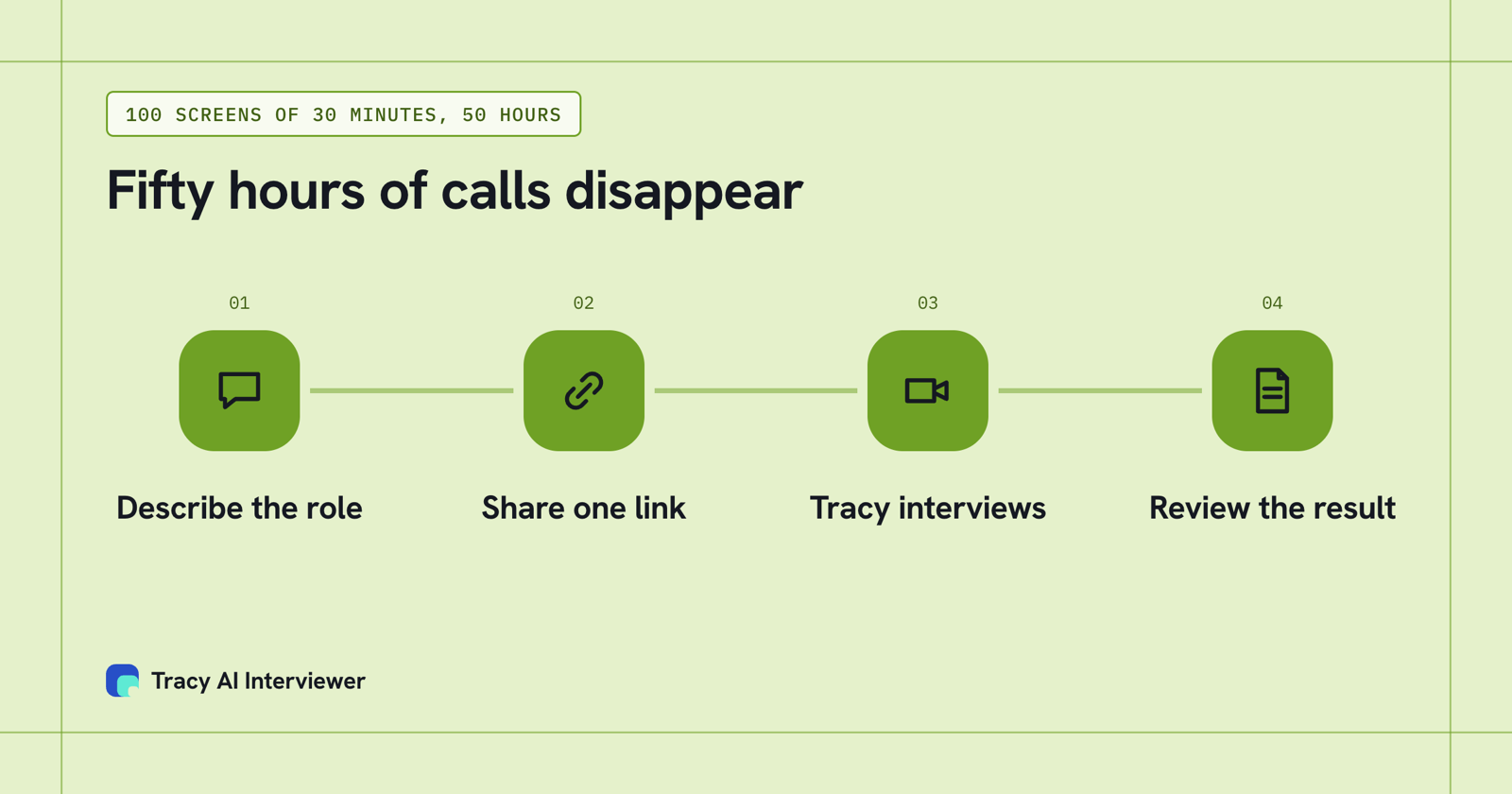
Tracy runs the call, so 100 screens of 30 minutes take about 50 hours off the calendar.
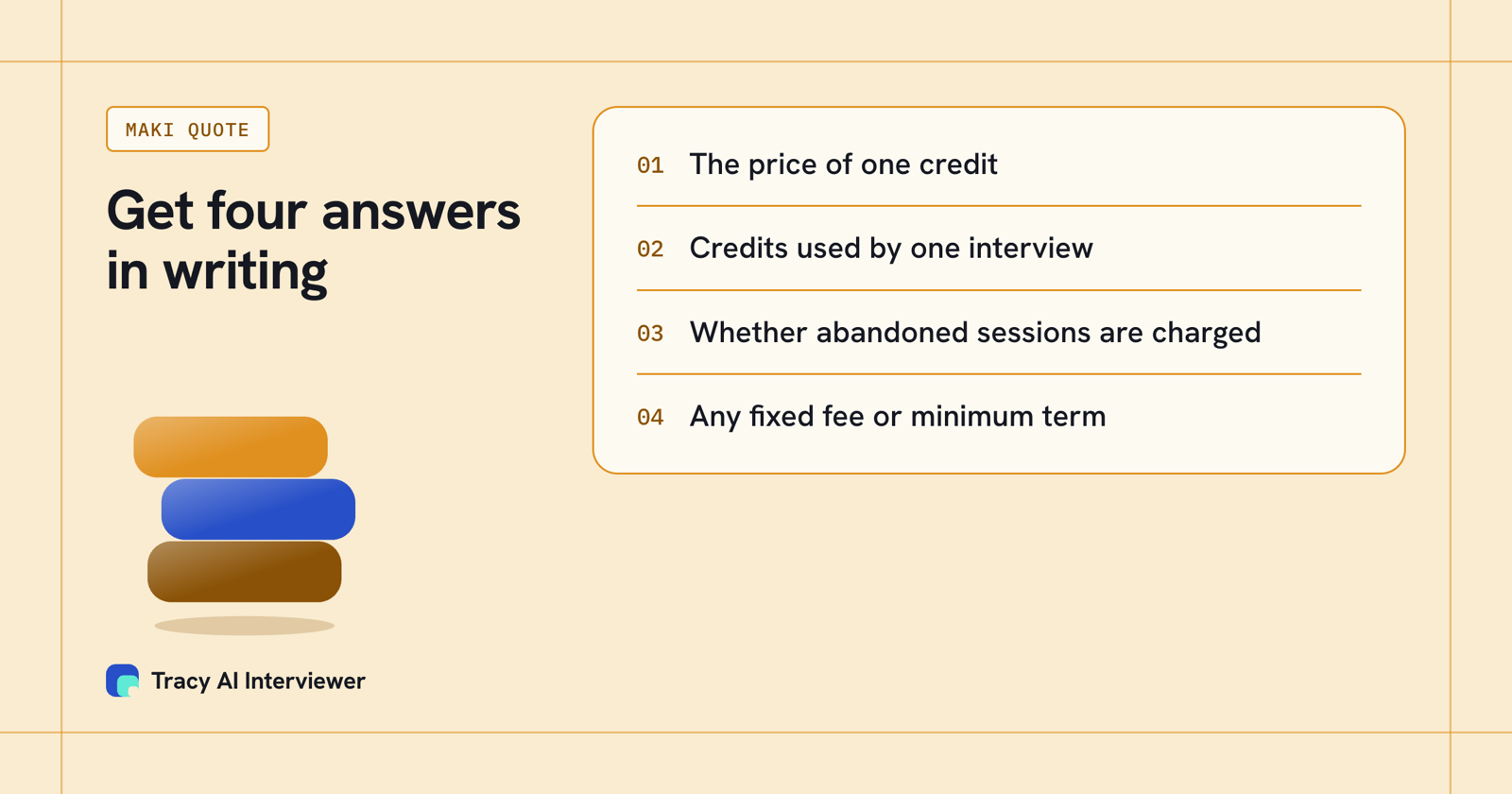
Four written answers turn Maki's quote into figures you can compare with Tracy's published price.
What does one result contain?
Both vendors bill per interaction rather than per seat, so compare what a result holds. A Tracy result is a two-sided recording, a timestamped transcript and what the person said to each question; a reviewer reads it and decides, and Tracy does not score, rank or reject. On video it also shows integrity signals (tab changes, gaze, face detection, leaving fullscreen) with their evidence, and a signal is never proof. Maki describes its own integrity evidence as webcam snapshots, tab-focus logs, IP records and device fingerprints behind a risk level. For what to ask any vendor, see AI interview cheating detection.
What Tracy adds to the interview step
- Every applicant starts on click, at any hour, with no scheduling and no recruiter on the call, so the whole pool gets the same first round.
- Tracy asks the next question in the applicant's own field and waits for the answer, so a stated claim is followed down to the detail.
- Every result keeps a recording, a timestamped transcript and a written assessment per question with its reasoning. Tracy does not score, rank or reject; your team reads it and decides.
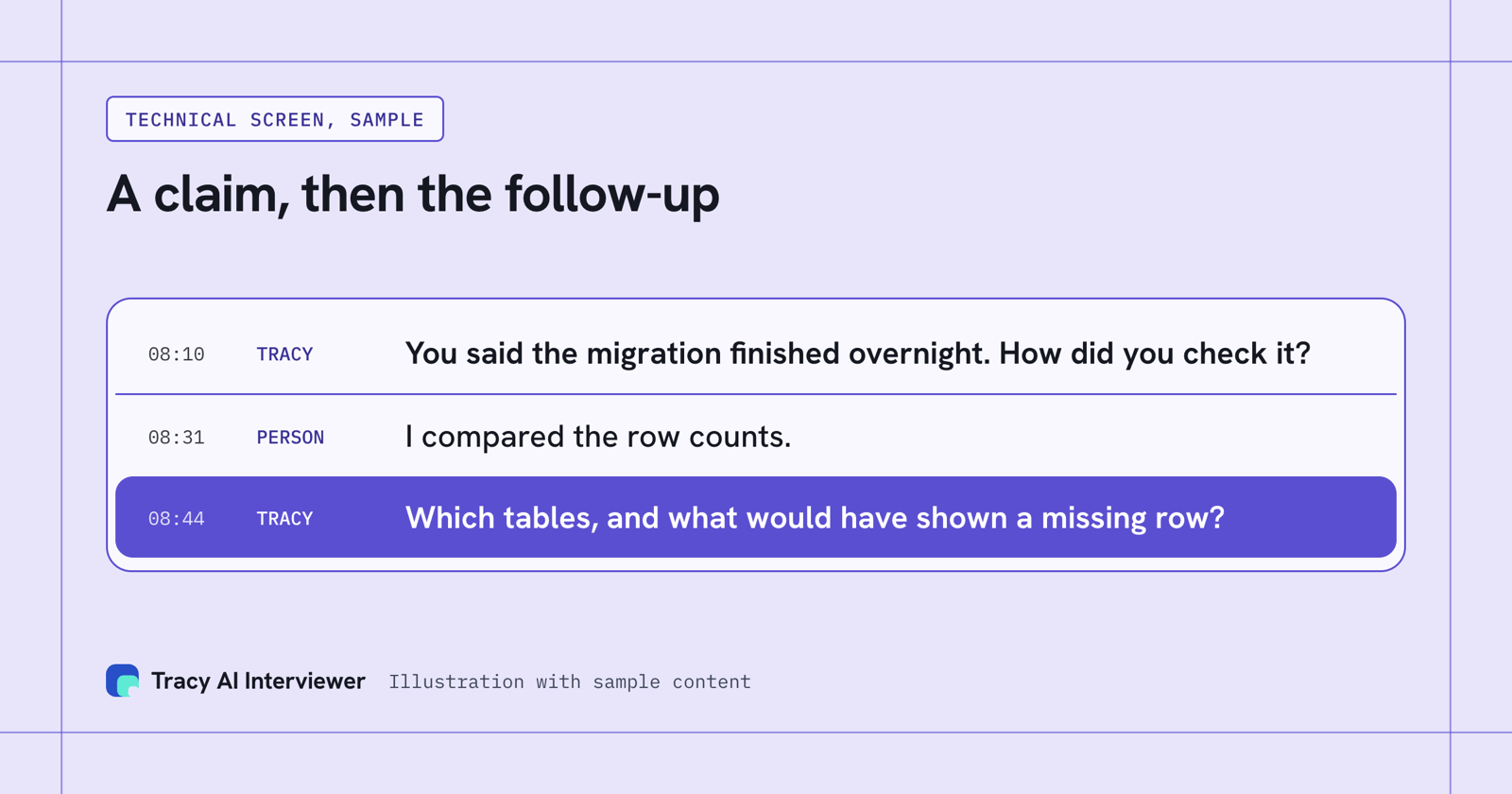
A stated claim becomes a detail a reviewer can check.
How do you compare the two quotes?
Ask each vendor to price the same three cases: 100, 500 and 1,000 interviews of the same length. Then add what a quote line can hide: a platform fee, setup, integration work and a minimum term. Divide the total by the results you expect to get, not by the interviews you start, since a session with no answers may cost nothing at one vendor and a credit at another. Tracy's price is on a public page, so its side of that sum takes minutes. Maki's depends on its quote, and if your volume is large and ATS write-back matters most, the quote may be worth getting.
Which path fits you?
- A bias-audited screening suite with ATS write-back: ask Maki for a quote with the questions above.
- A video interview with a published credit price: try Tracy on one role.
- Technical roles at volume: see hiring at volume and AI technical interviews.
- Pricing for other vendors in this group: Sapia pricing and HireVue pricing.
Common questions
How much does Maki People cost?
Does Maki have a free plan?
How does Maki charge?
What does Maki include?
Does Tracy score candidates?
Does Maki automatically reject candidates?
Does Maki connect to my ATS?
Price 100 interviews with Tracy
Run one technical role through Tracy and set its result beside what Maki's demo shows. The first 3 results are free.
Book a demo (opens in a new tab) Try it free (opens in a new tab)
Your first 3 results are free. No card needed.
Sources
- Maki People, Pricing, retrieved 14 Nov 2026.
- Tracy AI Interviewer, Pricing, retrieved 11 Nov 2026.
- Tracy AI Interviewer, Connect, retrieved 11 Nov 2026.