In short
Gong prices licences per user and adds a platform fee based on the number of users supported. Its pricing page shows no figure, only a form that asks how big your team is.
Tracy AI Interviewer runs the interview itself, so nobody on your team needs a seat to read results. It asks follow-ups in each applicant's own field and keeps the recording and a timestamped transcript behind every result.
Gong fits when the calls to learn from are sales and customer calls. For applicants, a per-interview price is easier to forecast than a per-user one.
Gong pricing is not public. Its pricing page says licences are priced per user, adds a platform fee based on the number of users supported, and asks "How big is your team?" before it prepares a customized proposal. No figure, plan or free trial appears on it, so any number you find elsewhere is a third party's estimate, not Gong's. Below: what Gong says, the lines to ask for in a quote, and, if you are hiring, how a per-interview price compares. For the wider picture see what an AI interview costs.
What does Gong say about its pricing?
Gong's pricing page makes three statements: licences are priced per user, there is a platform fee based on the number of users supported, and you can integrate your existing tech stack for free. The form that follows offers four team-size bands, from 1 to 50 up to 10,000 or more. The table sets that against what Tracy publishes.
Gong: its pricing page, read 22 Nov 2026. Tracy's figures come from its own pricing page, read 22 Nov 2026.
| Item | Tracy | Gong |
|---|---|---|
| Billing unit | One credit per started 20 minutes; no seats | A licence per user, plus a platform fee |
| Seats | None; no upfront cost | Licences are priced per user |
| Price shown | Published on its pricing page; Enterprise priced to volume | No figure on the pricing page |
| Integrations | Full API and MCP access on pay as you go | Integrating your tech stack is free |
Where does Gong fit better than Tracy?
Gong describes itself as Revenue AI and speaks to go-to-market teams, "From execs to RevOps to frontline reps." It says it learns from every call, email and meeting. If the calls you want to analyse are sales and customer calls, and your team works inside that workflow, Gong is built for it. Tracy does one job, interviewing applicants and handing a reviewer the evidence.
How does a per-user licence scale with your team?
Per-user pricing ties cost to the people who hold a licence, so the licence count sizes the quote. Gong's form sorts teams into four bands, from 1 to 50 up to 10,000 or more, and the platform fee follows the number of users supported. That is reasoning from the pricing model; Gong has given no quote.
Say a team has 12 recruiters who record calls and 8 hiring managers who review them. If every reviewer needs a licence, that is 20 licences before the platform fee; if readers need none, it is 12. Ask Gong which applies, and for the figure at 500 applicant calls a month. Volume recruiting shows what that load looks like.
The bands matter because the form sorts you before anyone talks to you. Gong's form offers 1 to 50, 51 to 1,000, 1,001 to 9,999 and 10,000 or more. A 12-recruiter team sits in the first band, while a talent-acquisition group that adds seasonal helpers could cross into the second. Whether the platform fee steps up at a band edge is a fair question for the proposal. Ask for the fee at your current headcount and at the headcount you expect after your busiest hiring month.
What should you ask Gong for in a quote?
Gong publishes no price, so build the model from your own numbers and ask for each line in writing:
- Count the licences: recruiters who record calls and managers who review them.
- Ask for the platform fee and the user count it assumes.
- Ask which features sit in the base licence and which are charged separately.
- Ask whether the integrations you need carry any charge, since Gong says integrating your existing tech stack is free.
- Ask for the term, the renewal terms and what happens if the team shrinks.
- Ask for the cost of 500 applicant calls a month, so the quote uses your volume.
What does Tracy cost at 100, 500 and 1,000 interviews?
Tracy's unit is a $1 credit. An interview that produced a result uses one credit for every started 20 minutes. Twenty-minute interviews cost $100 for 100, $500 for 500 and $1,000 for 1,000, and a 34-minute interview uses 2 credits. Nothing is billed for a session with no answers, and reading results needs no seat, so 500 interviews cost the same with one recruiter or fifty. An Enterprise volume price comes through a demo. The pricing page shows more worked examples.
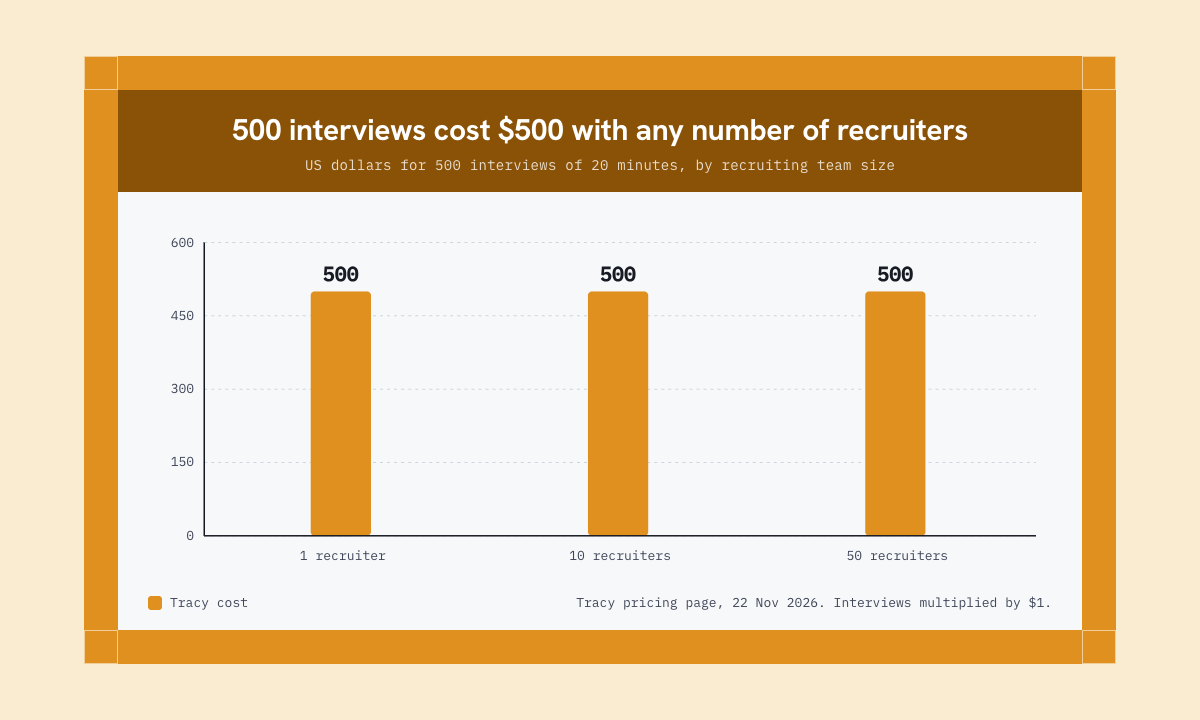
The cost follows interviews, not the number of people on the team.
What Tracy does with a call you keep repeating
Take a sales applicant who says they research a prospect for ten minutes. Tracy asks for a real opening line they used. Every applicant gets that follow-up at any hour, with nobody from your team on the call, and the reviewer reads the recording and the timestamped transcript before deciding. Because calls people run themselves do not scale, Tracy runs the interview; on Enterprise it can also take notes on the calls your people do run. See AI interview tools for high-volume hiring and the mass hiring process.
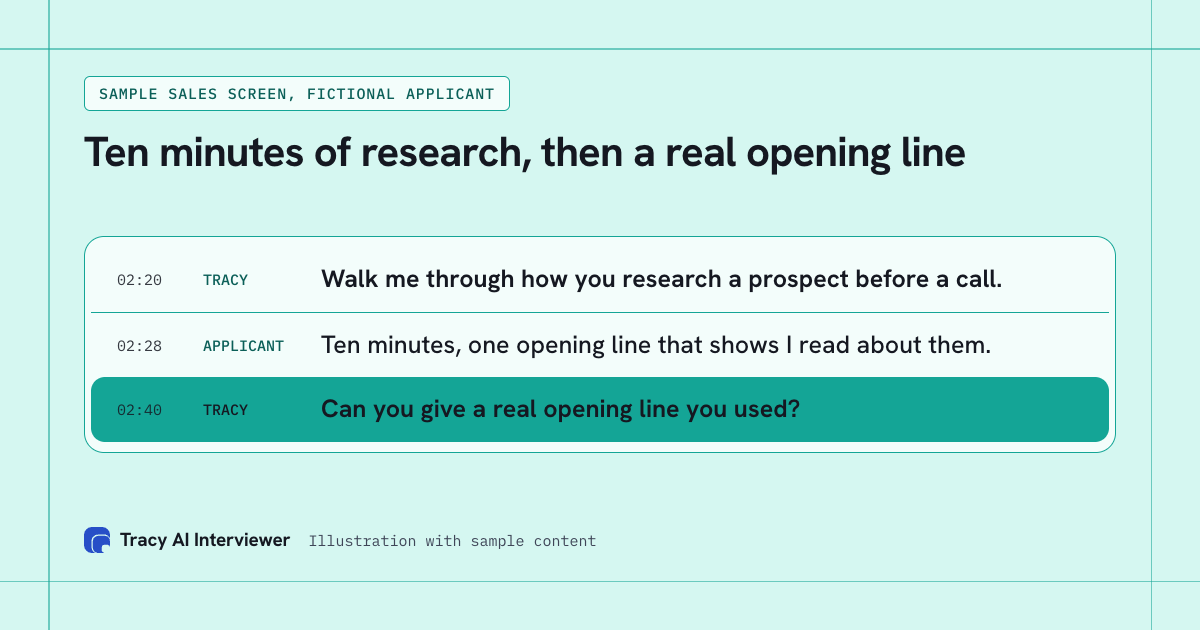
Tracy asks for the example the applicant left out, and the answer is timestamped.
How do you compare a per-user quote with a per-interview price?
The two use different units, so convert both to what a round of hiring costs. Take 100 applicant calls of 20 minutes: about 33 hours of recruiter time. At 1,000 calls it is about 333 hours. Price those hours at your own recruiter cost (this page does not guess that rate), add the licences and platform fee from the quote, and set the total against credits for the same 100 or 1,000 interviews. Then ask each vendor, Gong included, which of those calls its product runs and which it only records. With Tracy each applicant starts on click and nobody on your team is on the call, so the credits above cover the conversation and your people spend their time reading results.
How does Tracy connect to the tools your team uses?
Gong says integrating your existing tech stack is free. Tracy connects through its API and MCP server, which a host such as ChatGPT or Claude uses to set up an interview, invite people and read results in the chat. It also works from Slack and WhatsApp and works next to the Workable and Breezy HR connectors and can write results back to the ATS, so shortlisted people can be invited from the same place. API and MCP access come with pay as you go.
Which path fits you?
- You coach sellers on sales and customer calls: put the questions above to Gong's sales team.
- You screen applicants and want a price per interview before you start: run one role on Tracy.
- You are still choosing a note taker: read the recruiter note takers compared, or the hiring tools shortlist for the wider list.
Common questions
How much does Gong cost?
Does Gong have hidden fees?
What is Gong's platform fee?
Does Gong publish plans?
Who is Gong built for?
Does Tracy charge per seat?
Can Tracy take notes on calls recruiters run?
Run one role through Tracy
Tracy runs the interview and keeps a recording and timestamped transcript behind each result. First 3 results free.
Book a demo (opens in a new tab) Try it free (opens in a new tab)
Your first 3 results are free. No card needed.
Sources
- Gong, Pricing, retrieved 22 Nov 2026.
- Tracy AI Interviewer, Pricing, retrieved 22 Nov 2026.