In short
Metaview and BrightHire turn recruiter-run calls into ATS scorecard notes, and Fireflies, Otter and Notta record meetings per seat, so a note taker fits while recruiters keep running the calls. Tracy AI Interviewer holds the first round itself: each applicant interviews on click, and you send on one record with the recording, timestamped transcript and what each person said. Your team reads it and decides.
What AI notetakers do well for recruiters
A notetaker takes the typing out of a recruiter's day. Metaview and BrightHire post notes to ATS scorecard fields, Fireflies lists Greenhouse and Lever, and a good note lands where a recruiter's notes go: the ATS record, the hiring manager or client, and the next call. That makes the best AI note taker for recruiters the one whose notes end up where you submit candidates. A transcript alone leaves the rewriting to you.
The limit is the hour. A notetaker can only write down a call a recruiter already sat through, so the first round keeps filling the diary until the interview itself changes hands. Tracy AI Interviewer takes that hour: each applicant interviews from a link, and you share the recording, a timestamped transcript and what the person said to each question by link or PDF. On Enterprise, Tracy can also take notes on calls your recruiters run.
What should a notetaker do for a recruiter?
Four things matter to a recruiter:
- ATS notes: do they post to the candidate record, ideally as scorecard fields?
- Client-ready output: can you send it to a hiring manager or client without rewriting?
- Capture: does a bot join the candidate's call?
- Cost: does the price follow your headcount or your interviews?
Which is the best AI note taker for recruiters?
Tracy is first for a recruiter whose problem is first-round calls: it runs the interview and gives you one record to share. The rest follow the order of the table below. Metaview and BrightHire come next for recruiters who keep running calls, since both post notes to ATS scorecards. Fireflies follows: it has a recruiting page and lists Greenhouse and Lever. Otter and Notta come last, because their pages reviewed describe general meetings and name no ATS.
What each vendor's own pages state, read on 9 and 10 November 2026.
| Tool | Notes go to | Output for the client | Capture |
|---|---|---|---|
| Tracy AI Interviewer | A record shared by link or PDF; ATS chat connectors, API and MCP | Recording, timestamped transcript, what was said per question | Interview on a link; the join screen says it is recorded |
| Metaview | Greenhouse, Ashby, Lever, Workday and more | Scorecards, notes and video snippets | A bot does not have to join |
| BrightHire | ATS scorecard fields | Notes and highlight clips | Opens inside Zoom, no per-call bot |
| Fireflies | Greenhouse, Lever and others | Notes, transcripts and scorecards | Bot; Chrome extension on paid plans |
| Otter | Salesforce, HubSpot, Zapier; no ATS stated | Transcripts and notes | Bot, or bot-free on desktop, Chrome or mobile |
| Notta | CRM and Zapier on Business; no ATS stated | Time-stamped notes and summaries | Zoom, Teams, Meet and Webex; Chrome extension |
Scroll the table sideways to see all 4 columns.
What Tracy adds to recruiter notes
A staffing recruiter submits against a clock, so the record matters as much as the call. Three things change when Tracy holds the first round.
- Reach every applicant. Each applicant starts on click, at any hour, with no scheduling and no recruiter on the call. The whole pool gets a first round, not only the people who fit the diary.
- Ask the next question. Tracy follows the answer in the person's own field, including on a resume claim when the CV check is on, and waits for the reply. A claim comes back with the detail behind it.
- Keep the evidence. Every result carries the recording, a timestamped transcript and what the person said to each question, shared with a hiring manager or client by link or PDF. A person reads it and decides what goes on.
For the submit-side view, see staffing speed to submit and AI interview tools for RPO.
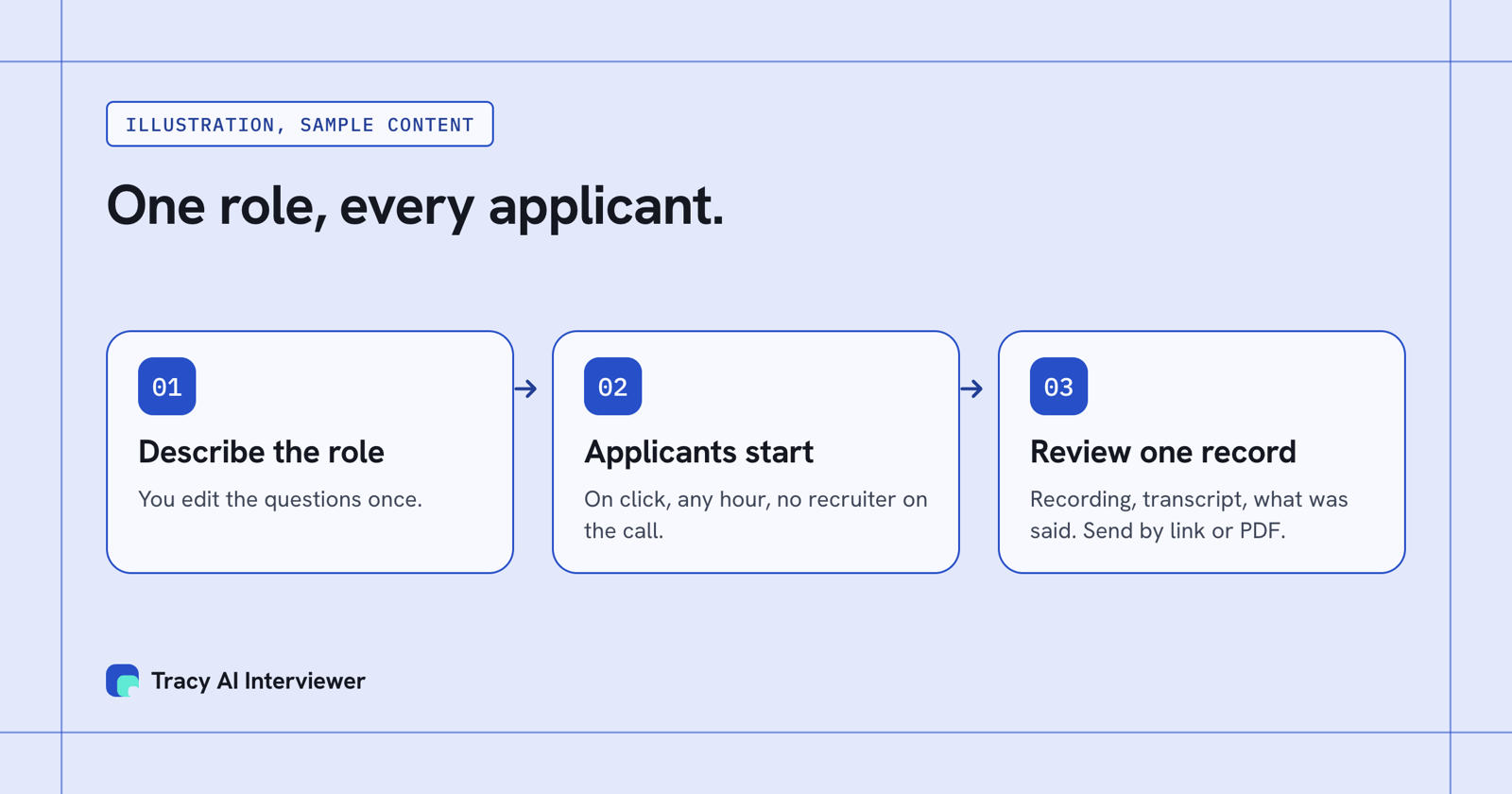
One role, every applicant, one record to send on.
What does a notetaker leave you to do?
A notetaker records the calls your recruiters run, so it saves the typing and not the hour. Take the cost table below: 5 recruiters at 20 interviews each is 100 first-round interviews a month. At 20 minutes each, that is about 33 hours of live calls before a single note is written. With 20 recruiters it is about 133 hours, and with 50 about 333. Tracy interviews those applicants on click, so none of those hours is booked into a diary, and the recording and transcript wait for a recruiter to read. One customer cut its average time to hire from 44 days to 7, and Tracy did the work of 53 full-time recruiters in one month.
A note taker fits while your recruiters keep running the calls. Tracy fits when first-round calls fill the diary.
What does it cost for a recruiting team?
Seat tools bill per person, so cost follows headcount. Tracy bills per interview, so cost follows volume. Tracy arithmetic from list prices, assuming 20 interviews per recruiter a month, each within one 20-minute credit. Seat figures are annual-billing list rates times seats. List prices were read on 9 Nov for Fireflies and Notta and on 14 Nov for Otter.
| Monthly cost | 5 recruiters | 20 recruiters | 50 recruiters |
|---|---|---|---|
| Fireflies Business, $19 per seat | $95.00 | $380.00 | $950.00 |
| Otter Business, $19.99 per seat | $99.95 | $399.80 | $999.50 |
| Notta Business, $16.67 per seat | $83.35 | $333.40 | $833.50 |
| Tracy, $1 per interview | 100 interviews, $100 | 400 interviews, $400 | 1,000 interviews, $1,000 |
Scroll the table sideways to see all 4 columns.
BrightHire publishes no amounts, and Metaview's current notetaker prices are on its pricing page, so neither is in the table. A seat price rises with the team even in a quiet month, while a per-interview price rises only when interviews run. A session with no answers is never charged. Enterprise is priced to your volume.
What should you ask a vendor that does not publish a price?
BrightHire shows no dollar amounts, so budget by asking. On a quote call, ask what the unit is (seats, interviews or company size), whether the ATS connection is included, what the minimum term is, and whether a recruiter who runs few calls costs the same as one who runs many. Ask every vendor the same questions and compare the answers on one sheet.
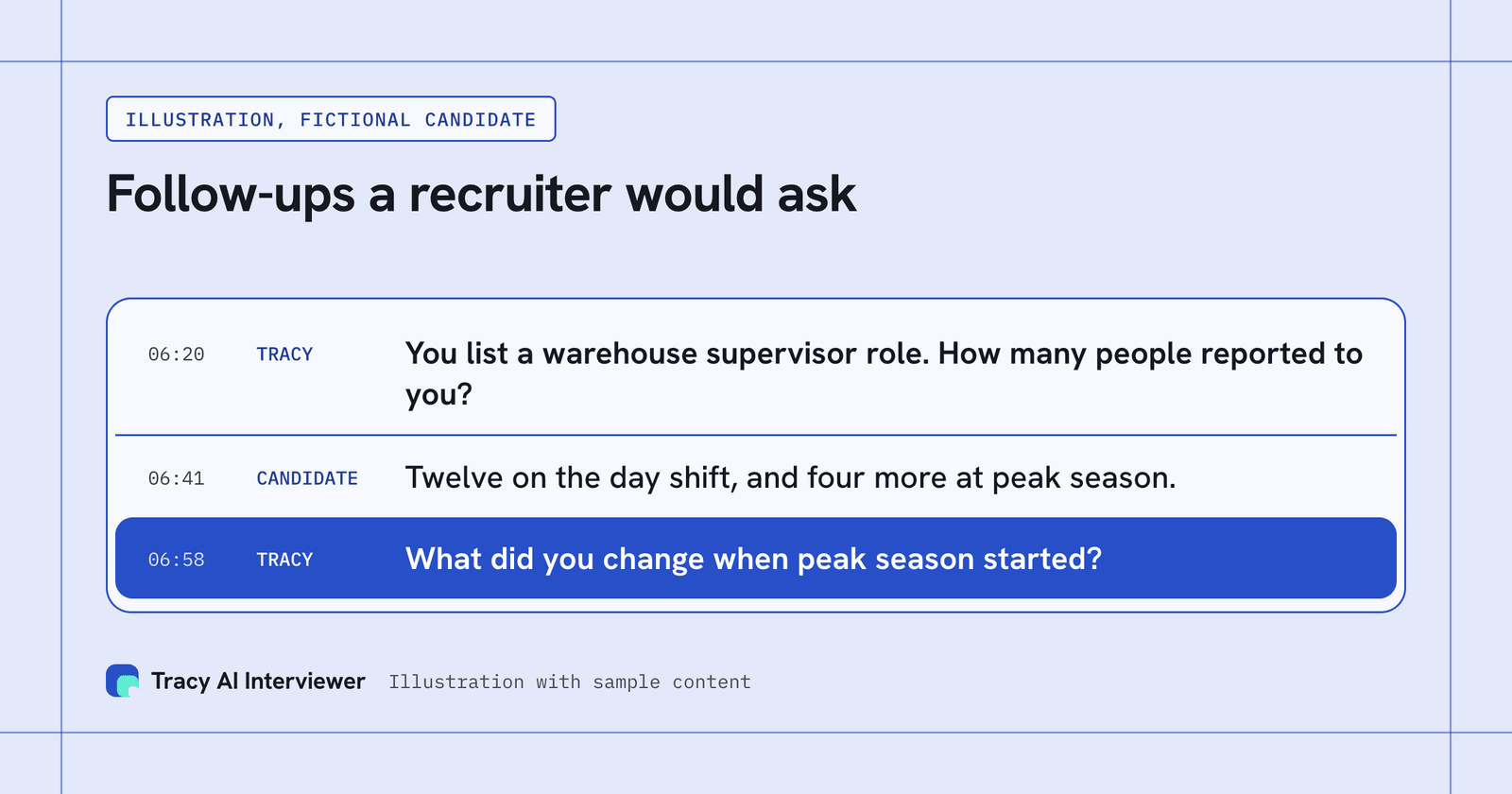
Tracy asks about the size of a past role, so the recruiter sees the claim tested.
Which notetaker fits which recruiting team?
- Tracy. Verdict: the pick when first-round calls fill the diary. Best for staffing teams submitting at volume. Trade-off: it runs the interview rather than joining yours, except on Enterprise. Price: per interview, not per seat; see the cost table.
- Metaview. Verdict: the pick when recruiters keep running their own calls and the ATS record is the deliverable. Best for recruiters on Greenhouse, Ashby, Lever or Workday. Trade-off: a recruiter still joins every call. Price: free plan listed 9 Nov; current plans on its pricing page. See Metaview pricing.
- BrightHire. Verdict: after the call, notes land in the scorecard fields a hiring manager reads. Best for teams that live in Greenhouse, Ashby or Workday. Trade-off: no published prices. Price: not published; priced by company size for interview intelligence. See Tracy against BrightHire.
- Fireflies. Verdict: one tool for recruiting calls and the firm's other meetings. Best for a staffing firm that also records sales and client calls; its recruiting page names scorecards and an ATS sync. Trade-off: a bot joins unless a paid plan uses the Chrome extension. Price: Business $19 per seat per month, billed annually. See Fireflies alternatives.
- Otter. Verdict: live transcripts of candidate and client calls. Best for a recruiter who mainly wants a searchable transcript. Trade-off: no ATS stated on the pages reviewed. Price: Business $19.99 per user per month, billed annually. See Otter alternatives.
- Notta. Verdict: transcripts across Zoom, Teams, Meet and Webex. Best for a small team watching seat cost. Trade-off: no ATS stated on the pages reviewed. Price: Business $16.67 per seat per month, billed annually. See Notta pricing.
Which path fits you?
- First-round calls fill your diary: hiring at volume with Tracy.
- Compare note takers for interviews in general: best AI note takers for interviews.
- Check whether a transcript is enough: transcription software against interview reports.
- Look beyond notes: best AI tools for recruiters.
Common questions
What is the best AI note taking app for recruiters?
Is there an AI note taker for recruiters that works with an ATS?
Can I send notes to a client without rewriting them?
Do recruiters need to tell candidates about recording?
Run one first round in Tracy
Pick one role and create the interview, then read the follow-ups and the record your team sends on. The first 3 results are free.
Book a demo (opens in a new tab) Try it free (opens in a new tab)
Your first 3 results are free. No card needed.
Sources
- Metaview: Pricing and Interview notes, retrieved 9 Nov 2026.
- BrightHire: Pricing and Interview notes, retrieved 9 Nov 2026.
- Fireflies: Pricing and Recruiting, retrieved 9 Nov 2026.
- Otter: Pricing, retrieved 14 Nov 2026.
- Notta: Pricing and Integrations, retrieved 9 Nov 2026.
- Tracy AI Interviewer: Pricing, retrieved 11 Nov 2026.
- Tracy AI Interviewer: Hiring at volume, retrieved 9 Nov 2026.