In short
A skills assessment platform gives candidates a test or a task and returns a result. Tracy AI Interviewer takes a different route: a video interview that reads each answer and follows up in the person's own field, so you hear how they reason.
Every applicant starts from one link at any hour, and a reviewer reads the recording and what each person said, per question, with no score in between.
The entry plans at HackerRank and CodeSignal run $79 a month for 60 credits. Choose them for a deep question library or a coding IDE; choose TestGorilla or iMocha for tests across many job types.
Run one role through Tracy and compare the result with your current test.
What is a skills assessment platform?
A skills assessment platform is software that tests what a candidate can do before anyone interviews them. The candidate takes a timed test, a coding task or a work simulation, and the platform returns a result the hiring team can compare across people.
Hiring on skills is a common aim, though practice lags. A Burning Glass Institute and Harvard Business School study of 11,300 roles at large US firms found that only about 3.6% of roles actually dropped a degree requirement, and that the added opportunity reached not even 1 in 700 US hires in 2023. Teams that want to hire on skills still need a way to see them, and a test is one way; a conversation about the work is another, which skills-based hiring covers in more depth.
Which are the best platforms to assess candidate skills?
It depends on whether you want a score from a test or the candidate's own reasoning. CodeSignal and HackerRank suit engineering teams that want question libraries and an IDE, TestGorilla and iMocha suit teams that test many kinds of roles, and Tracy suits teams that want every applicant interviewed on the skills the role needs.
The order below is by published entry price, lowest first, with tools that publish no price last: Tracy, CodeSignal, HackerRank, TestGorilla, iMocha.
Choose Tracy when:
- every applicant should talk about the work, not only the shortlist;
- the next question should follow the last answer;
- reviewers want a recording and quotes to read instead of a score to trust;
- you would rather pay per interview than commit to a plan.
Choose one of the others when:
- you need a large library of validated questions and a coding IDE (CodeSignal, HackerRank);
- you test many roles beyond engineering and want one test library for all of them (TestGorilla, iMocha);
- your process already runs on a score and a pass line.
How do the five platforms compare?
The table sets out how each platform has the candidate show a skill, what the hiring team receives and what the cheapest published plan costs. Prices are what each vendor's own page shows.
Prices as published on the vendors' pages: Tracy, CodeSignal, TestGorilla and iMocha 22 November 2026; HackerRank 14 and 15 November 2026.
| Platform | How the skill is shown | What you get | Entry price |
|---|---|---|---|
| Tracy | Video interview with follow-ups | Recording, transcript, what was said per question | $1 a credit after 3 free results |
| CodeSignal | Assessments, AI and live interviews | Credits per candidate; AI interviewers on Build and Grow | $79 a month billed annually, 60 credits |
| HackerRank | Coding tests, live pair coding, AI interviewer | Report with transcript, replay and scores | $79 a month billed annually, 60 attempts |
| TestGorilla | Skills tests, video questions, AI interview | Credits per test; AI interview is 2 credits | Core from $215 a month, billed annually |
| iMocha | 10,000+ skills evaluations, AI interviews | Scoring on skills and responses | No price published, demo first |
Scroll the table sideways to see all 4 columns.
Which platform fits which hiring team?
1. Tracy
Tracy has no minimum, so it comes first on price. It is also the one that talks to the candidate. Describe the role and Tracy drafts the questions, which you edit or replace with your own, and each applicant opens one link whenever they like. Tracy asks follow-ups in the person's own field and waits for the end of the thought. When a role needs it, an interview can include a coding task, live coding, SQL, debugging or multiple choice, with follow-ups on approach and trade-offs. Reviewers get the recording, a timestamped transcript and a written summary of what each person said, per question, with integrity signals shown as evidence for a person. Tracy reports what was said and leaves any scoring to the reviewer. Billing is per result with no seats, and the table has the rate.
2. CodeSignal
CodeSignal's Build plan is $79 a month billed annually with 60 annual credits, and extra credits are $20 each. Build and Grow both include AI interviewers, with Product, Design and Engineering on Build and Sales, CS and Marketing added on Grow at $479 a month billed annually. It fits an engineering team that wants standardised assessments and interviews drawn from one pool of credits. A credit is used for each candidate, so volume turns into spend quickly.
3. HackerRank
HackerRank's Starter plan is $79 a month, $948 billed annually, with 60 candidate attempts a year and extra attempts at $20 each. It lists 2,000+ library questions, live collaborative coding, an AI interviewer called Chakra, and a report with transcript, session replay and scores on every plan. It suits engineering teams that want a large question bank and a shared coding pad. Pro is $419 a month for 360 attempts a year, billed annually.
4. TestGorilla
TestGorilla's Core plan is from $215 a month and Plus from $520 a month per account, billed annually, with a Free plan at 10 credits a month. It runs skills tests and video questions, and a customised AI interview costs 2 credits per candidate. Its pricing page does not say how many credits Core or Plus include. ATS and API integrations are on Plus only. It fits a team that tests many job types and wants one account for them.
5. iMocha
iMocha describes 10,000+ skills evaluations and an AI interview agent called Tara that scores skills and responses. It publishes no price, and its pricing page leads to a demo, so a budget starts with a conversation. It fits an organisation that tests a wide range of skills and expects to negotiate a contract.
What does a reviewer read after a Tracy interview?
A Tracy interview returns the answer together with the reasoning behind it. In the sample below the candidate describes a single pass with a set and names memory as the cost, and Tracy follows with what happens if the list does not fit in memory. The reviewer reads both lines with their times and decides whether the approach holds up. Nothing is scored or ranked, so the judgement stays with a person.
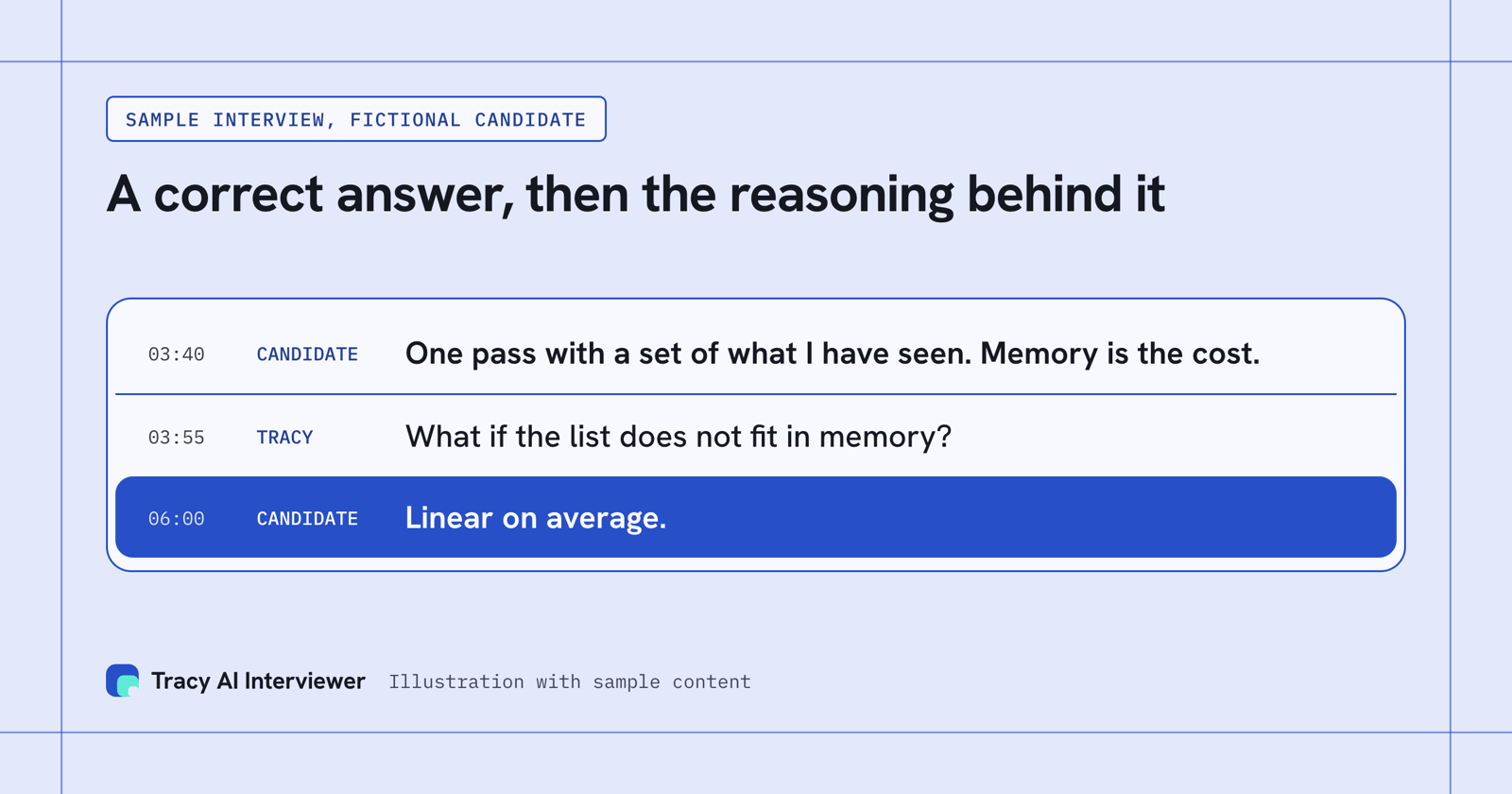
A follow-up on one answer shows how the candidate reasons, and the reviewer reads it with its time.
What does each platform cost at volume?
Cost depends on how many candidates you put through. Take a year of one role, with every candidate completing one test or interview. HackerRank Starter and CodeSignal Build share the same published entry terms: $948 for the year covers 60 candidates and each extra is $20. For 100 candidates that is $948 plus 40 extra at $20, or $1,748. For 500 it is $9,748 and for 1,000 it is $19,748. A larger plan lowers the rate; HackerRank Pro is $5,028 for 360 attempts.
Tracy charges per started 20 minutes of an interview that produced a result, so the same three volumes cost $100, $500 and $1,000 for interviews up to 20 minutes. TestGorilla's pricing page does not state a credit quantity for Core or Plus and iMocha publishes no price, so neither can be summed here. Ask each for a quote at your volume before you compare.
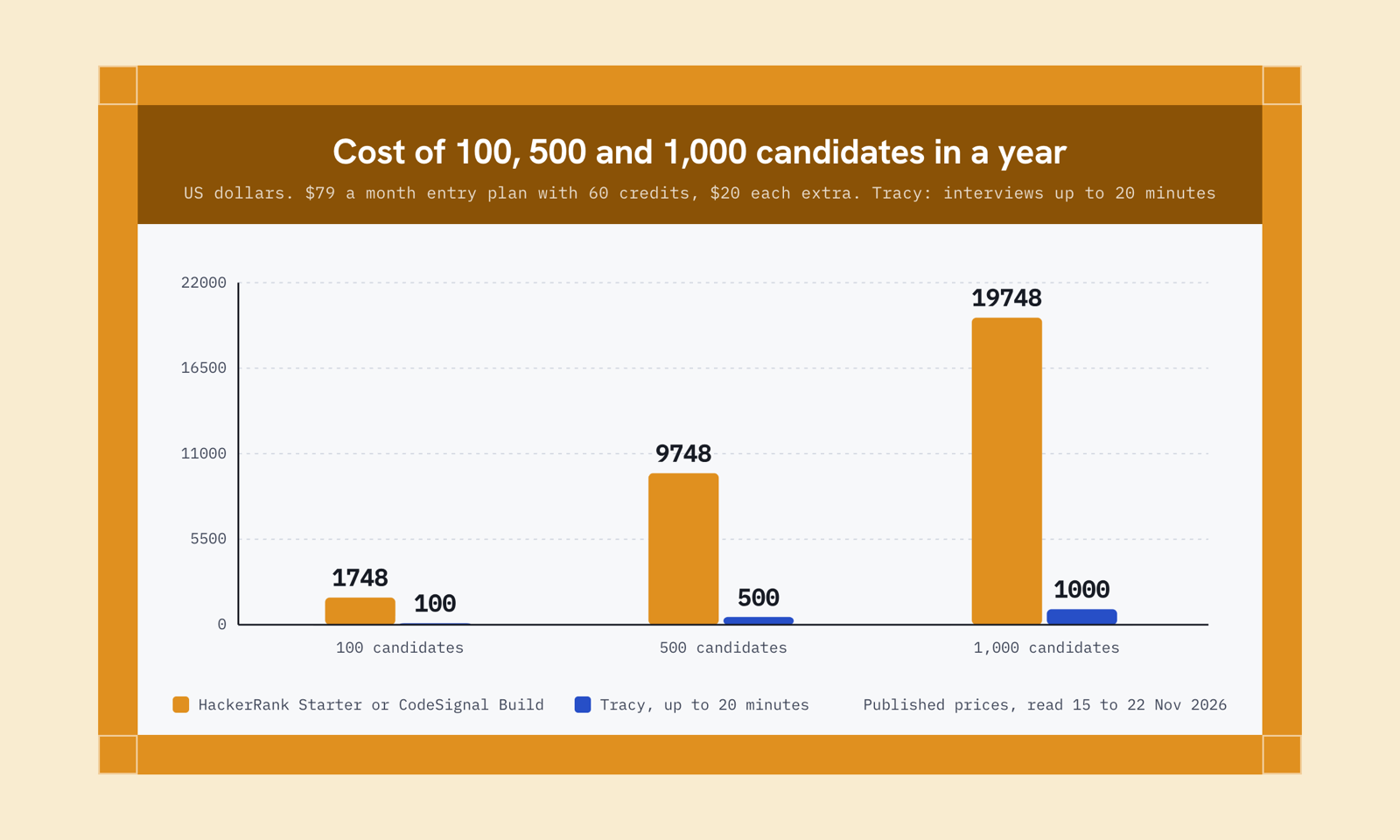
At 500 candidates a year, an entry plan plus extras costs $9,748 and Tracy's per-interview rate costs $500.
Which path fits you?
- Hiring engineers: best technical interview platforms goes deeper on coding tools.
- Screening a large applicant pool: high-volume recruitment shows how to interview everyone who applies.
- Weighing HackerRank directly: Tracy vs HackerRank sets the two side by side.
- Weighing CodeSignal directly: Tracy vs CodeSignal does the same for that tool.
Common questions
What is a skills assessment platform?
What is the best skills assessment software for engineers?
Which skills assessment platforms test more than engineering?
Can a skills assessment replace an interview?
How much does a skills assessment platform cost?
Interview every applicant, not just a few
Run one role through Tracy and read the follow-ups next to your test results. First 3 results free.
Book a demo (opens in a new tab) Try it free (opens in a new tab)
Your first 3 results are free. No card needed.
Sources
- Tracy AI Interviewer: Pricing, retrieved 22 Nov 2026.
- CodeSignal: Pricing, retrieved 22 Nov 2026.
- Burning Glass Institute: Skills-Based Hiring 2024, retrieved 9 Nov 2026.