In short
Test platforms hold the big libraries of timed, auto-graded tasks, plus live pads and proctoring. Tracy AI Interviewer adds the interview: a coding task inside it, follow-ups on approach and trade-offs for every applicant on click, and a recording with a timestamped transcript for your engineers. Your team decides. HackerEarth, HackerRank, Codility, CodeSignal and iMocha list AI interviews or follow-ups too; Mercer Mettl lists none.
The best technical interview platforms fall into three kinds: coding-test libraries, live rooms where your own engineers interview, and AI interviewers that ask follow-ups. A team hiring engineers at volume usually needs the third kind next to the first. Tracy AI Interviewer is the third kind: each applicant starts on click, works on a coding task inside the interview and answers follow-ups about the approach. This list covers eight platforms: how each one interviews, what it costs where the price is public, and when it is the better pick.
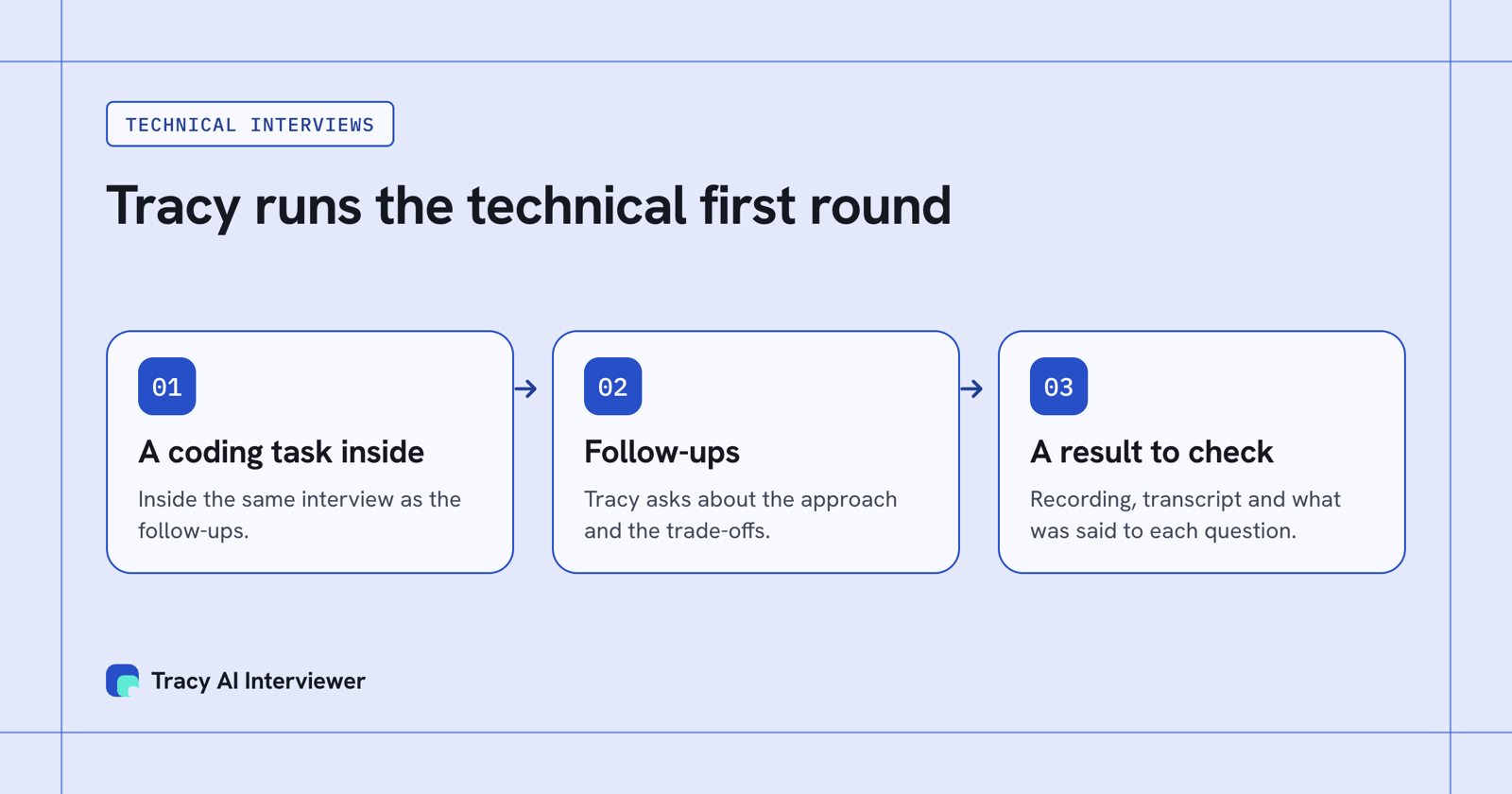
The coding task and the follow-ups happen in one interview, and the engineer reads the result afterwards.
What the test platforms do well
The test platforms hold the largest libraries: HackerEarth lists 40,000+ questions, iMocha 5,000+ coding problems, Codility 1,300+ validated tasks on Enterprise and CodeSignal 2,000 questions on Build. They add proctoring, live pairing and replay, and five of the eight list AI interviews or AI follow-up questions.
A library tells you what an applicant can solve. It does not ask why they chose that approach, and an engineer cannot ask it of every applicant. Tracy asks it of everyone, inside the interview, before an engineer spends an hour.
What should a technical interview platform do?
A technical interview platform should give an engineering lead what they need to decide who moves on. Six things matter most: whether the task library fits your roles, whether your own engineers can pair with a candidate live, how much proctoring and integrity checking you get, how deep the ATS integration goes, whether a recording or replay sits behind each result, and what it costs at your volume. Integrity signals such as tab changes belong in front of a reviewer as evidence, never as proof. A platform that interviews adds a seventh: do its questions follow what the candidate says about their code?
How do the platforms rank, and why in this order?
Which platform leads depends on the job. For a first-round conversation about the candidate's own work, with a coding task and follow-ups for every applicant, Tracy leads. The order below is for that job, the first round at volume. Two tests decide every position, applied in this sequence:
- How directly the tool runs the first conversation about the candidate's own work. Tracy's interview is the product. HackerEarth's OnScreen and HackerRank's Chakra are AI interviewers that sit beside the candidate's code, in a live IDE or a live canvas. Codility, CodeSignal and iMocha list AI follow-up questions or AI interviews and do not say where they run. Mercer Mettl lists no AI interviewer, and Karat's interviews are run by people.
- Within a level, the yearly cost of the smallest published plan with at least 100 interviews a year. A tool with no published price goes last in its level. HackerEarth's OnScreen Growth is $1,290 a year billed annually for 120 invites. HackerRank's is Pro, 360 attempts for $5,028 a year; its Starter has 60. Codility's is 200 invites for $4,800 a year. CodeSignal's is Grow, 420 credits at $479 a month billed annually, or $5,748. iMocha publishes no price.
The units differ (invites, attempts, credits), so read the figures as the entry cost of 100 or more interviews a year, not as a price per interview.
The order is Tracy, HackerEarth, HackerRank, Codility, CodeSignal, iMocha, Mercer Mettl and Karat. Tracy is first because an applicant starts on click, works a coding task inside the interview and gets follow-ups on it, and every result carries a recording and transcript. HackerEarth is second: OnScreen runs an avatar interview with a live IDE, FaceCode adds live panel interviews, and its 120 invites a year cost the least of the published plans. HackerRank is third: Chakra opens a live canvas and asks follow-ups, and it lists pair programming, recording and a transcript report on every plan; it sits level with HackerEarth on test 1 and costs more on test 2. Codility is fourth: recording and transcripts are listed for Enterprise only. CodeSignal is fifth, with AI interviewers on its entry plan, one credit per interview started and live interviews in a cloud IDE; it loses to Codility only on test 2. iMocha is sixth: Tara runs a conversational AI interview, and it publishes no price, so it is last at its level. Mercer Mettl is seventh, with coding tests, live coding interviews and proctoring, and an AI interviewer not stated on the pages reviewed. Karat is last because its own interview engineers run the interview, so there is no AI interviewer to compare.
Each row is what the vendor's own pages state, read between 9 and 15 November 2026.
| Platform | Best for | Where it trails | ATS | Price |
|---|---|---|---|---|
| Tracy AI Interviewer | First-round interview for every applicant, with follow-ups | Library size and live pairing: Not verified | ATS chat connectors, Workable, Breezy HR; API and MCP | First 3 results free, then $1 per credit, no seats |
| HackerEarth | Live panel interviews and OnScreen avatar interviews with a live IDE | OnScreen availability is not stated on the page reviewed | Native ATS integrations and API | OnScreen from $129 a month for 10 invites |
| HackerRank | Tests, pair programming and an AI interviewer from one vendor | 60 attempts a year on Starter, 360 on Pro; extra attempts $20 each | ATS and calendar from Pro; 22+ on Enterprise | From $79 a month billed annually |
| Codility | Timed tests and live interviews from one invite allowance | Recording and transcripts: Enterprise only | All ATS on Enterprise; check online plans | 200 invites for $4,800 a year; Enterprise quoted |
| CodeSignal | Validated assessments and AI interviewers on one credit | 60 credits a year on Build; extra credits not stated | Gem, Ashby; Workday, iCIMS, Oracle on Pro | From $79 a month billed annually |
| iMocha | Skill tests beyond code, plus Tara, a conversational AI interview | Price not published on the pages reviewed | Greenhouse, Workable, Lever, iCIMS and more | Not published; demo |
| Mercer Mettl | Psychometric and technical tests with proctoring | AI interviewer not stated on the pages reviewed | Prebuilt ATS integrations | Not published; quote |
| Karat | Interviews run by its own interview engineers | People outside your team run the interview | Not stated on the pages reviewed | Not stated on the pages reviewed; consult |
Scroll the table sideways to see all 5 columns.
What Tracy adds to technical interviews
01
Reach every applicant
Each applicant starts on click, at any hour, from one link. Nobody books a slot, and your engineers do not run the first-round call.
02
Ask the next question
A coding task sits inside the interview, and Tracy asks about the approach and the trade-offs. She reads the CV when the CV check is on, and you can start from the job description or bring your own questions.
03
Keep the evidence
Your engineers receive a recording of both sides, a timestamped transcript and a written assessment per question with its reasoning. Integrity signals (tab changes, leaving full screen, gaze) arrive with their evidence for a reviewer, and Tracy only reports: your team decides.
Tracy is SOC 2 Type II attested, with the report on request at hello@tracyinterview.ai. You pay for results, not seats: one credit per started 20 minutes, and a session with no answers is never charged. API and MCP access means a team can start interviews from ChatGPT or Claude. Read more on AI interviews for software engineers and coding interview follow-up questions.
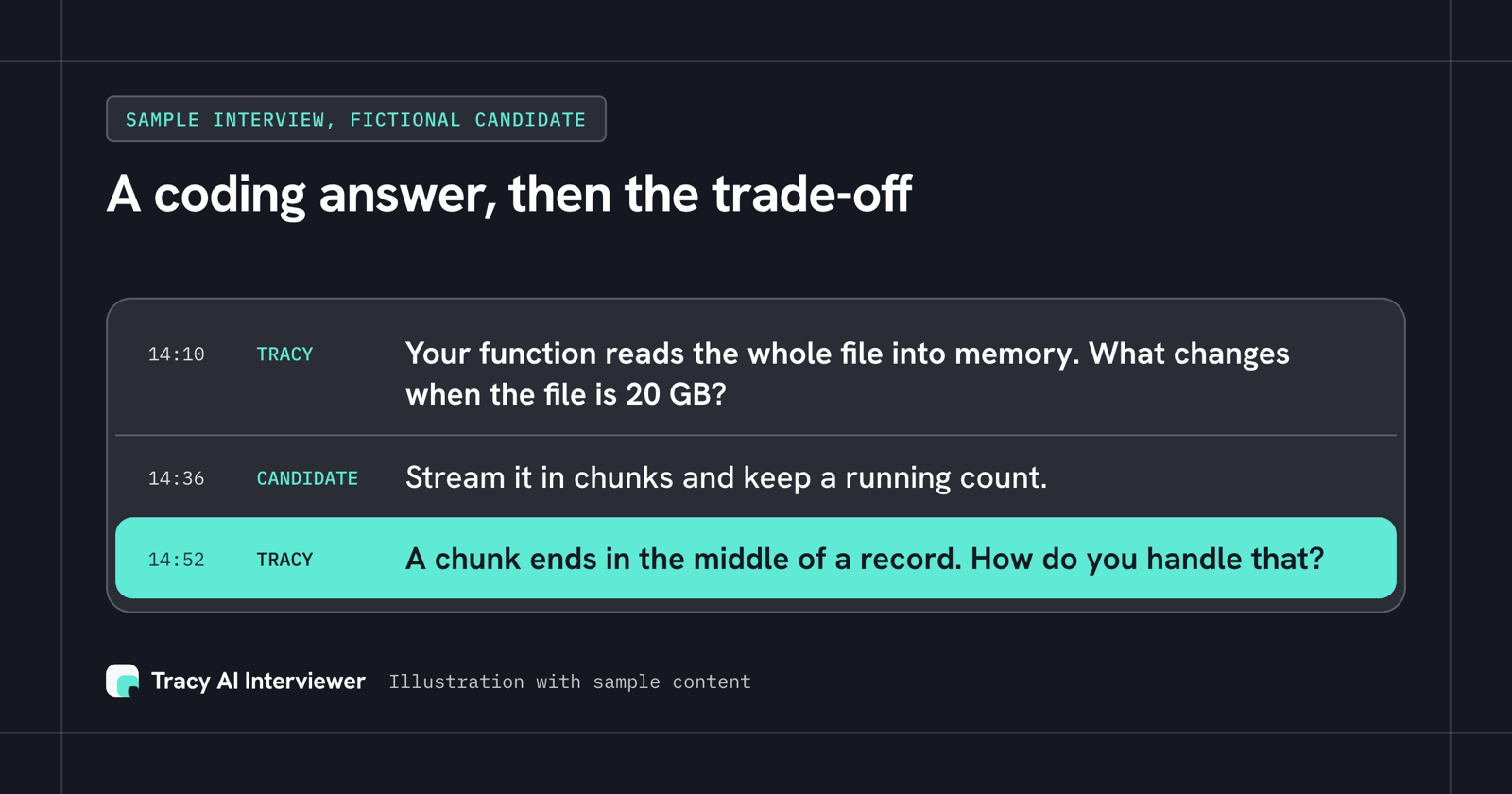
Tracy follows a coding answer with a question about the trade-off, and each line is timestamped.
Calls your engineers run, and interviews run for you
Some picks spend an interviewer's hour on every candidate: HackerEarth's FaceCode panels take up to five interviewers, and Karat's engineers run its interviews. At 20 minutes a call, 100 interviews are about 33 hours of live time, and 1,000 are about 333.
Say 100 people apply for a platform role. A live panel reaches the few your engineers have time for. A test reaches all 100 on one fixed task. An interview run for you reaches all 100 with follow-ups, and your engineers read the recordings.
Choose live calls when you want your own people in the room, a test platform when the library and proctoring matter, and Tracy when the first round is the bottleneck.
Which platform fits which team?
- HackerEarth fits teams that want live panel interviews, since FaceCode takes up to five interviewers, next to OnScreen.
- HackerRank fits teams that want assessments, pair programming and an AI interviewer from one vendor. Extra candidate attempts are $20 each on its Starter and Pro plans.
- Codility fits teams that assess up to 1,400 people a year on fixed invite packs. Recording is listed for Enterprise only.
- CodeSignal fits teams that want assessments, AI interviewers and live interviews on one credit, with live interviews in a cloud IDE.
- iMocha fits teams that screen far beyond code: it lists 10,000+ skill tests across 300+ job roles, plus Tara.
- Mercer Mettl fits teams that want psychometric tests and proctoring beside technical tests. An AI interviewer is not stated on the pages reviewed.
- Karat fits teams that want its own interview engineers to run the interview. Karat states no price on the pages reviewed.
Which path fits you?
- Hiring engineers at volume: AI technical interviews shows the whole flow.
- Weighing one vendor against Tracy: Tracy vs HackerRank, Tracy vs Codility and Tracy vs CodeSignal.
- Checking cost first: HackerRank pricing and Codility pricing.
- Defining the step itself: what is a technical screen.
Create one interview for an engineering role and compare the follow-ups and the report with your current tool.
Common questions
What is a technical interview platform?
Which technical interview platforms ask follow-up questions?
Which technical interview platform is best for hiring at volume?
How much do technical interview platforms cost?
Do technical interview platforms flag cheating?
Run one engineering role through Tracy
Create one technical interview and read the follow-ups and the report yourself. The first 3 results are free.
Book a demo (opens in a new tab) Try it free (opens in a new tab)
Your first 3 results are free. No card needed.
Sources
- Tracy AI Interviewer: Pricing, retrieved 14 Nov 2026.
- Tracy AI Interviewer: Technical interviews, retrieved 14 Nov 2026.
- CodeSignal: Pricing, retrieved 14 Nov 2026.