In short
AI tools for talent acquisition come in three types: tools that find and match people, tools that chat and book, and tools that interview and write up what was said.
Tracy AI Interviewer is the third type. Each applicant starts from a link on click, Tracy follows up in their own field, and your reviewer reads the recording and what the person said to each question. Candidates rate Tracy 92 on NPS.
LinkedIn's Hiring Assistant and Gem find people, Paradox chats and schedules, Tenzo screens by phone or video, and Metaview takes notes on calls your team runs.
Pick the stage that backs up first and test one tool there.
What are the 3 types of AI recruiting tools?
The three types are tools that find and match people, tools that chat and book, and tools that interview and write up what was said. Each type works from different material: the first from profiles, the second from short answers and calendars, the third from the conversation itself.
Time saved is the reason teams give. LinkedIn's Future of Recruiting 2025 report surveyed 1,271 recruiting professionals in 23 countries in September 2024. It says talent acquisition professionals integrating or experimenting with generative AI saved about 20% of their work week. The type a team needs first is the one for the stage where applicants wait longest, and for many teams that is the first real conversation, which Tracy AI Interviewer holds.
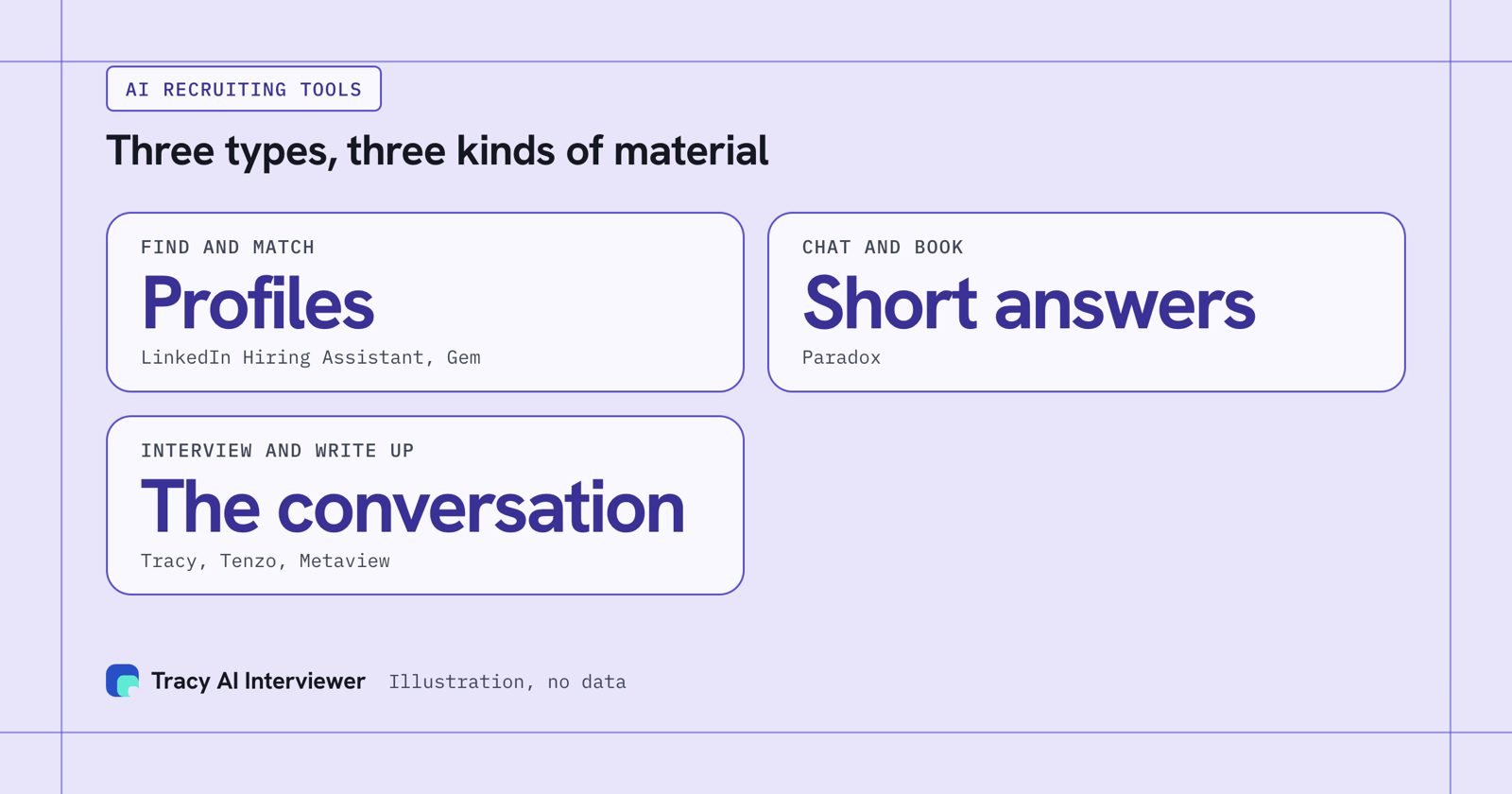
Each type of AI tool works from different material, so each fixes a different wait.
Where do applicants wait?
Map your hire and mark where applicants sit longest. If roles stay open because few people apply, start with a find tool. If applicants drop out between applying and a first call, a chat and book tool shortens that gap with a slot picker, while an interview tool takes the call off the calendar altogether: a Tracy interview starts when the applicant clicks the link. If hiring managers turn down people the recruiter passed, the problem is what the first screen shows, and a recorded, transcribed conversation with follow-ups gives the manager something to read before the live round.
Which AI talent acquisition software is best in 2026?
It depends on the type. For the first-round interview, Tracy. For chat screening and booking, Paradox. For finding people, LinkedIn's Hiring Assistant or Gem. For notes on calls your own team runs, Metaview.
The order follows how much of what a person says the tool takes in. Tools that hear the whole conversation come first, then chat and booking tools, then tools that work from profiles. Features are the vendors' own, read on 23 Nov 2026, and Paradox's and Metaview's on 14 and 9 Nov.
AI tools for talent acquisition side by side
What each vendor's pages state. Dates read: 23 Nov 2026 except Paradox (14 Nov), Metaview (9 Nov) and Tenzo (22 Nov).
| Tool | Type and job | Entry price |
|---|---|---|
| Tracy | Interview: runs it and follows up | Free for 3 results, then $1 per credit |
| Tenzo | Interview: screens by phone or video | Annual subscription by volume, quote |
| Metaview | Record: notes on calls your team runs | See its pricing page |
| Paradox | Chat and book: screens by chat, schedules | Ask the vendor |
| LinkedIn Hiring Assistant | Find: searches LinkedIn, drafts, pre-screens | Add-on to Recruiter, no price |
| Gem | Find: AI sourcing, CRM, ATS, scheduling | No list price; startup program offer |
Each tool: verdict, fit, trade-off and price
Tracy AI Interviewer
Verdict: Runs the interview itself from a link and returns the recording, a transcript and what the person said to each question.
Best for: Teams hiring at volume, where the first conversation is the wait.
Trade-off: It covers the interview; sourcing and booking live elsewhere.
Price: Listed in the table above.
Tenzo
Verdict: An AI recruiter for high-volume hiring that screens, interviews and schedules applicants, with a team of agents from application review to rediscovery.
Best for: High-volume teams that want phone and video screens in 40+ languages.
Trade-off: The pricing page carries a demo form and no price; a free one-week trial runs on one or two roles.
Price: An annual subscription based on volume.
Metaview
Verdict: A notetaker for interviews that captures video, phone and in-person conversations, and connects to Greenhouse, Ashby, Workday, Lever and more.
Best for: Teams whose interviewers run the calls themselves.
Trade-off: The notetaker is built for conversations your team holds, so the interview itself still takes a person's time.
Price: See its pricing page.
Paradox
Verdict: An AI assistant, Olivia, that screens through chat or text and lets candidates choose their own interview slot.
Best for: Frontline workers and managers, where mobile-first chat fits.
Trade-off: Screening runs through chat or text.
Price: Ask the vendor.
LinkedIn Hiring Assistant
Verdict: Builds a sourcing strategy from the hiring goal, searches LinkedIn, drafts messages and pre-screens interested candidates by voice or text.
Best for: Teams already on LinkedIn Recruiter.
Trade-off: The add-on is not sold without Recruiter.
Price: None on the page; LinkedIn asks you to get in touch.
Gem
Verdict: An AI recruiting platform joining sourcing, CRM, ATS and scheduling, with a search over 800M+ profiles.
Best for: Teams that want sourcing and the pipeline together.
Trade-off: Enterprise pricing is custom.
Price: No list price. Its FAQ names $135 a month for early-stage startups in its Startup Program, and enterprise pricing is custom.
What do ATS vendors add to the three types?
Applicant tracking systems now sell pieces of each type as modules. Ashby lists an AI Notetaker and an AI Interviewer as paid add-ons, and Greenhouse puts an AI Notetaker on every plan and shows a Voice AI interviews entry in its menu. If your ATS already offers a module, test it against a point tool on one role before you buy a second product. The AI recruiting software comparison covers the ATS side.
What Tracy does as the interview type
Each applicant opens the link on click, at any hour, in a browser, and Tracy asks in their field and follows what they say. The reviewer opens a report link with the recording and what the person said to each question, and the result can be written back to your ATS. A person decides.
Tracy has an API and an MCP server, so it can start from the chat tool or system you already use. On Enterprise, Tracy can also take notes on calls your own people run, which covers the record type for those calls.
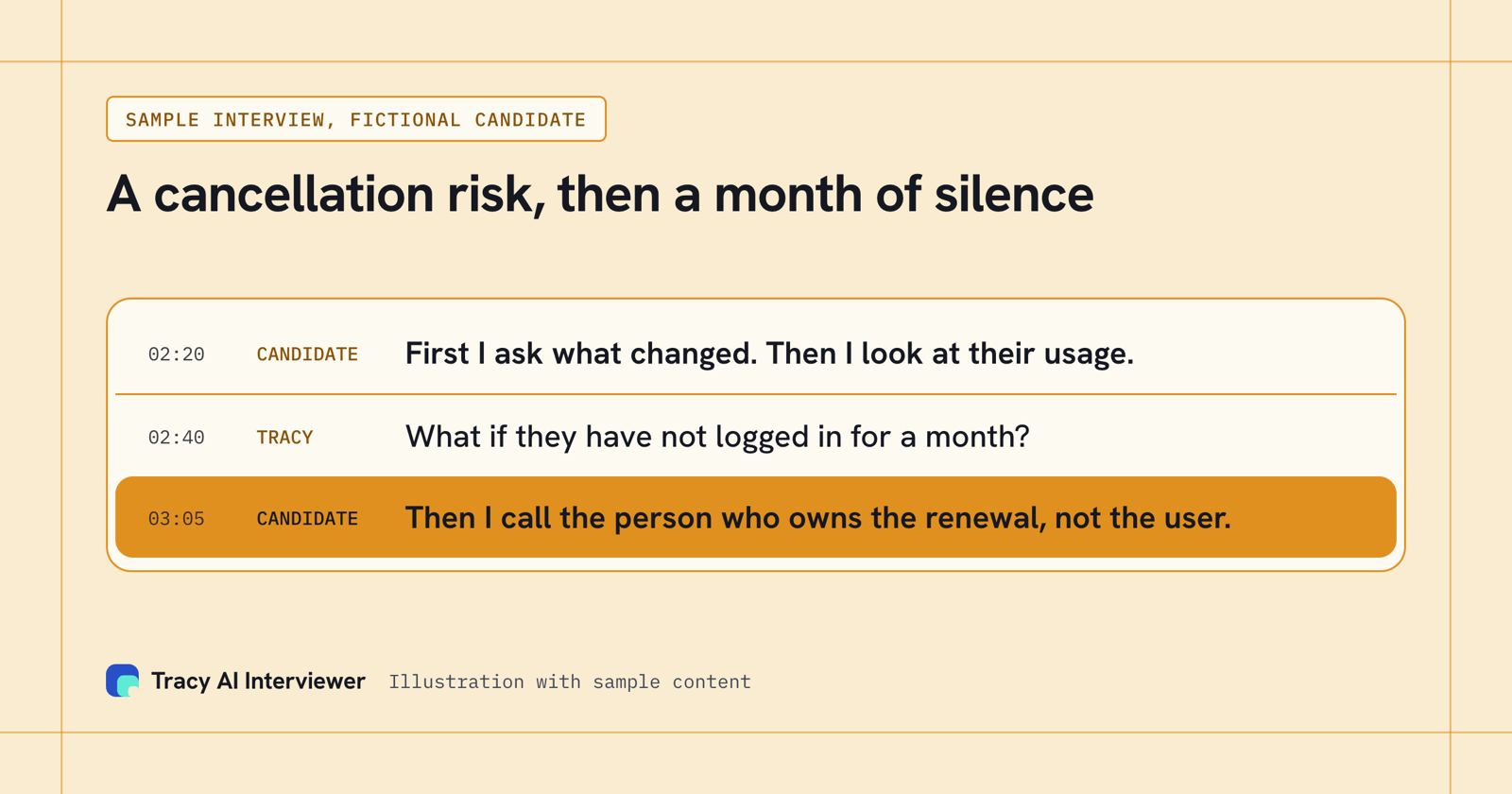
When a customer might cancel, Tracy asks what happens if they have gone quiet for a month.
Which AI tools fit a small team?
A small team gets the most from one tool at the stage where its hours go. Tracy has no seats and no upfront cost, so a team that hires a few people a year pays for the interviews it runs. Gem shows no list price beyond a startup-program offer, and Tenzo and Paradox are sold through a demo. Try the tool on one open role before you commit a budget line to it.
Which path fits you?
- Finding people for clients: AI sourcing tools compares Gem, hireEZ, SeekOut and Juicebox.
- Handing off one task: AI recruiting assistants sorts tools by task.
- Choosing a full platform: AI recruiting platforms.
- Chat-led hiring: conversational AI for hiring.
- Automating the pipeline: recruitment automation.
- Unsure what an AI recruiter is: what is an AI recruiter.
Common questions
What are the 3 types of AI recruiting tools?
Which AI talent acquisition software is best in 2026?
What are the best AI recruiting tools for small teams?
Do AI recruiting tools replace recruiters?
Interview every applicant, not just a few
Tracy starts each first-round interview on click and follows up on every answer. Your first 3 results are free.
Book a demo (opens in a new tab) Try it free (opens in a new tab)
Your first 3 results are free. No card needed.
Sources
- Tracy AI Interviewer: Pricing, retrieved 23 Nov 2026.
- Tracy AI Interviewer: Connect, retrieved 23 Nov 2026.
- LinkedIn: The Future of Recruiting 2025, retrieved 18 Nov 2026.