
In short
Gallup reports that only 12% of U.S. employees say their company does a good job of onboarding, and only 29% of new hires feel fully prepared and supported (articles from 2019 and 2021).
Feedback is thin as well. Microsoft Viva Glint's onboarding surveys averaged a 40% response rate in 2022, so most new hires never answer.
Tracy AI Interviewer runs the day-30 check-in as a conversation. Each new hire starts from a link when ready, Tracy follows up on vague answers, and your people team reads what each person said.
Next step: send one cohort's check-in through Tracy. The first 3 results are free.
Onboarding statistics keep repeating the same few Gallup figures, which date from 2019 and 2021. This page lists what Gallup and Microsoft Viva Glint report, with the year and the group each number covers, so you can tell which figures describe how new hires feel and which describe how many of them answer a survey at all. For what happens after the first weeks, see employee engagement statistics.
How does onboarding affect retention?
Gallup says organizations often lose one-third to two-thirds of new hires in their first 12 months, with the rate varying by role, and that about a third of new employees do not last 90 days (Gallup, January 2019).
The link to onboarding runs through feeling prepared. In a 2021 Gallup article, employees with an exceptional onboarding experience were 2.6 times as likely to be extremely satisfied with their workplace, and 70% of them said they have the best possible job. Those figures measure satisfaction, and Gallup does not give how many of those employees stayed, so they argue for caring about the first weeks without being a retention rate.
Which onboarding number counts what?
Gallup's figures come from articles dated January 2019 and August 2021; Microsoft Viva Glint's are mean survey response rates across its customers, 2022.
| Measure | Figure | Who said it, when |
|---|---|---|
| Good onboarding | 12% | Gallup, U.S. employees who say their company does a good job, 2021 |
| Fully prepared | 29% | Gallup, new hires who feel fully prepared and supported, 2021 |
| Poor onboarding | Nearly 1 in 5 | Gallup, employees reporting a poor most recent onboarding, 2021 |
| Manager involved | 3.4 times | Gallup, likelihood of calling onboarding successful with an active manager, 2021 |
| First-year loss | One-third to two-thirds | Gallup, share of new hires lost in 12 months, varies by role, 2019 |
| Onboarding survey | 40% answer | Microsoft Viva Glint, mean response rate, 2022 |
| Exit survey | 51% answer | Microsoft Viva Glint, mean response rate, 2022 |
What is a good onboarding process?
The sources here point at the manager. Gallup reports that employees are 3.4 times as likely to feel their onboarding was successful when their manager takes an active role. Gallup also says, from its own experience, that new employees typically take around 12 months to reach peak performance, so a plan that stops after week two ends long before the ramp does.
The 2021 Gallup article adds that only 29% of new hires feel fully prepared and supported to excel in their role, and that nearly one in five employees describe their most recent onboarding as poor. A people team that wants to know which group its own new hires belong to has to ask them, and ask more than once.
How many new hires answer an onboarding survey?
Fewer than half. Microsoft Viva Glint's mean response rate for onboarding surveys was 40% in 2022, 42% in 2021 and 45% in 2020, against 51% for exit surveys and 75% for recurring engagement surveys in 2022. Glint counts completed surveys divided by invitations, and it warns that comparisons between survey programs are never apples to apples, so treat the gap as a rough size.
Glint's own guidance says a sample is useful less for its size than for how closely it resembles the whole group. A 40% response leaves a people team with replies from fewer than half its new hires and no way to see the rest.
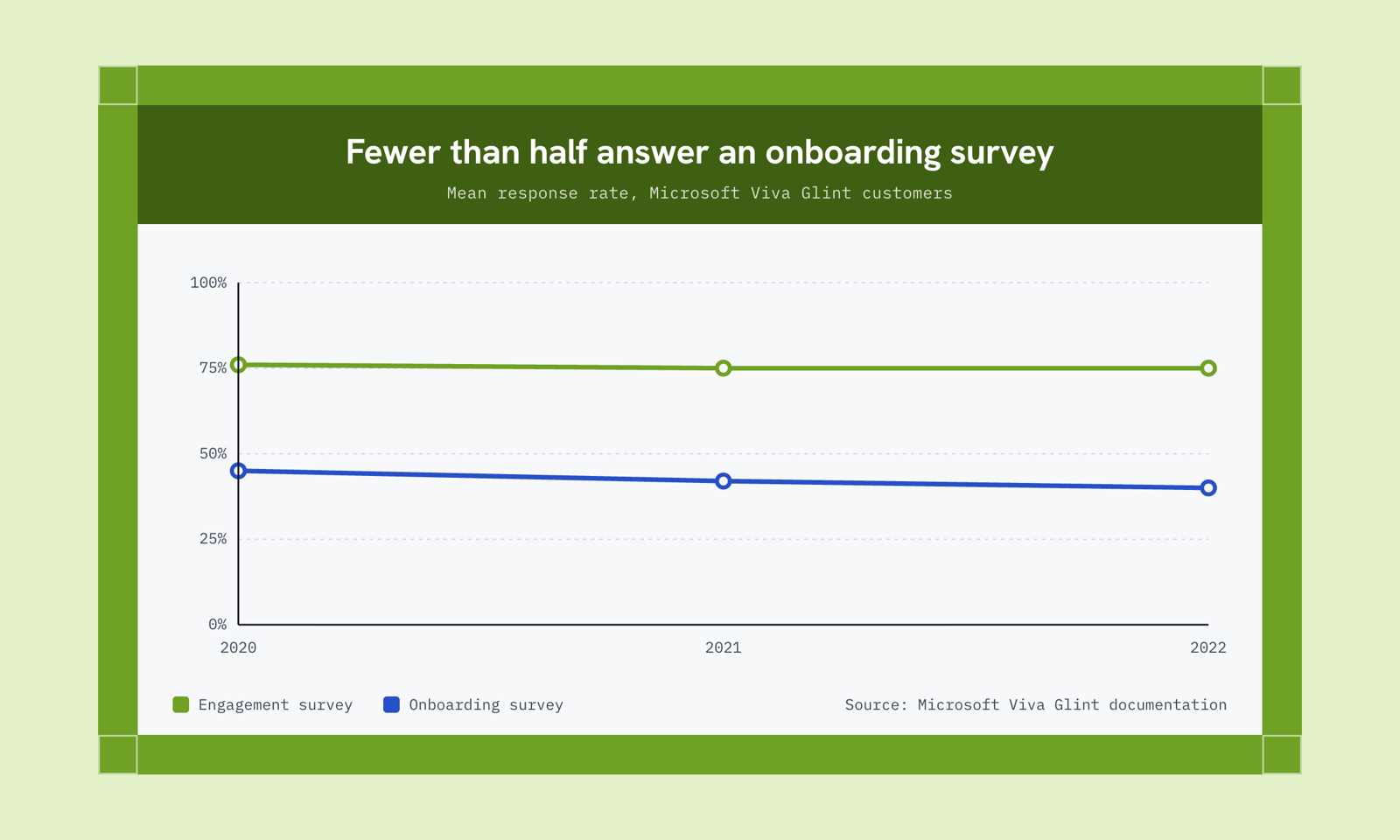
Fewer than half of invited new hires complete an onboarding survey, and the rate has slipped each year since 2020.
What does a 30-day check-in catch that a form misses?
Tracy AI Interviewer is built for this conversation. A people team picks the kind of check-in (onboarding, engagement or exit), brings its own questions or describes the goal and lets Tracy draft them, and sends one link. Each new hire opens it at any hour in a browser, so no manager has to find a calendar slot. Tracy says who she is and what happens next, and people are told about the recording before it starts.
When an answer is vague, Tracy asks a kind, sharper question, so "it was fine" turns into the thing that was unclear. Your people team then reads a written summary of what each person said to each question, with the words and the moment in the recording behind it, and decides what to change. Tracy reports what was said. She does not rate the new hire or the manager.
A sample day-30 note, with invented data, shows the pattern: the new hire says a buddy helped finish their first project, Tracy asks what they would like more of, and an open question about who approves purchase requests is logged with its time. To try it on your own cohort, send one check-in to a few new hires and read the summaries.
Pricing follows results: $1 per credit, one credit for each started 20 minutes, so 100 check-ins of up to 20 minutes cost up to $100.
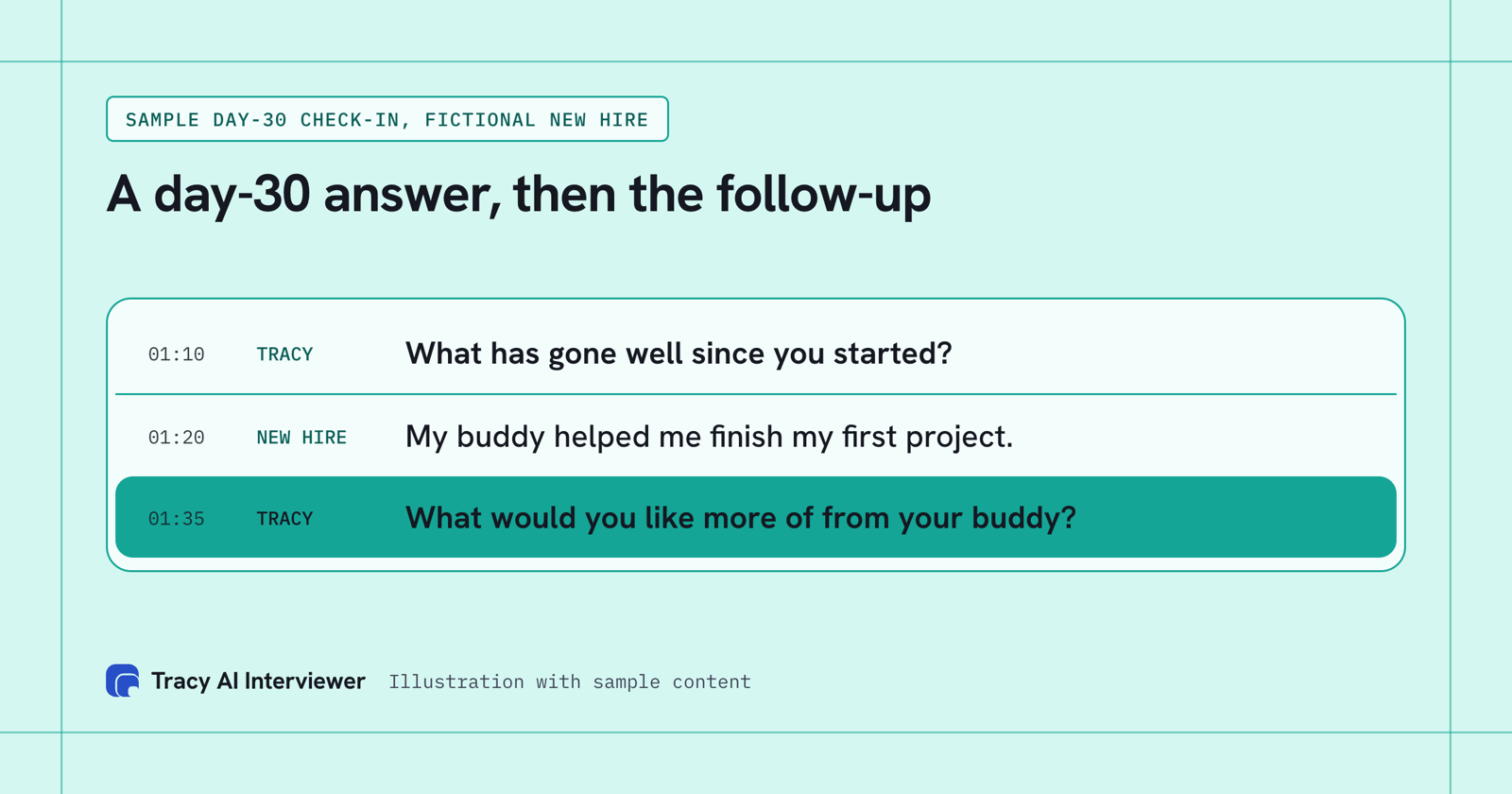
A day-30 answer gets a follow-up that shows what the new hire still needs.
Which path fits you?
- Writing the questions: 30-60-90 day check-in questions.
- Asking at the pulse level: employee pulse survey questions.
- Hearing from people who leave: reading exit interviews.
- Acting on an engagement signal: how to improve eNPS.
- Looking at the wider HR numbers: HR statistics.
People team interviews with Tracy covers check-ins and exit interviews from the first link to the summary.
Common questions
How does onboarding affect retention?
What is a good onboarding process?
What share of new hires feel fully prepared?
Employee vs customer onboarding stats?
Why do these onboarding statistics look so old?
Hear how week four really went
Tracy runs your 30-day check-ins as a conversation and asks a sharper question when an answer is vague. Your first 3 results are free.
Try it free (opens in a new tab) Book a demo (opens in a new tab)
Your first 3 results are free. No card needed.
Sources
- Gallup: onboarding article, 31 January 2019, retrieved 23 Nov 2026.
- Gallup: 8 Practical Tips for Leaders for a Better Onboarding Process, 12 August 2021, retrieved 23 Nov 2026.
- Microsoft Learn: Viva Glint's position on expected response rates (updated 29 June 2026), retrieved 23 Nov 2026.