
In short
To improve eNPS, find the reason behind each score, change one thing, tell people what you changed and measure again with the same question.
Tracy AI Interviewer can run an eNPS interview: she asks each person what is behind their answer, follows up when it is vague and highlights insights and signals from what they said.
The survey still gives you the number. Tracy does not score or calculate eNPS, so you use the interview as the reference for your next round.
An eNPS survey tells you how many people would recommend the company, but the number alone does not give the reason. Improving it means collecting the why from people who gave a low score, and from those who gave a middling one, before you pick a fix. This page covers how eNPS works, what a good score is, five steps to raise it and how an eNPS interview gets the reasons. If you also run a broader pulse survey, keep the eNPS question in it as one of your anchors.
How does eNPS work?
Employees rate, from 0 to 10, how likely they are to recommend their company as a place to work. AIHR sorts the answers into three groups and subtracts one from another.
| Group | Score given | Counts toward |
|---|---|---|
| Promoters | 9 or 10 | Added |
| Passives | 7 or 8 | Ignored in the sum |
| Detractors | 0 to 6 | Subtracted |
eNPS is the percentage of promoters minus the percentage of detractors, so it runs from -100 to 100. Say 50 people answer: 20 score 9 or 10, 20 score 7 or 8 and 10 score 0 to 6. That is 40% promoters minus 20% detractors, an eNPS of 20. The example is made up to show the sum.
What is a good eNPS score?
AIHR calls 10 to 30 good and 50 to 70 excellent, and says anything above zero is acceptable. Other guides draw the lines elsewhere, so the number that matters most is your own from the last round. A score that moves from 12 to 25 after you fixed something tells you more than a comparison with a stranger's benchmark.
To see what moved your own number, read the reasons behind each score before you plan a fix.
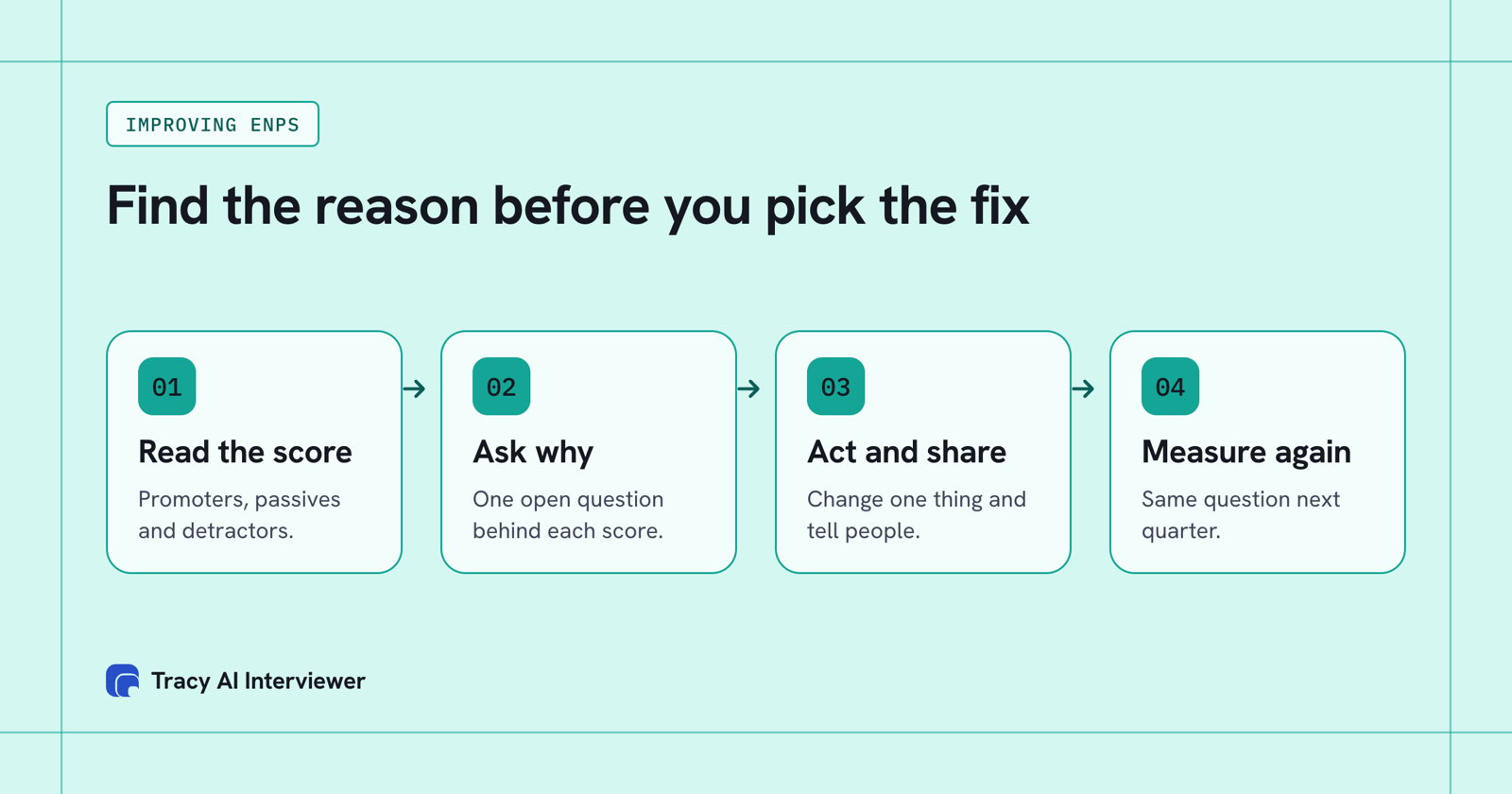
Reasons come before fixes: read the score, ask why, act and tell people, then measure again.
How do you improve eNPS?
Five steps, in this order.
- Read the groups, not only the number. Look at how many people are detractors, how many are passives and where they sit by team. Deel suggests different actions for each group: recognition and growth for promoters, listening and career development for passives, and addressing concerns for detractors.
- Ask why. AIHR says follow-up questions should be open-ended so the score comes with the reason behind it, for example "What is the reason for giving that score?" and "What can we improve as an employer?"
- Talk to detractors. Deel advises open and honest conversations with them, and suggests skip-level meetings as one way in. A survey box gets a number from a detractor, and a conversation can get the cause.
- Change one thing and say so. AIHR says to act on the feedback and to share the results and the action plan with the organization. Pick the one cause that came up most often, name an owner and a date, and tell people.
- Measure again. AIHR suggests running eNPS every quarter, twice a year or after important company milestones. Keep the question the same so the two scores can be compared.
Deel's headings for each group show where the effort goes.
| Group | What Deel suggests |
|---|---|
| Promoters | Offer recognition and rewards, provide opportunities for growth, empower your people |
| Passives | Listen to feedback, focus on engagement, offer career development, appreciate their work |
| Detractors | Address concerns, maintain open dialogue, provide support, improve their experience |
How do you find out why people scored the way they did?
Ask them in a conversation. A comment box gives one line from the people who choose to write, and nobody can ask what they meant while they answer. In an interview someone can.
Tracy AI Interviewer lets a company set up an eNPS interview. You write your own questions, for example the recommend question followed by "what is behind that answer?", or describe the topic and edit the draft Tracy gives you. Then you share a link. Employees open it in a browser when it suits them and are told before it starts that the conversation is recorded and transcribed. If someone gives a six and says "it is fine", Tracy asks for the example, and waits for them to finish before asking the next question.
Four questions to put in an eNPS interview, the first two from AIHR's sample follow-ups:
- What is the reason for giving that score?
- What can we improve as an employer?
- What would have made your score one point higher?
- What has changed since the last time you were asked?
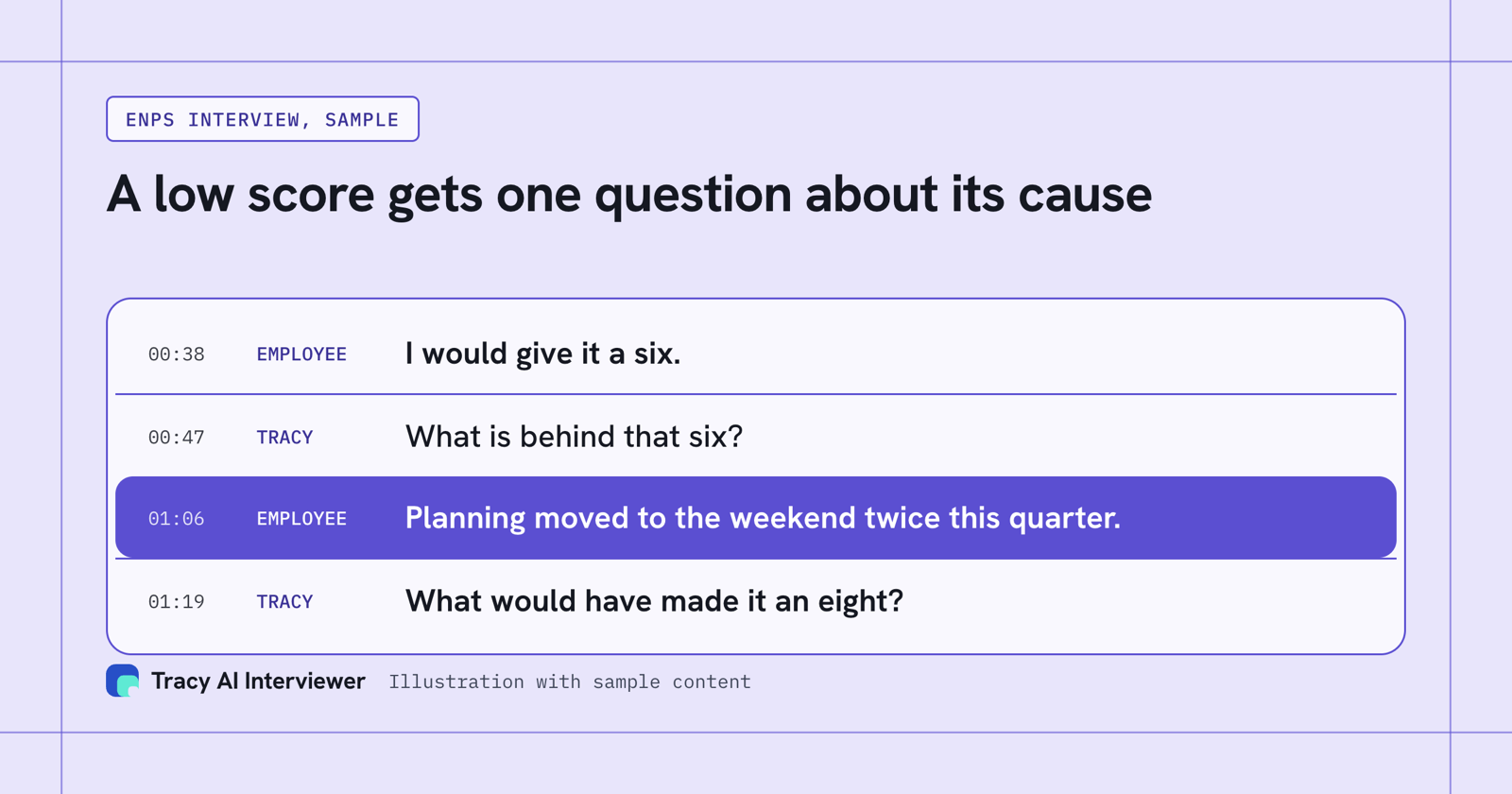
A low score gets one question about its cause and one about what would have changed it.
What does an eNPS interview give you to act on?
For each question you get what the person said, next to the recording and a timestamped transcript. Tracy also highlights insights and signals from what people said. She does not score or calculate eNPS: your survey still produces the number, and the interview is the reference you use to improve and to compare against at the next round.
Grouping what many people said into causes is work for the reviewer, or for Claude or ChatGPT reading the results, and a person checks each cause against the quotes before choosing a fix.
Where should you start?
Start with one team where detractors cluster, and keep to one: a single clear change that people can see counts for more than a long plan nobody reads. Invite its detractors, and a few passives, to an eNPS interview. A 15-minute interview is one credit, $1, since Tracy costs $1 per credit with one credit per started 20 minutes. Read what they said, fix the cause that came up most and tell the team what you changed before the next survey. Deel advises making feedback and follow-up business as usual, so the same team hears back each round.
Which path fits you
- You want questions for the survey itself: employee pulse survey questions.
- You want to talk to people you do not want to lose: stay interview questions.
- Your low scores end in resignations: exit interview analysis.
- You want all the people-team conversations in one place: AI interviews for people teams.
- You want the price first: pricing.
Common questions
How do you improve eNPS?
What is a good eNPS score?
How is eNPS calculated?
How often should you run eNPS?
Can Tracy calculate eNPS?
Find the reason behind each score
Set up one eNPS interview and read what people said about their score, in their own words. Your first 3 results are free.
Try it free (opens in a new tab) Book a demo (opens in a new tab)
Your first 3 results are free. No card needed.
Sources
- AIHR, Employee Net Promoter Score (eNPS): The Ultimate 2026 Guide (undated), retrieved 23 Nov 2026.
- Deel, How to improve your eNPS score (last updated 10 January 2025), retrieved 23 Nov 2026.
- Tracy AI Interviewer people teams use case, retrieved 14 Nov 2026.
- Tracy AI Interviewer pricing, retrieved 22 Nov 2026.