In short
Good onboarding check in questions ask whether the job matches what the new hire was told, how confident they feel and what would help, then follow up on any answer that stays vague. Below are 12 questions for week one and days 30, 60 and 90, plus a prep sheet.
Tracy AI Interviewer runs the check-in from your questions in the browser, asks a kind, sharper question when the answer is "fine", and gives you what each person said with the words behind it.
Copy the questions, then try one check-in. The first 3 results are free.
Gallup's 2019 article on onboarding says only 12% of people say their company does a good job of it. Onboarding check in questions are where a company finds out why: what the job turned out to be, where the new hire is stuck and what nobody told them. The 12 questions below sit in four moments, and each has a follow-up and a note on what to listen for.
The page is built for people teams who run check-ins for many managers. For a longer set organised around three stages, see the 30-60-90 day check-in questions. For the data behind onboarding, see onboarding statistics.
Which onboarding check in questions should you ask in week one?
Week one is the time to find out whether the first days matched the description of the job, what is still unclear and whether anything raised a doubt. It is the cheapest time to fix a gap, and the new hire still remembers what they were told in the interview.
1. What did you expect to be doing this week, and what did you do?
Follow up with: What surprised you most?
Listen for: The gap between how the job was described and the first days.
2. What do you still not understand about how we work?
Follow up with: Who could explain it to you?
Listen for: A named process, tool or term.
3. Did anything in the first days make you doubt the move?
Follow up with: What would have prevented it?
Listen for: An early warning you can fix for the next person.
What to ask at 30 days: is the job what you expected?
By 30 days the new hire has done real work, so the question about expectations has an answer. Follow it with how confident they feel doing the main task alone.
4. Is the job what you expected?
Follow up with: Which part is different from how it was described?
Listen for: A mismatch you can trace back to the job ad or the interview.
5. How confident do you feel doing the main part of the job on your own?
Follow up with: What would make you more confident?
Listen for: A named gap, such as a system, a person or a decision.
6. Who do you go to when you are stuck?
Follow up with: How long does help take to arrive?
Listen for: Whether help is a person or a search through old chats.
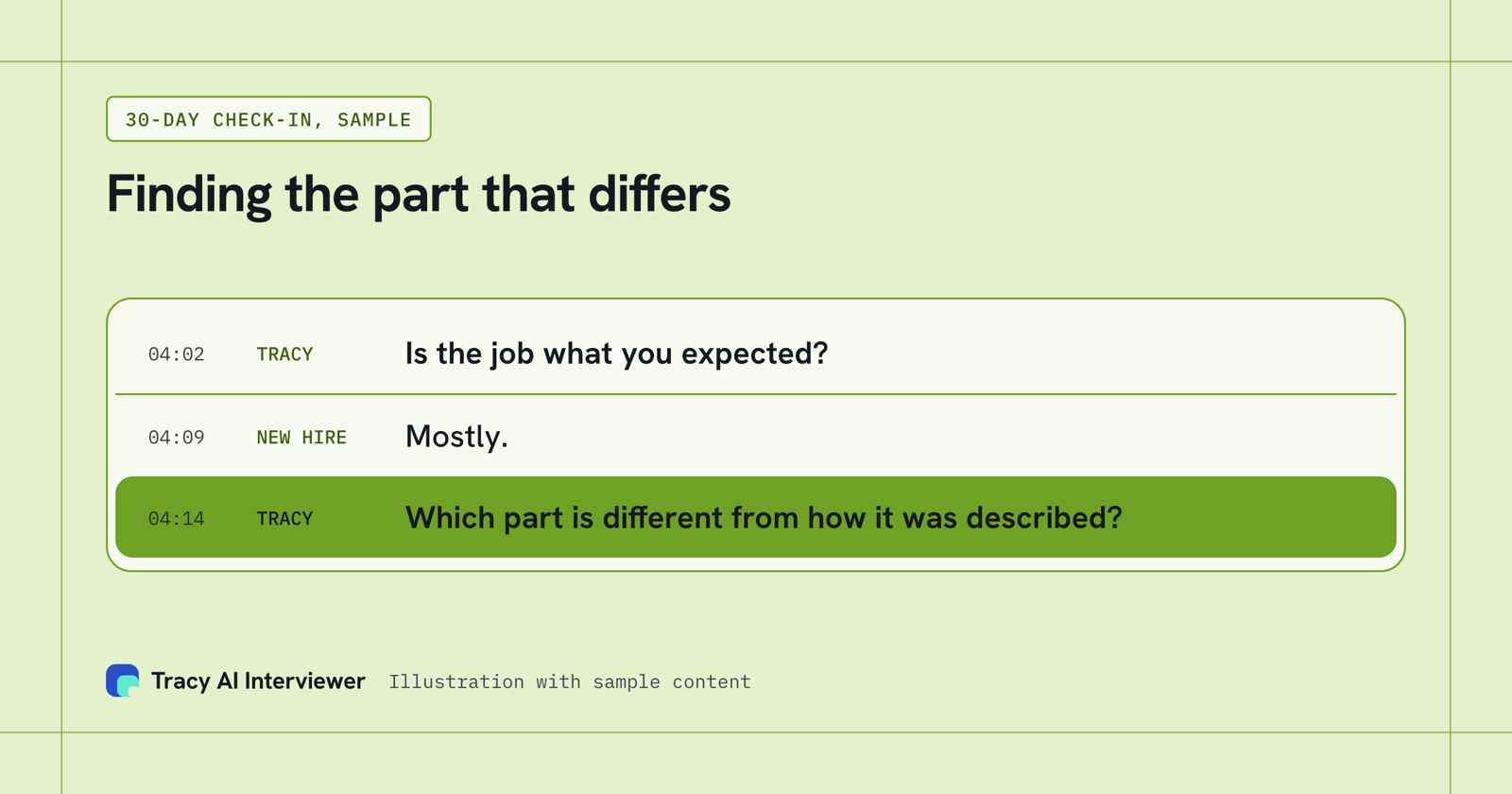
The follow-up finds the part of the job that differs from the description.
What to ask at 60 and 90 days
By 60 days the new hire is doing the work and can say what slows it down. At 90 they can judge the company and advise the next person.
7. Which part of the job takes more time than you thought?
Follow up with: What would you change about it?
Listen for: A task that needs a tool, a template or a decision from you.
8. What feedback have you had so far, and what did you do with it?
Follow up with: What feedback do you want that you have not had?
Listen for: Whether feedback is arriving and being used.
9. Which meetings or reports feel like a waste of your time?
Follow up with: What would you replace them with?
Listen for: A candid list. Protect the person who gives it.
10. If a friend asked whether to join us, what would you say?
Follow up with: What would you leave out?
Listen for: The honest summary, including what they would hold back.
11. What would you tell the next hire to do in their first week?
Follow up with: What should we have told you earlier?
Listen for: Onboarding steps that are missing from your plan.
12. What do you want from your manager over the next quarter?
Follow up with: What should I stop doing?
Listen for: A request the manager can act on this month.
What can a new hire ask their boss at a check-in?
A new hire can use these five questions with their manager at any check-in:
- What does success look like for me by day 90?
- How do you like to give feedback, and how often?
- What should I stop doing?
- Who else should I meet in the first month?
- What is the one thing I should get right first?
If your people team collects the answers, managers can see which questions their new hires ask most.
The prep sheet to copy
Paste this table into a doc and fill it before each check-in, so the conversation starts from the last one.
| Moment | Before the check-in | After the check-in |
|---|---|---|
| Week 1 | Read the job ad and the offer notes | Fix one gap this week |
| Day 30 | Note the tools and access requested so far | Report one change to the hiring team |
| Day 60 | List the feedback given so far | Agree one meeting to drop or change |
| Day 90 | Gather what earlier check-ins said | Tell the new hire what changed |
A new hire who sees a change after the first check-in answers the second one more fully, so the last column carries the most weight.
Can an AI interviewer run onboarding check-ins?
Yes. Tracy AI Interviewer runs the onboarding check-in as one of its conversations. Choose it, bring your own questions or describe the role and let Tracy draft them, then share one link. The new hire joins in the browser when it suits them, with no calendar slot. Tracy says who she is and what happens next, and the join screen tells them the conversation is recorded and transcribed before it starts. When an answer is vague she asks a kind, sharper question and waits for the end of the thought.
You read themes with the words behind each one. This is an invented sample from a pulse check-in.
| Question | What the person said | Time |
|---|---|---|
| How is your workload at the moment? | Two colleagues left, so it was heavy, and it is easing now | 01:30 |
| Do you have what you need to do your work? | Still needs access to the reporting tool | 03:10 |
The blocker, "reporting tool access", is a fix the people team can make that week. Tracy reports what was said and does not score the person.
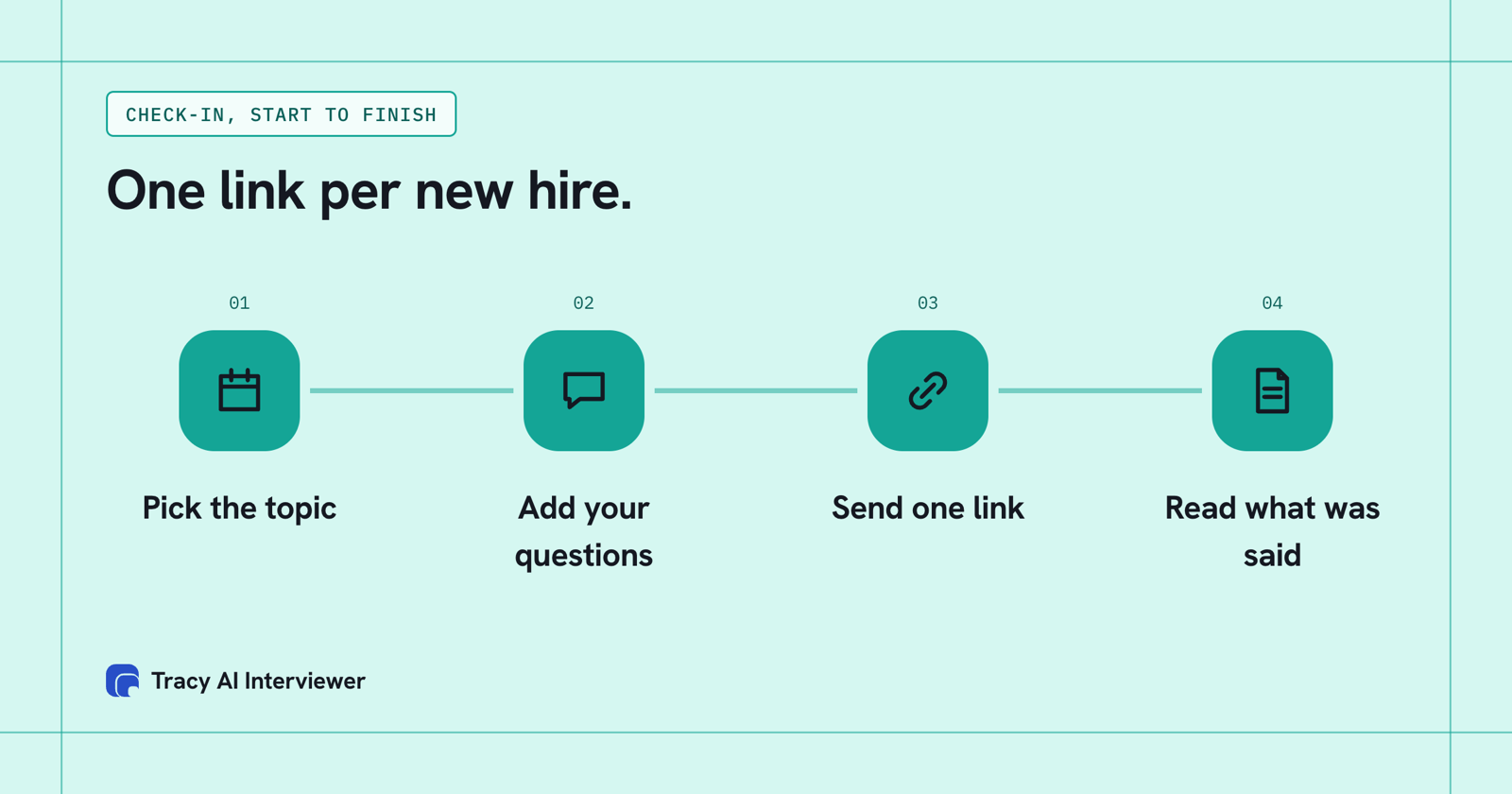
Pick the conversation, add your questions, send one link and read the themes.
What stays with your team?
Managers and people teams keep every decision. They read what each new hire said, act on the blockers and handle anything sensitive under their own policy. A check-in costs 1 credit per started 20 minutes at $1 per credit, and the first 3 results are free.
Which path fits you
- Starting a new hire programme: AI interviews for people teams.
- Hearing from people who stay: stay interview questions.
- Hearing from people who leave: exit interview questions.
- Using ChatGPT to draft the plan: ChatGPT for onboarding.
Common questions
What to ask at 30/60/90 days?
Is the job what you expected?
How confident do you feel?
What are good onboarding check in questions to ask your boss?
Where do onboarding checklist examples fit?
Hear what new hires think
Copy the day-30 questions into one Tracy check-in, send the link and read what your new hire said. The first 3 results are free.
Try it free (opens in a new tab) Book a demo (opens in a new tab)
Your first 3 results are free. No card needed.
Sources
- Gallup, onboarding article (31 January 2019), retrieved 23 Nov 2026.
- Tracy AI Interviewer people teams use case, retrieved 14 Nov 2026.
- Tracy AI Interviewer pricing, retrieved 11 Nov 2026.