In short
Interview Coder says its overlay stays hidden from screen sharing, so the app is hard to see. The person using it is easier to read, because a fed answer arrives late and is hard to explain.
Tracy AI Interviewer runs the coding task inside the interview and asks follow-ups on approach and trade-offs. On video, it shows a reviewer full-screen exits, a face leaving the frame and the delay before each answer, beside a recording and transcript.
A signal is a reason to look, not proof. Candidates are told about the recording, and a person decides.
Is Interview Coder detectable?
Partly, and not by looking for the app on a shared screen. Interview Coder's own site says its overlay "remains hidden when sharing your screen". What can still show is the person using it: a pause before every answer, code they cannot talk through, and, on some test platforms, pasted code or the editor window losing focus. None of these proves anything alone. For the wider habit of reading out an answer, see candidates using ChatGPT in interviews.
What does Interview Coder claim to hide?
Its home page, read on 23 Nov 2026, says: "Overlay remains hidden when sharing your screen, ensuring interviewers can't detect the assistance tool visually." It makes the same claim for screen recording, and it lists Microsoft Teams, Zoom, Google Meet, HackerRank and CoderPad among the tools it calls undetectable.
These are the seller's claims. For a hirer, that means a candidate's shared screen is not a dependable way to see this kind of tool, so the checks below look at what the person does and says.
Where can a trace show up?
A trace can appear in four places. Each one is a prompt to ask a question, and none is a verdict.
| Where | What can show | What it cannot tell you |
|---|---|---|
| Screen share | Nothing, if the tool works as its seller says | Whether help is in use |
| Test platform | Pasted code and the candidate leaving the editor | Which tool, or why the person left |
| Video | The face leaving the frame; reading rather than thinking | A glance at notes looks the same |
| The answers | A long pause before each answer; no change when a requirement changes | Nerves and a slow connection look the same |
Platforms are adding their own checks. Codility says its Desktop App is "designed to surface AI helper tools that hide from screen sharing", with the evidence going to a human reviewer. CoderPad's documentation lists two live alerts, pasting code from an external source and leaving the IDE, and tells interviewers to "treat alerts as prompts for clarification, not immediate disqualification".
Does CoderPad flag Interview Coder?
CoderPad's documentation says it records code changes, runs, cursor movement and clipboard activity in each pad, and alerts the interviewer when a candidate pastes code from outside or leaves the IDE. The page does not name Interview Coder.
Ask the vendor in writing which tools it covers and what the interviewer sees when a flag is raised. Forum threads about it disagree with each other, so treat them as rumour, not as a test.
How do you test understanding when answers can be fed to the candidate?
Ask about the candidate's own choices after the first solution. A person who built the approach can change it when you change the constraint, while someone relaying an answer has to wait for the next one. Use the same chain for every candidate, so a gap shows against a baseline and not against one interviewer's mood.
- Ask for the approach in plain words before any code is written.
- Change a requirement once the solution works: "Now the input arrives sorted" or "Now two services call this at once."
- Ask why this approach and not the obvious one, and what it costs.
- Ask the candidate to point at one line and say what breaks if it is removed.
- Ask what they would test first, and why that case.
Listen for reasoning that moves when the constraint moves. A longer set of questions by problem type is in coding interview follow-up questions.
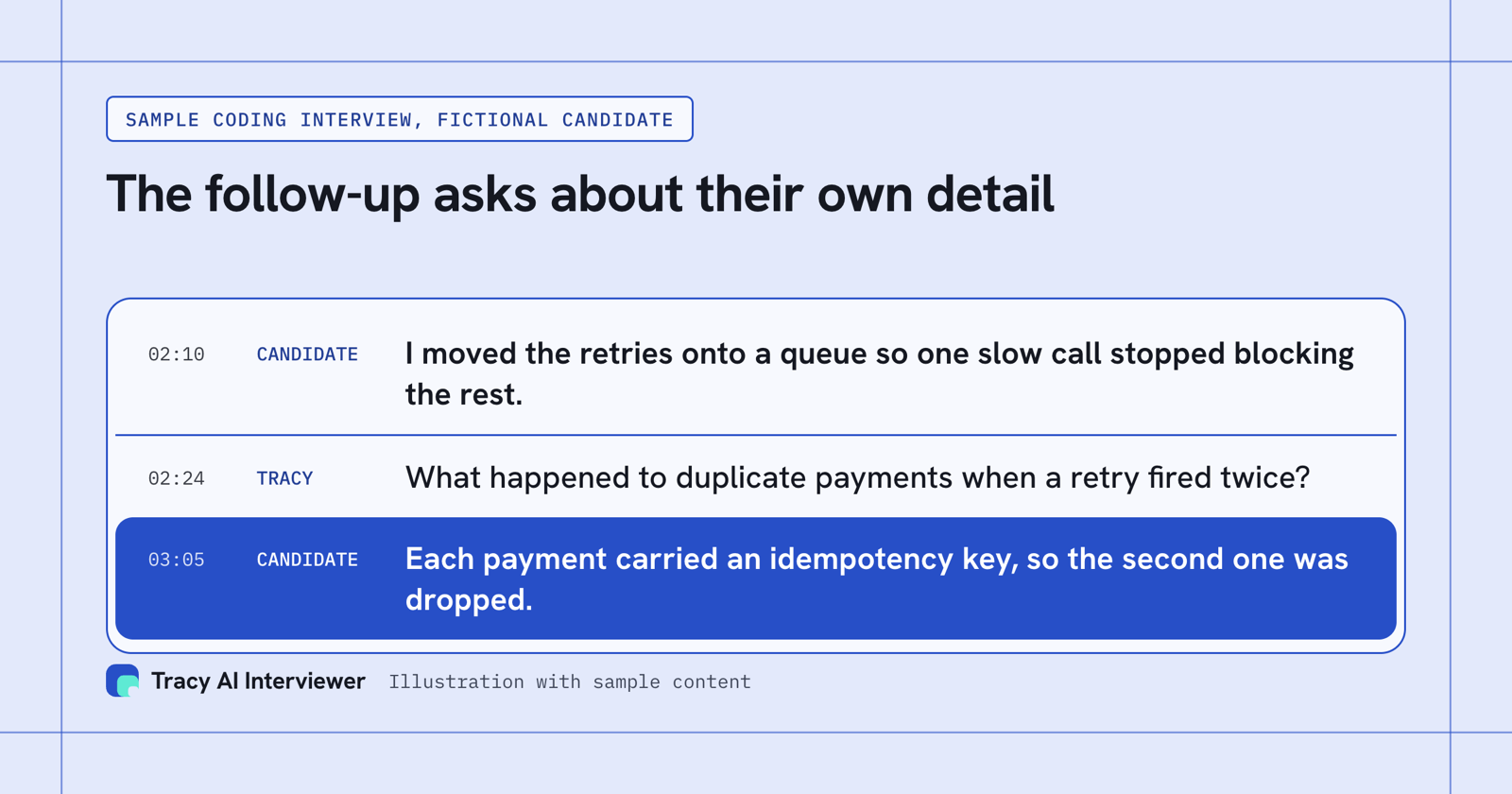
A follow-up on the candidate's own detail asks for reasoning that a copied answer does not carry.
What does Tracy AI Interviewer add to a coding interview?
Tracy puts the coding task inside the interview (live coding, SQL, debugging or multiple choice), then asks follow-ups on approach and trade-offs and waits for the end of each thought. Every applicant starts on click, at any hour, so the second question reaches the candidates your engineers had no time to interview.
Video interviews run integrity signals unless you turn them off: the full-screen window, the face on camera, and a pop-up if the face leaves the frame. The report also shows how long each answer took to start. A reviewer reads these beside the recording and the timestamped transcript, together with what the person said to each question. Tracy only reports. It gives no detection rate, the candidate is told on the join screen that the conversation is recorded and transcribed, and a person decides.
To see how these read together in one result, run a single coding interview yourself; the first 3 results are free. For the engineering workflow, see AI interviews for software engineers.
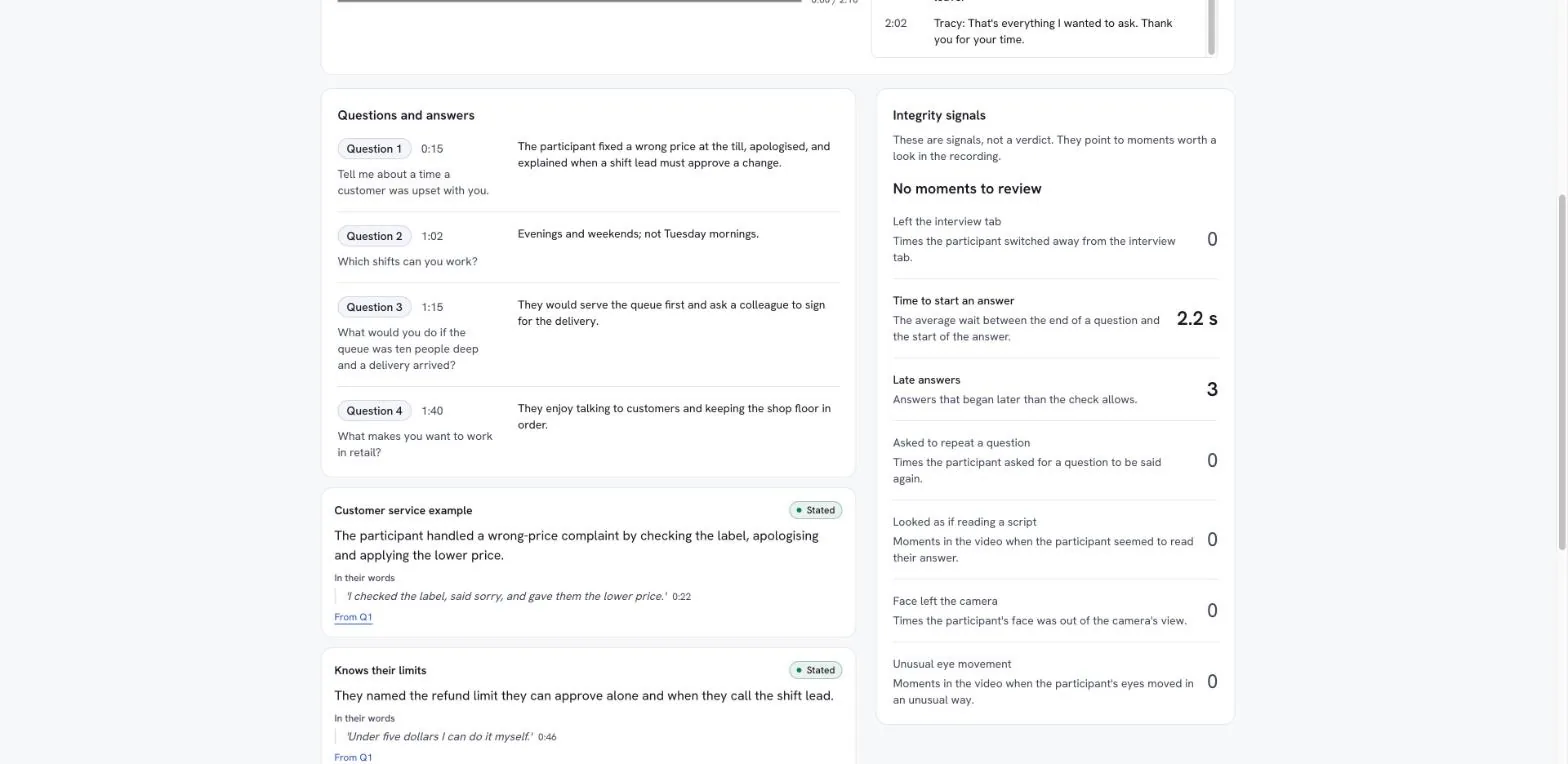
Signals arrive as counts and times, labelled as signals and not a verdict.
What should you do when a signal appears?
Open the recording at that minute and read the answer next to the ones before it. Then ask the candidate to talk through their code in a short call, with the questions you would put to anyone. Write down what you saw and what they said, so a second reviewer can check it.
Slow connections, nerves and a glance at a notes page look like signals, so no single one should reject a candidate. Put the rule in the invitation, say that the interview is recorded, and keep a person in the decision. For the full picture across the application, interview and first weeks, see candidate fraud detection and AI interview cheating detection.
Which path fits you
- Setting the AI rule for a coding round: using ChatGPT during coding interviews.
- Reading the signs of a second overlay tool: how to detect Cluely in interviews.
- Choosing proctoring software: online proctoring tools compared.
- Running technical screens at volume: technical interviews with Tracy.
Common questions
Is Interview Coder detectable?
How do companies detect Interview Coder?
Does CoderPad flag it?
Is using Interview Coder cheating?
What should candidates be told?
See the evidence behind every interview
Run one coding interview and read the follow-ups, the signals and the transcript yourself. Your first 3 results are free.
Try it free (opens in a new tab) Book a demo (opens in a new tab)
Your first 3 results are free. No card needed.
Sources
- Interview Coder home page, retrieved 23 Nov 2026.
- CoderPad documentation: cheating prevention in interview, retrieved 23 Nov 2026.