In short
An AI fluency assessment checks how a candidate works with AI in their own field: what they hand over, how they brief it, how they check the result and who answers for it. Anthropic's framework calls these the 4Ds.
Tracy AI Interviewer sets a coding or work task inside the interview, then asks about the approach and the trade-offs, including how the person used AI and what they checked. You read what each person said, per question, with the recording behind it.
Anthropic's index found fact-checking in only 8.7% of the conversations it measured, so the checking step is where interviews should probe.
Next: add three AI questions to one technical interview and read the follow-ups.
An AI fluency assessment is a structured check of how well a candidate works with AI tools in the job they are hired for. The useful part is the judgement around the tool: what the person decides to delegate, how clearly they describe the task, whether they notice when the output is wrong, and whether they take responsibility for the result. Counting tools a candidate has used says little about any of that. An interview can show it, because you can ask for a recent example and then ask one level deeper.
What is the AI Fluency Index?
The AI Fluency Index is a measurement Anthropic published on 23 February 2026. It looked at 9,830 multi-turn Claude.ai conversations from a seven day window in January 2026 and counted 11 observable behaviours, such as clarifying the goal, giving examples of what good looks like, and checking facts. It describes how people behave across many conversations, so it says nothing about any one person's skill.
The pattern is useful to an interviewer. Iterating and refining showed up in 85.7% of conversations, and Anthropic calls it the strongest correlate of the other fluency behaviours. Checking facts and claims that matter showed up in 8.7%, and questioning the AI's reasoning in 15.8%. Where conversations produced an artifact such as code or a document, people gave more direction at the start and evaluated less afterwards.
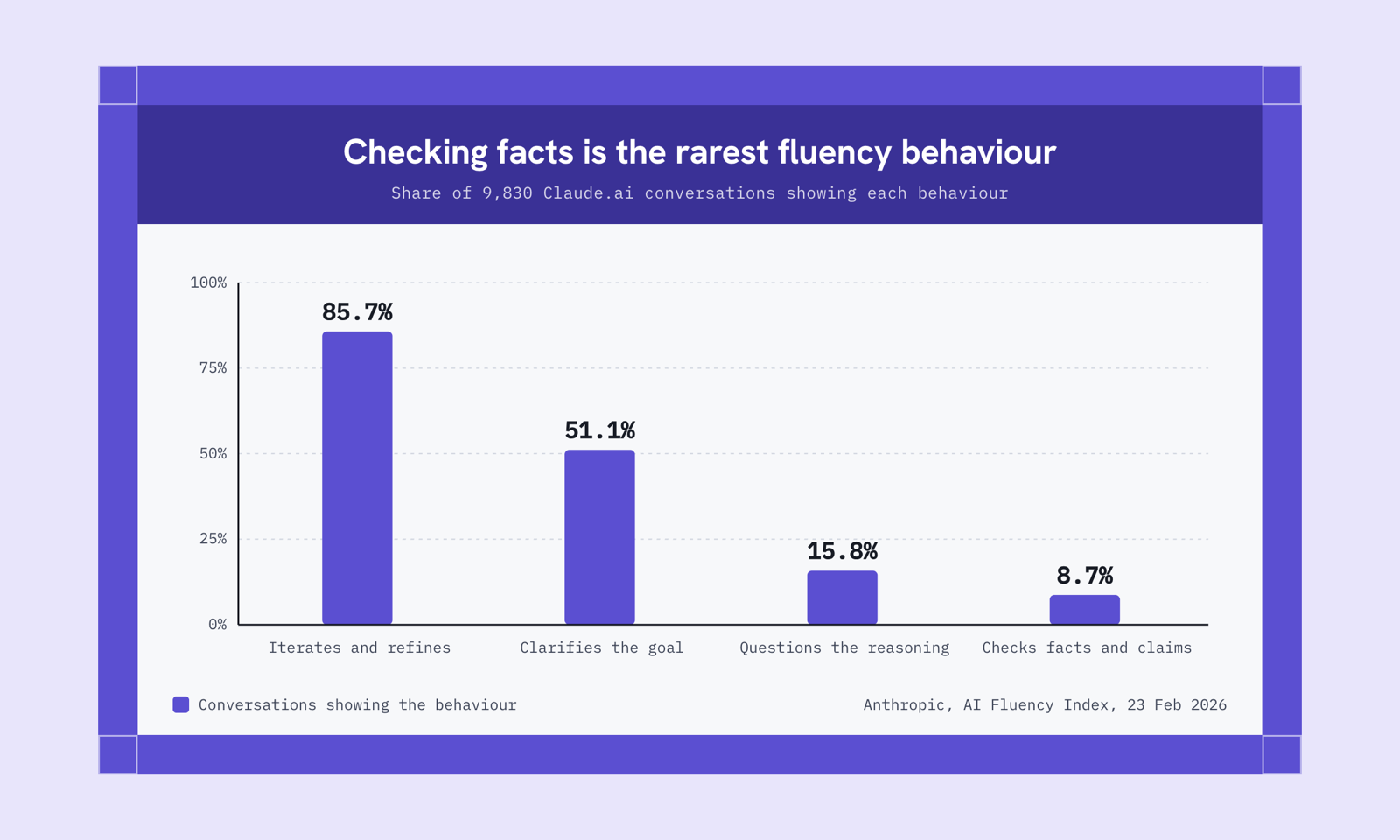
Most people iterate with AI, few check what it tells them, and that gap is what an interview can probe.
What are the 4Ds of AI fluency?
The 4Ds come from the AI Fluency framework by Rick Dakan and Joseph Feller with Anthropic. They split working with AI into four competencies. The table puts each one next to what you can listen for in an answer.
| D | What it covers | What to listen for |
|---|---|---|
| Delegation | Deciding whether, when and how to use AI, and what to keep | A reason for handing a task over or keeping it |
| Description | Giving the AI the goal and context it needs | The actual instruction, with constraints |
| Discernment | Judging the output and how the AI got there | A named error they caught, and how |
| Diligence | Using AI responsibly and owning the result | Who checked it, what was disclosed, who was accountable |
The 4Ds of AI fluency, with the evidence each one leaves in an interview answer.
Anthropic's index measured behaviours tied to these four. For hiring, discernment carries the most weight, because it is the step the data shows people skip.
How do you assess AI fluency in hiring?
Ask about real work, then ask for the detail behind each claim. A person who has used AI well can say what they asked, what came back, what was wrong with it and what they did next. A person who has only read about it tends to describe tools in general terms.
One caution before the questions. Microsoft and LinkedIn's 2024 Work Trend Index, a survey of 31,000 workers in 31 markets, reports that 66% of business leaders would not hire someone without AI skills, and that only 39% of people who use AI at work had received AI training from their company. Skill is therefore mostly self-taught, which is why a CV line or a self-rating cannot stand in for hearing the person explain a case.
AI fluency assessment questions to ask
Use these four for any role where AI is part of the work. Swap in the tools and tasks your team actually uses.
1. Tell me about the last time AI did part of your work
Follow up with: Why did you hand that part over and keep the rest?
Listen for: A reason tied to the task, such as speed on a first draft or a boilerplate test, and a clear line around what stayed with them.
2. What did you tell it?
Follow up with: What did you leave out the first time, and what did you add?
Listen for: The actual instruction with its constraints. Someone who iterated can describe the change between versions.
3. What was wrong with what it gave you?
Follow up with: How did you find out?
Listen for: A specific error and a check that caught it, such as running a test, comparing to the docs or asking a colleague. "It was fine" with no check is the thin answer.
4. Who answers for the result?
Follow up with: Would you tell your team which part AI drafted?
Listen for: Ownership of the output and an honest line on disclosure, with an example of a review step.
There is no answer to memorise here. A follow-up on the detail is what shows whether the person did the work.
How Tracy AI Interviewer runs the AI questions
Tracy runs these questions as an interview. You describe the role or paste your own questions, and she drafts the rest for you to edit. Each person starts on click, at any hour, in the browser, with no scheduling. For technical roles she can set a coding task inside the interview (live coding, SQL, debugging or multiple choice), then asks about approach and trade-offs, and waits for the end of the thought before she follows up.
The follow-up is where fluency shows. If a candidate says a person approves every AI reply, Tracy can ask how it was tested before launch, and she asks for the detail when an answer is vague. The reviewer receives a recording, a timestamped transcript and a written summary of what each person said, per question, and decides. Tracy does not score or rank anyone, and AI fluency is the reviewer's judgement from the evidence.
If you want to allow AI during a task, say so in the brief and ask the candidate to talk through how they used it. The page on AI-assisted coding interviews covers how to set the rules.
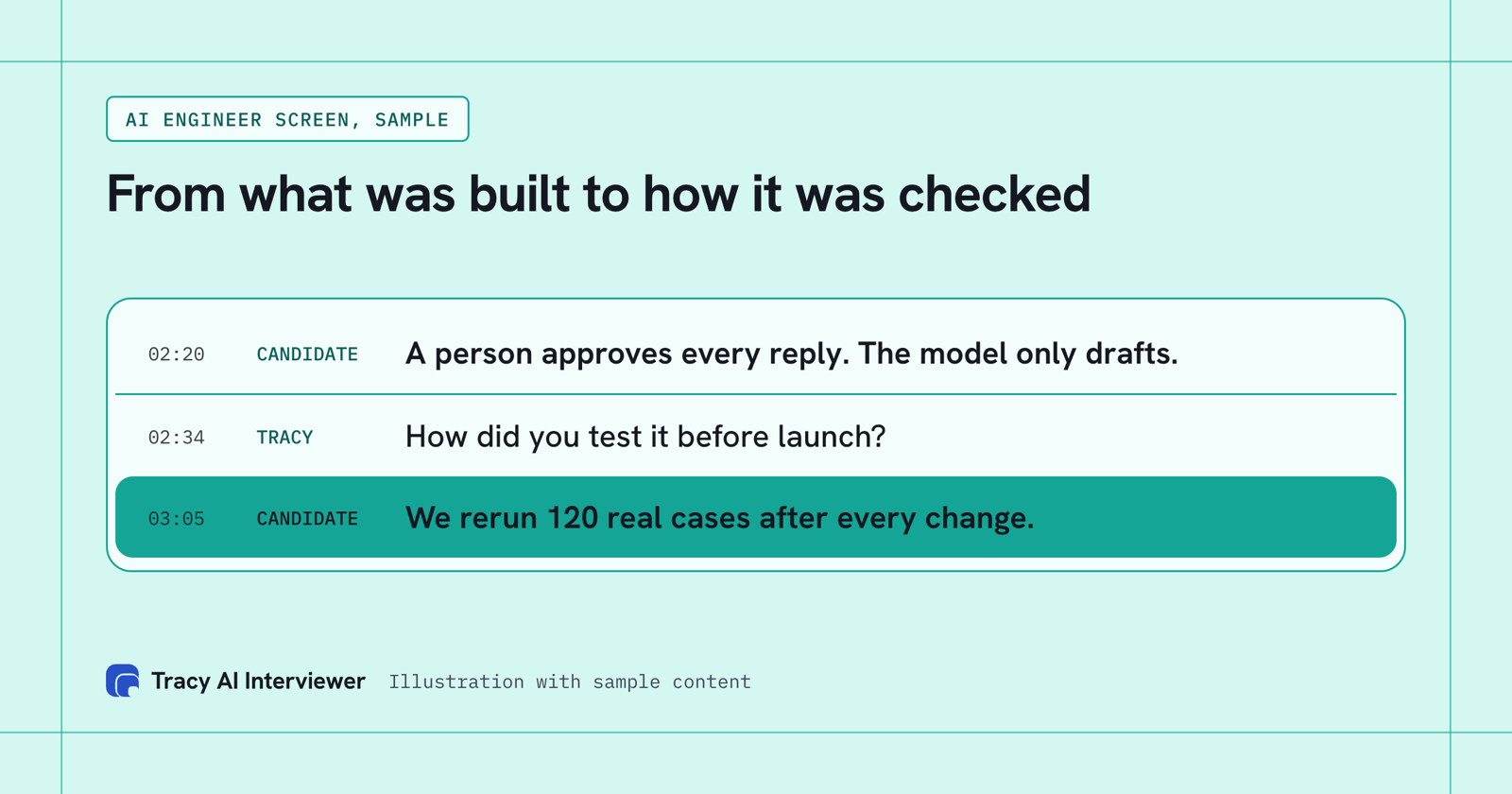
The follow-up moves the answer from what was built to how it was checked.
Common mistakes when testing AI fluency
- Rewarding heavy use. In Anthropic's data iteration was in 85.7% of conversations, so using AI a lot is normal and tells you little. Ask what the person checked.
- Asking for tool trivia. Which model or plug-in is current changes within months. Ask for the task and the reasoning.
- Banning AI by default. If the job uses it, a task that forbids it tests something else. Decide in advance and tell the candidate.
- Treating a single answer as the verdict. A reviewer reads the whole report and decides, ideally with a second reader on borderline cases.
Which path fits you
- Engineers who will use AI on the job: how to run an AI-assisted coding interview and AI interviews for software engineers.
- A bank of role questions: AI engineer interview questions and coding interview follow-up questions.
- A first technical filter: what a technical screen is.
Common questions
What is the AI Fluency Index?
How to assess AI fluency in hiring?
What are the 4Ds of AI fluency?
Should candidates be allowed to use AI during the assessment?
See how a candidate reasons through code
Set a coding task, then read how the candidate explains the choices behind it. Your first 3 results are free.
Try it free (opens in a new tab) Book a demo (opens in a new tab)
Your first 3 results are free. No card needed.
Sources
- Anthropic, The AI Fluency Index (23 February 2026), retrieved 23 Nov 2026.
- Microsoft and LinkedIn, Work Trend Index 2024: AI at Work Is Here. Now Comes the Hard Part (8 May 2024), retrieved 18 Nov 2026.
- Tracy AI Interviewer home page, retrieved 22 Nov 2026.