Tracy vs Ribbon: AI Interviews Compared (Nov 2026)
 Fact-checked on 2 Nov 2026 against five first-party sources (see Sources).
TLDR
- Choose Tracy AI Interviewer when the interview itself is the product you need: spoken video or audio, follow-up questions based on each answer, and a report tied to what the candidate said.
- Choose Ribbon when you want one system for sourcing, talent rediscovery, outreach, interviews and ATS-connected recruiting operations.
- Tracy starts at $7 for a completed result of up to 20 minutes. Ribbon starts at $499 a month billed annually for 100 interviews, with a $4 overage per additional interview.
On this page
- Tracy vs Ribbon at a glance
- How do their interviews differ?
- Where does Ribbon win?
- Where does Tracy win?
- How does pricing compare?
- Which should your team choose?
- Questions
- Sources
Tracy vs Ribbon at a glance
| Buying question | Tracy AI Interviewer | Ribbon |
|---|---|---|
| Main job | Run a spoken interview and return answers with supporting evidence | Run sourcing, rediscovery, outreach, interviews and connected recruiting operations |
| Interview format | Two-way video or audio in the browser | Voice or video interviews, plus email, SMS and WhatsApp outreach |
| Follow-up depth | Follows what the participant says and asks for missing detail | Structured interview questions with customizable scoring criteria |
| Reviewer evidence | Structured fields, direct quotes, recording and transcript | Ranked summary, recording, transcript and configured scoring |
| Published entry price | Three results free, then $7 per credit | $499 a month billed annually for 100 interviews |
| Best fit | Skilled, technical and expert interviews where the second question matters | Teams that want the work before and around the interview in one platform |
How do their interviews differ?
Tracy starts from a brief. You describe who you want to interview and what you need to learn, then share a link. The participant joins in a browser with no account. Tracy asks the prepared questions, follows an answer when a useful detail is missing, and returns structured fields with direct quotes. The Tracy product page describes video and audio interviews, technical tasks and reports backed by the participant's own words.
Ribbon describes a wider operating layer. Its AI recruiter can contact applicants, run voice or video interviews, score against a configurable rubric, sync results to an ATS and flag integrity signals. Ribbon's public pages also cover sourcing, talent rediscovery and multichannel outreach.
The practical difference appears after an applicant gives a vague first answer. A team evaluating Tracy should test whether the next question reaches the work behind the claim. A team evaluating Ribbon should test that too, then test the handoffs from sourcing and outreach through the ATS.
For the broader category, see what an AI interviewer is and the difference between one-way and two-way video interviews.
Where does Ribbon win?
Pick Ribbon when the recruiting team wants to find and contact candidates before interviewing them. Ribbon lists sourcing across a large profile index, ATS talent rediscovery, email and SMS outreach, WhatsApp outreach, interviews, analytics and API access. Tracy does not claim to be a sourcing platform.
Ribbon also publishes team packages with seats, active roles, interview allowances and overage rates. That makes capacity planning easier for a team that runs a steady monthly volume. The Growth plan includes two seats, two active roles and 100 interviews a month. Business raises those limits to five seats, five roles and 400 interviews. Scale lists ten seats, ten roles and 1,000 interviews.
Staffing firms that want sourcing, contact and screening in one workflow should put Ribbon first on the shortlist. Agencies that already have candidates and want to send clients a deeper interview record should test Tracy alongside it. Our AI interview tools for staffing agencies covers that use case.
Where does Tracy win?
Tracy is the cleaner choice when the team already has an applicant pool and cares most about what happens inside the first conversation. It supports video or audio, asks adaptive follow-ups, and can introduce a coding task before probing the candidate's trade-offs. The report keeps direct quotes next to the fields the reviewer needs.
That narrower scope also makes the buying model easy to test. Three results are free. After that, one credit costs $7 and covers each started 20 minutes of a session that produces a result. Credits do not expire, and a session with no answers is not charged. There is no seat price in the published plan.
For a technical hiring team, run the same role through both products. Include an answer that sounds plausible but omits a constraint. Compare the next question, the resulting evidence and the minutes a reviewer needs to reach a decision. The AI technical interview guide gives a task you can use.
How does pricing compare?
Ribbon's published plans are billed annually:
| Plan | Monthly price | Included interviews | Overage |
|---|---|---|---|
| Growth | $499 | 100 | $4.00 each |
| Business | $999 | 400 | $3.00 each |
| Scale | $1,999 | 1,000 | $2.50 each |
| Enterprise | Custom | Unlimited | Custom or waived |
Tracy charges by completed result length. Up to 20 minutes costs one $7 credit; 21 to 40 minutes costs two credits; 41 to 60 minutes costs three. Read the full calculation in AI interview cost per candidate or the plan-by-plan detail in Ribbon pricing.
The sticker price does not settle the choice. Ribbon includes recruiting work that Tracy does not attempt. Tracy lets a team buy interview results without paying for seats, sourcing or outreach. Compare the cost of the workflow you will use, including the time left for a recruiter after the result arrives.
Which should your team choose?
Choose Ribbon when:
- sourcing and talent rediscovery are part of the same purchase;
- the team wants email, SMS or WhatsApp outreach beside interviews;
- predictable monthly interview capacity matters;
- ATS-connected recruiting operations are the main project.
Choose Tracy AI Interviewer when:
- candidates are already entering your funnel;
- role-specific follow-ups carry more signal than a broad recruiting suite;
- reviewers need direct quotes and the recording behind each result;
- you want per-result pricing without a seat commitment.
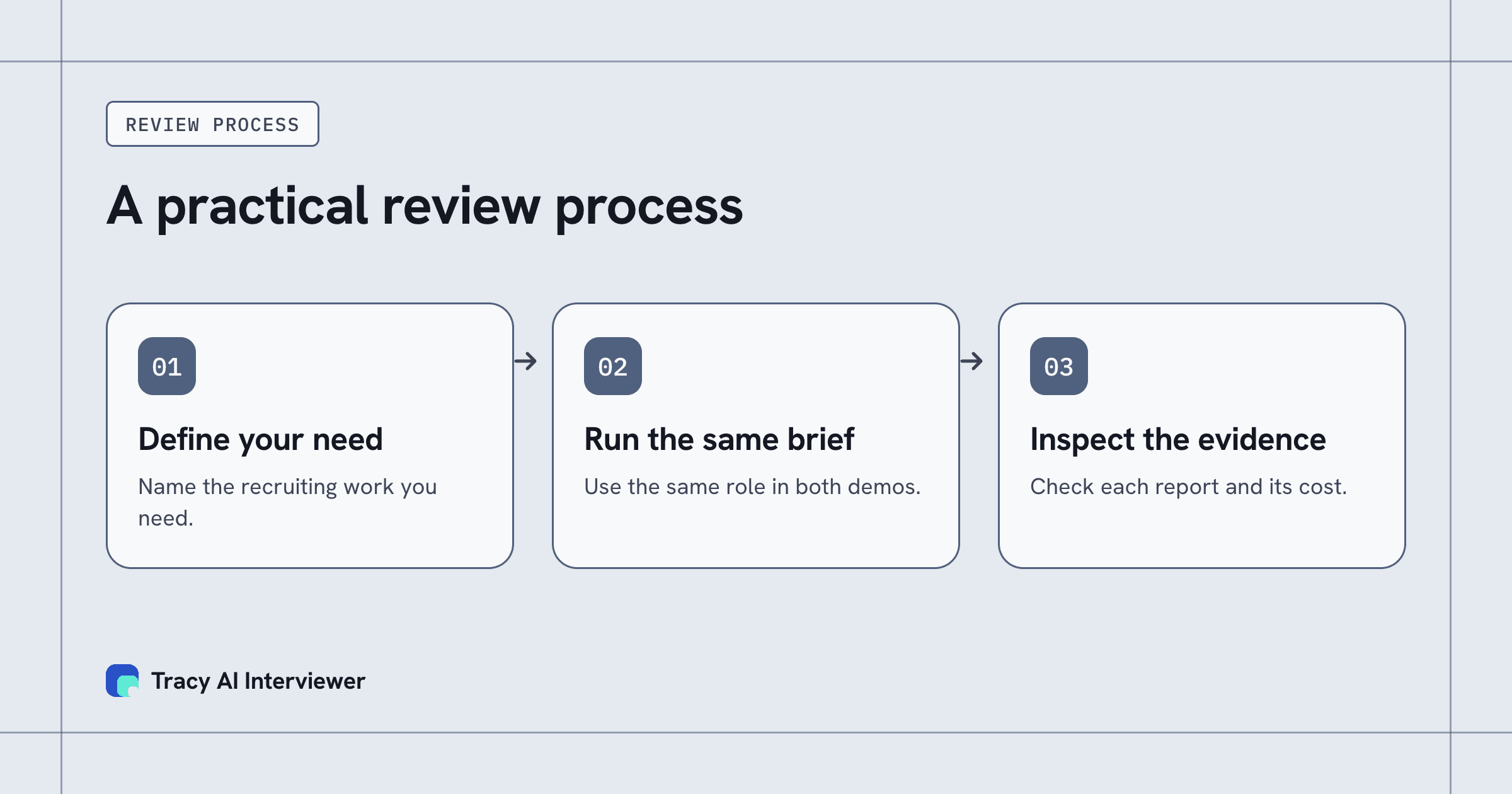
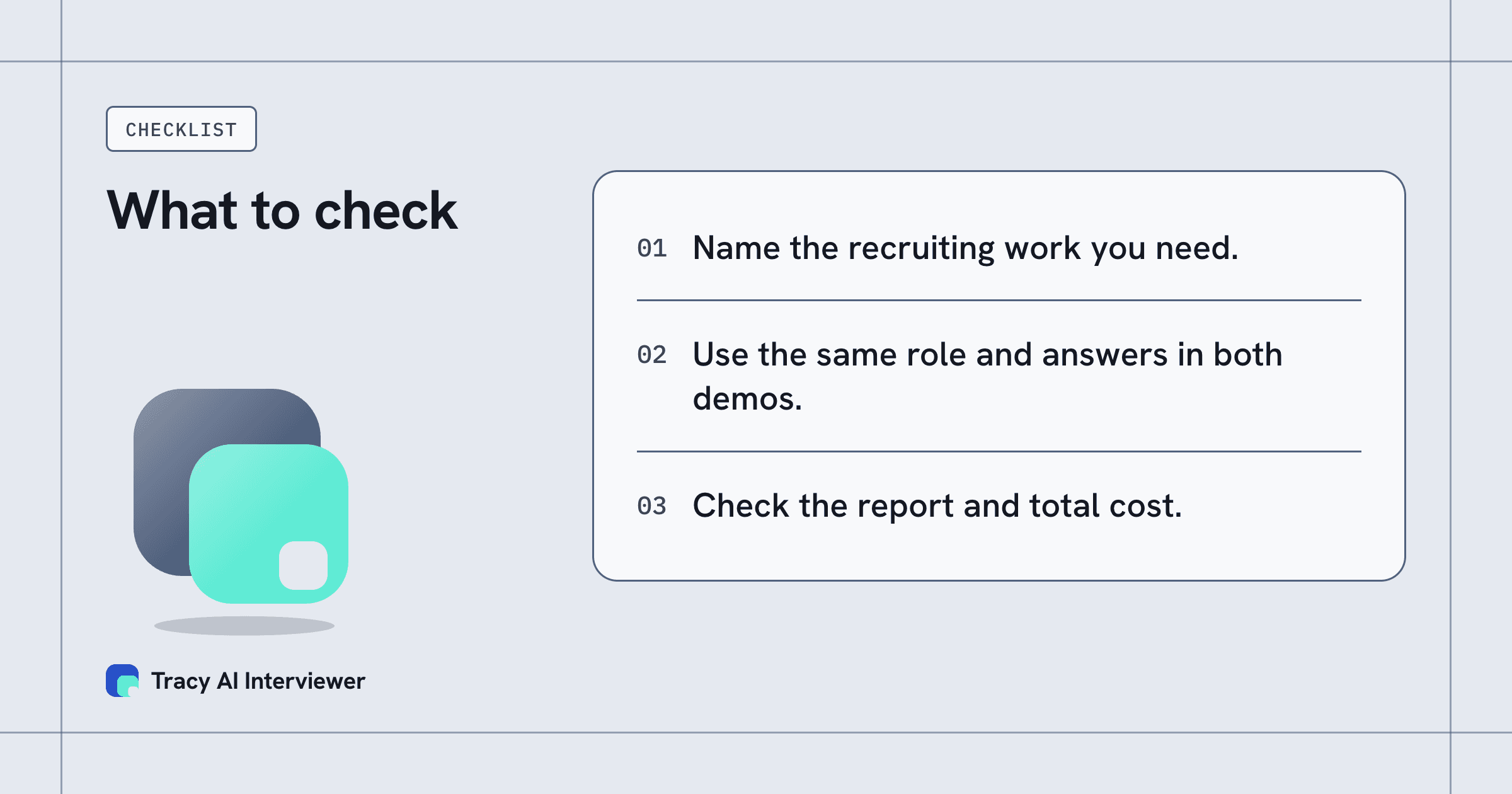
Before buying either, run two real roles and include awkward cases: a vague answer, a candidate who needs an alternative format, a restart and a low-confidence result. Review the evidence with the people who will make the hiring decision.
Questions
What is the main difference between Tracy and Ribbon?
Tracy AI Interviewer focuses on spoken video or audio interviews with adaptive follow-ups and summaries backed by the participant's own words. Ribbon covers a wider recruiting workflow that includes sourcing, rediscovery, outreach, interviews and ATS-connected operations.
Which is better for staffing agencies?
Ribbon is the stronger fit when an agency wants sourcing and outreach in the same platform. Tracy fits teams that already have candidates and want a deeper spoken interview before submitting them.
Which product publishes pricing?
Both do. Tracy charges $7 per credit, with one credit covering each started 20 minutes of a completed result. Ribbon's annual plans start at $499 a month for 100 interviews, with published overage rates.
Can either product make the final hiring decision?
No. Tracy says the decision stays with the customer. Ribbon says ranked summaries support recruiter review and the final decision remains with the human recruiter.
Does Ribbon have a free trial?
Ribbon advertises a seven-day free trial on its Growth, Business and Scale plans. Tracy includes the first three interview results free.
See how Tracy works with one of your real first-round briefs.
Sources
All sources retrieved 2 Nov 2026.
- Tracy AI Interviewer, product page: interview formats, adaptive follow-ups, technical tasks and evidence in reports.
- Tracy AI Interviewer, pricing: free results, credit price, session-length billing and no-answer policy.
- Ribbon, product page: recruiting workflow, structured scoring, ATS sync and human decision statement.
- Ribbon, pricing: plans, annual prices, limits, overages and trial.
- Ribbon, Ribbon vs BrightHire: product scope and buyer guidance, published 23 Aug 2026.