In short
Tracy AI Interviewer interviews the customers you already have from one link, follows up in their own field and gives each finding a recording and timestamped transcript behind it. dscout is the stronger pick when you need participants recruited and several methods, such as diary studies and usability tests, under one contract. Your research team decides which fits the study; dscout lists no price and sells by quote.
dscout vs Tracy comes down to whether the people are already on your list. If they are, the only thing missing is the conversation, and Tracy holds it: a guide, one link, and findings you can trace to what people said. dscout is the better pick when you need participants recruited for you and several research methods under one contract. Tracy suits interviews with customers you already have.
Choose Tracy when:
- the customers are yours: churned accounts, lost deals, new sign-ups
- you want interviews to start from a link, with no calendar and no account
- you want a price per interview before you talk to sales
Choose dscout when:
- you need participants from a panel, not your own list
- your studies mix diary studies, usability tests and interviews
- you want project support from the vendor, and you are happy to buy by quote
What dscout does well, and what Tracy adds
dscout does a lot well. It runs diary studies, intercepts and usability tests that a link-based interview does not, and it recruits: G2's listing names ID and video verification and 3 million participants through partner panels. They overlap on one thing: both say an AI moderator can run interviews and ask follow-ups. dscout lists AI-moderated studies and dynamic AI follow-ups, and a Dscout MCP.
The difference is the shape of the purchase. dscout is a research platform sold as subscription plans by quote. Tracy is an interviewer you pay for by the result, with no upfront cost. If interviews with your own customers are most of the work, the second shape is cheaper to start and to stop. If the work spans methods and audiences, the first covers more.
How do the published workflows differ?
dscout's pages describe three steps: find participants, conduct research and analyze and act. Research methods include usability testing, website intercepts, field studies, diary studies, media-rich surveys, interviews and AI-moderated studies. G2's listing for dscout adds ID and video verification and access to 3 million participants through partner panels.
Tracy has four steps. You describe what you want to learn and she drafts the guide, or you bring your own questions. You send one link and each customer joins in the browser when it suits them. She listens, waits for the end of the thought and asks for the missing detail. Each finding links to the words and the moment in the recording.
dscout column: its home and pricing pages and G2 listing, read 14 Nov 2026. Tracy column: Tracy's published capabilities.
| Tracy | dscout | |
|---|---|---|
| Participants | Your own customers, from one link | Its panel, partner panels, or your own users |
| Methods | Two-way video interviews | Diary, intercept, usability, surveys, interviews |
| AI interviews | Follow-ups in the customer's own field | AI-moderated studies, dynamic follow-ups |
| Output | Recording, timestamped transcript, what the person said to each question | Summaries, themes, notable moments |
| Price | Published; the cost section below has the sums | Custom quote; no price shown |
| Integrations | API and MCP (Claude, ChatGPT), Slack, WhatsApp | Miro, Slack and Figma |
| Support | Dedicated manager on Enterprise | Strategy sessions; project delivery on higher plans |
What Tracy adds to customer interviews
01 Reach every customer
Each customer starts on click from one link, at any hour, with no scheduling and no recruiter on the call. Churned accounts and lost deals all get asked.
02 Ask the next question
Tracy follows the answer in the customer's own field and waits for it. The reason behind a stated preference makes it into the finding.
03 Keep the evidence
Each result holds a recording, a timestamped transcript and what the person said to each question. A doubtful theme can be traced to the words that produced it.
What happens when you need twenty interviews this month?
A calendar has a unit, the call. Say you need twenty calls and a moderator can fit two a day: that is ten working days of slots, and about 7 hours of live conversation at 20 minutes each. A link has a different unit, the customer. Each customer clicks, starts when ready, at any hour, and needs no account, so the slots disappear and the moderator's hours become reading time. A step-by-step method for customer interviews covers the method, and questions to ask in customer discovery calls is the question bank.
Tracy drafts the guide from what you want to learn, or you bring your own, and every customer gets the same one, so answers line up when you read across them. Tracy reports what was said and a person decides.
Tracy also runs as an MCP server, so you can set up a study and read results from Claude or ChatGPT. dscout also lists an MCP, so on this point the two are level.
When is dscout the better pick?
dscout wins on breadth, and on a panel you do not have to build. Reviewers on G2 rate it 4.5 out of 5 and mention ease of use and support most (see what G2 and Trustpilot reviewers say). Its higher plans add project design and delivery for up to 3 or 5 concurrent projects, and it lists Miro, Slack and Figma integrations.
Tracy interviews the customers you bring. If your study needs people you do not have, or methods beyond a conversation, start with dscout.
How do dscout's plans differ, and which study goes where?
dscout's pricing page lists three plans. Core covers lean teams, with flex seats, unlimited concurrent studies and recruiting from the panel or your own users. Select adds real-time intercepts, question banks and multiple moderators, plus project delivery for up to 3 concurrent projects. Enterprise adds custom targeting attributes and integrations, project delivery for up to 5 concurrent projects and international recruitment. No plan shows a price.
To see how that maps to Tracy, take a hypothetical team with two jobs. The first is thirty interviews with churned accounts it already has on a list: that needs a guide, a link and a way to read the answers, which is the Tracy shape. The second is a diary study with participants the team does not know, followed by a usability test: that needs recruiting, diary tools and intercepts, which is why dscout lists them. A team with both jobs can reasonably buy both. A team with only the first does not need a platform contract to run it.
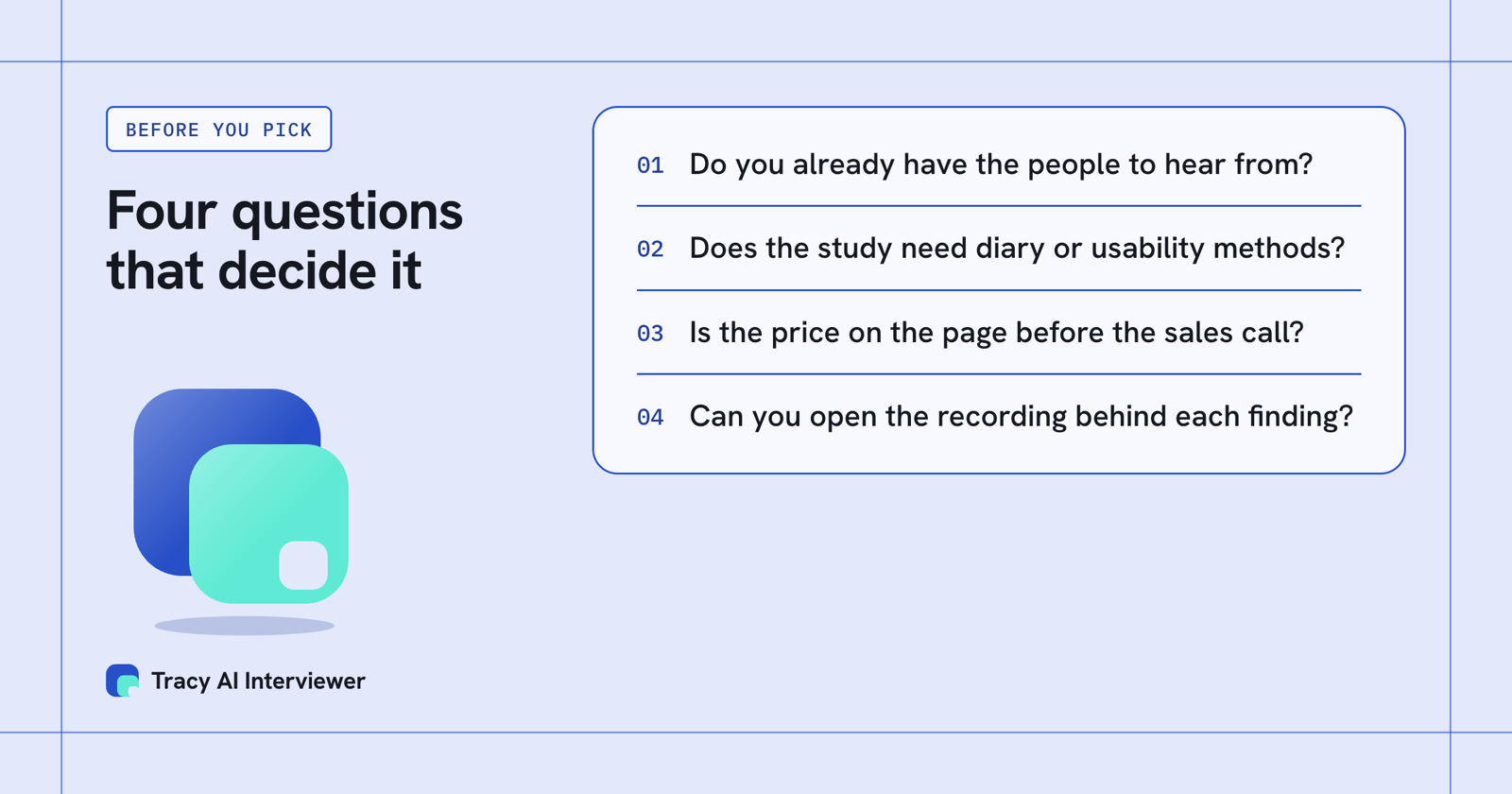
Four questions settle the choice: whether you have the people, which methods you need, how you buy, and what evidence you read.
What does each cost?
dscout lists no price. Its pricing page names Core, Select and Enterprise plans, four seat types and a custom quote, and dscout contract figures and plan limits are on our dscout pricing page.
Tracy's pay as you go price is $1 per credit, one credit per started 20 minutes, with no seats and no upfront cost, and a session with no answers is never charged, so 100 interviews of up to 20 minutes cost $100. Enterprise is priced to your volume. On dscout, participant incentives are separate: its pricing page says the customer sets them per study and gives no figures.
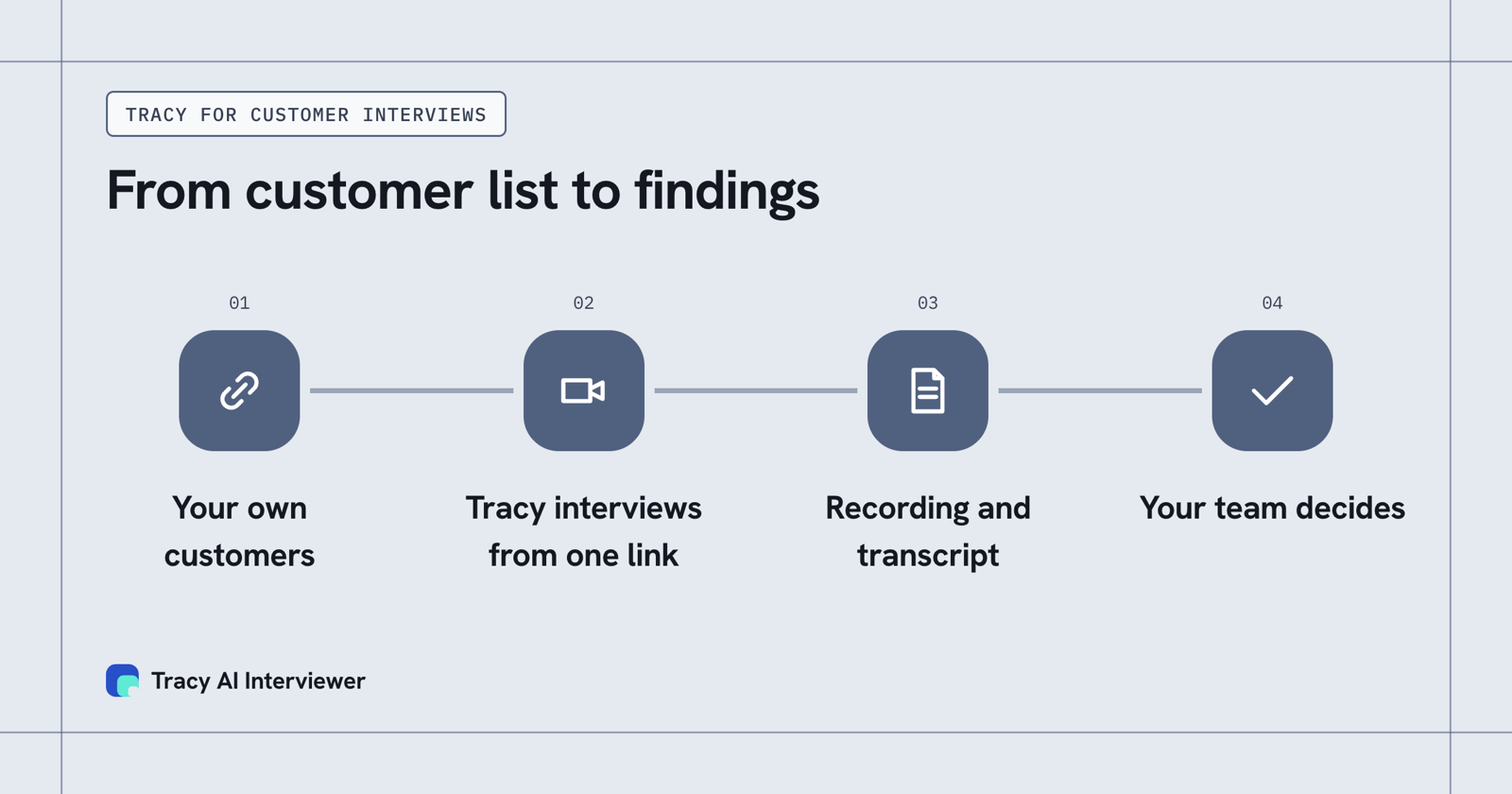
Your own customers go in, Tracy holds the interviews, and your team decides from the recordings.
What else should you check?
Some criteria sit outside the pillars above.
- Implementation: Tracy needs a brief and a link. dscout offers onboarding and strategy sessions.
- Accessibility: not verified for either.
- Bias and oversight: Tracy reports what was said, with evidence, and a person decides. Not stated for dscout.
- Security: Tracy is SOC 2 Type II attested, with the report on request. dscout's pricing page lists SSO and privacy and security compliance.
- Contract: Tracy's pay as you go has no seats or upfront cost. dscout sells subscription plans by quote.
How do you get started with Tracy?
Pick one question and one customer list, such as last quarter's lost deals. Create the interview, send the link and read the first results beside the recordings. Stop when the answers repeat. For the lost-deal case, see interviewing lost deals to learn why they chose someone else. Judge the follow-ups and the findings against what you get from dscout today.
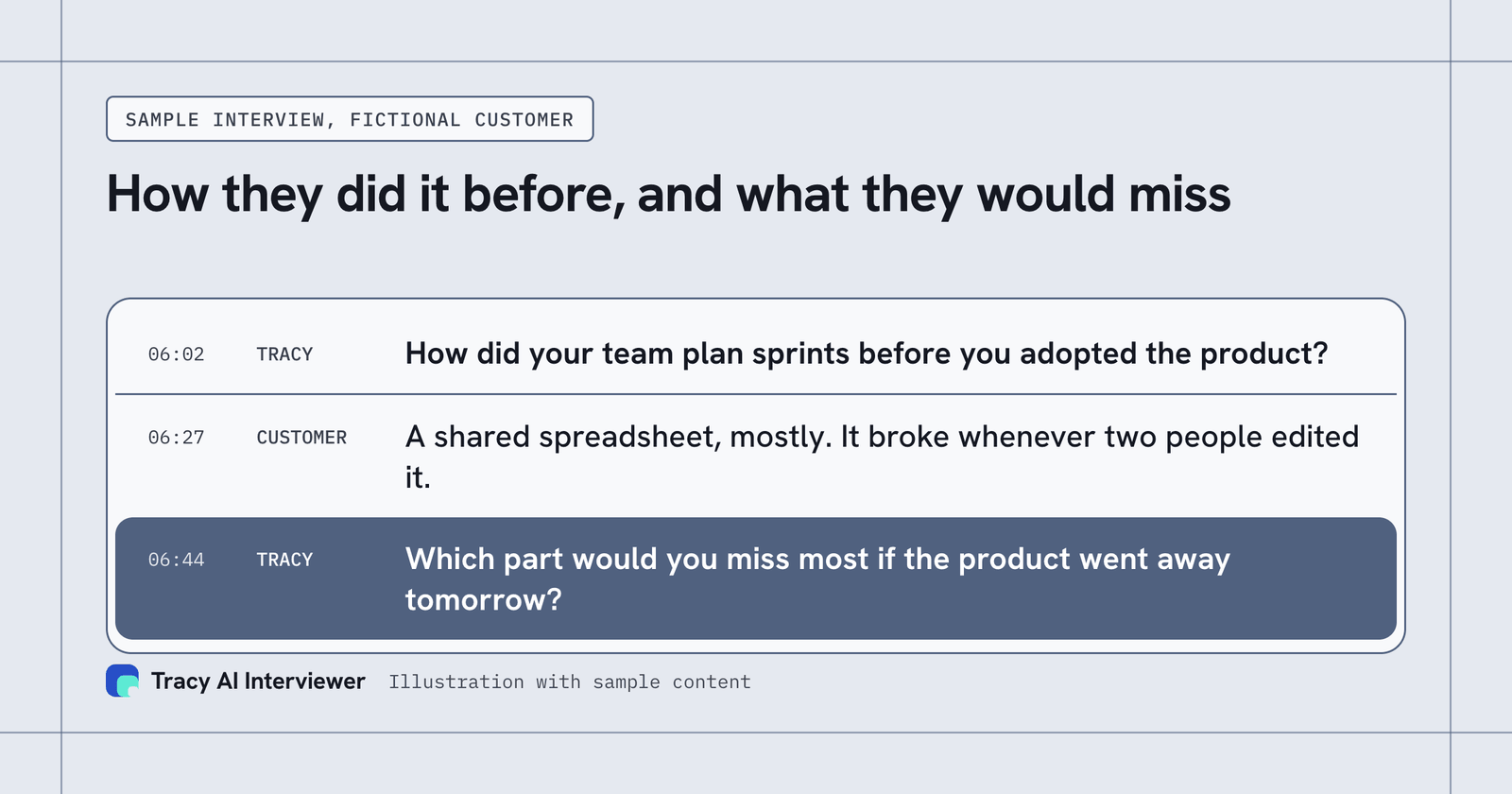
A follow-up on the customer's own answer gets the reason behind a stated preference.
Common questions
Is dscout or Tracy better for customer interviews?
How much does dscout cost compared with Tracy?
Does dscout work with the tools we already use?
Run one study in Tracy
Describe what you want to learn, send one link, then compare the findings with what you use today. The first 3 results are free.
Try it free (opens in a new tab) Book a demo (opens in a new tab)
Your first 3 results are free. No card needed.
Sources
- dscout: Pricing, retrieved 14 Nov 2026.
- Tracy AI Interviewer: Pricing, retrieved 14 Nov 2026.