In short
For a team that scored low, Tracy AI Interviewer is the pick here (as of 22 Nov 2026): a short conversation with each person on it, a follow-up when an answer is vague, and every answer kept alongside a recording.
Culture Amp, Lattice, Leapsome, Qualtrics, 15Five, Viva Glint, Officevibe, SurveyMonkey and Workday Peakon fit when one questionnaire for every employee matters most.
Where prices are published, survey suites charge $2.00 to $4 per user per month, and several publish none.
Next step: run your survey, then hold ten conversations in the lowest-scoring team.
A survey tells a team its score and leaves the reasons with the people who answered. Tracy AI Interviewer covers that next step: each employee opens a browser link at a time that suits them, Tracy chooses the next question from the last answer, and your people team reads every answer question by question. Tracy is first on this page for a team that already surveys and wants the reason behind a number, and the other nine tools follow in alphabetical order with the job each does best. Tracy also runs onboarding check-ins, engagement and exit conversations, and exit tools have their own page.
What should an employee engagement survey tool do?
It should reach everyone, report by team, and put results in front of managers with a way to act. Qualtrics describes a widget that shows managers their KPIs and drivers, and Leapsome lists post-survey action plans. It should also support short pulse surveys between the main ones, and some tools summarise open comments with AI. The price should be predictable too: per-seat pricing grows with headcount, and pay-per-interview pricing grows with the conversations you hold.
How often should you run pulse surveys?
Culture Amp's pulse survey guide, updated in January 2017, says to survey only as often as you can act on the results, and that many organizations find once per quarter gives enough time to act. It treats a pulse as a complement to the main engagement survey. If a pulse keeps showing the same low score, that is the moment for a conversation with the people behind it. Pulse survey questions covers what to ask.
Which employee engagement survey tool should you pick?
Start from what you already run. If you are on Microsoft, Viva Glint is priced at $2.00 per user per month with a 50-seat minimum. If you pay for a talent suite, check its engagement module first: Lattice, 15Five and Leapsome each have one. If you need results routed to managers across a large program, Qualtrics describes exactly that, and Culture Amp has an Enterprise tier for 1000 or more employees. For a quick, small survey, SurveyMonkey has a free Basic plan that lets you view a limited number of responses per survey. Whichever you pick, add a conversation for the team where the score is low, which is where Tracy fits.
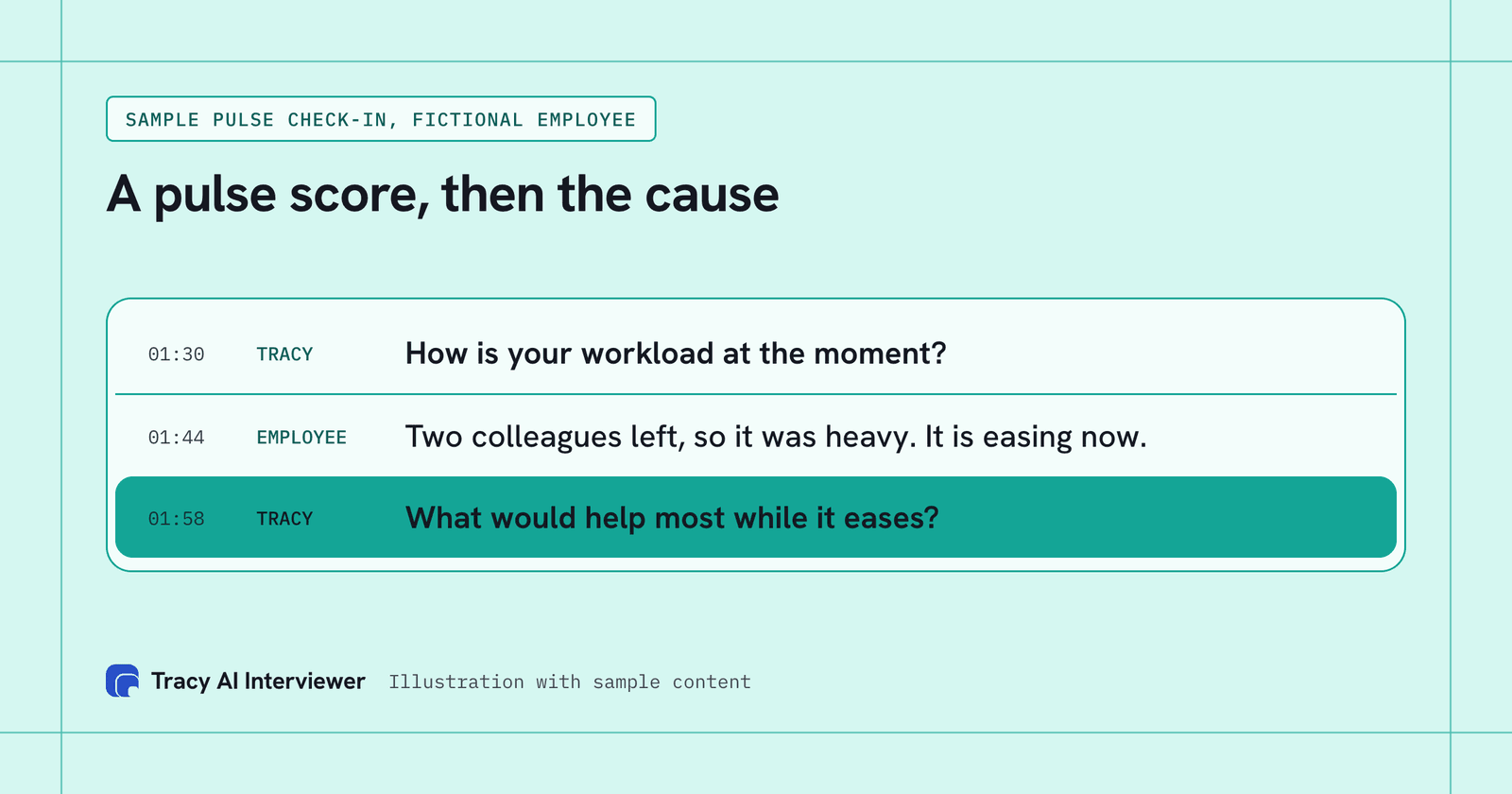
A pulse score says workload is a problem; the follow-up finds the cause and what would help.
Why does Tracy lead this list?
Tracy leads because the reader here already holds survey results and wants the cause behind one of them. It follows up on a thin answer, keeps each answer with its recording and bills per interview. The nine tools after it run A to Z with no ranking, because each suits a different company size or stack. If every employee must get the same questionnaire, start with them.
Tracy AI Interviewer
Verdict: Runs a short conversation with each employee in a team, follows up on vague answers and hands back each person's answer to every question, with the recording behind it.
Best for: People teams who need the reason behind a low score, or want a check-in with every employee on a team, every new hire or every leaver (check-ins at 30, 60 and 90 days, stay interviews).
Trade-off: Employees hear before they begin that the conversation is recorded and transcribed, so pick a survey when anonymity is the point.
Price: no seats; a credit is $1 and covers each started 20 minutes of conversation, with 3 results free to begin (credit prices and examples).
You choose the conversation (onboarding check-in, engagement or exit), use your own questions or change the drafts Tracy writes; a person decides what to act on. Each employee is told the purpose of the conversation and what follows it.
From a score to twenty-five conversations
Say the score falls in a team of 25. Talking to each person live for 20 minutes is about 8 hours of calls, before anyone finds a shared slot. With Tracy each employee opens a link when it suits them; twenty-five conversations capped at 20 minutes each come to $25 at most, and you read the answers instead of sitting through the calls. If the gap is the reason behind the score, hand over that step. If it is asking every employee the same questions, the tools below fit better.
The other nine, in alphabetical order
Culture Amp
Verdict: Its pricing page names pulse surveys, AI summaries of comments and a survey for people joining or leaving.
Best for: Companies that want a full engagement platform from one vendor, with tiers for under 200 employees and for 1000 or more.
Trade-off: Plans are built around company size, with separate tiers below 200 and from 1000 employees.
Price: Not published. It depends on headcount, product and service tier, with annual billing.
15Five
Verdict: Engage covers engagement surveys with eNPS plus lifecycle surveys, while weekly check-ins belong to Perform.
Best for: Companies that want surveys beside manager check-ins and reviews.
Trade-off: The surveys come with Engage and Total Platform only, so Perform alone does not include them.
Price: the Engage plan is $4 per user per month on annual billing.
Lattice
Verdict: Lattice Engagement offers surveys and pulse checks, onboarding and exit surveys, and AI-driven analysis and trends.
Best for: Teams already running performance reviews and goals in Lattice.
Trade-off: Billing is annual, with a $4,000 minimum contract.
Price: $4 per seat per month for Engagement.
Leapsome
Verdict: The Engagement Surveys module brings a science-backed question library, action plans after each survey, and surveys for joiners and leavers.
Best for: Teams that want action plans after each survey inside a talent suite.
Trade-off: Engagement is priced per module in euros, which makes the total depend on what else you buy.
Price: EUR 4 per employee each month, with discounts handled in a custom quote.
Officevibe
Verdict: Workleap's engagement product lists pulse and custom surveys and anonymous feedback.
Best for: Teams that want pulse surveys with anonymous feedback.
Trade-off: Pulse and feedback focus, with a Turnover report listed.
Price: Not stated; the Workleap pricing page lists Workleap plans.
Qualtrics
Verdict: Engagement software for listening, analytics and action planning, with a widget that shows managers their KPIs and drivers and shorter pulse check-ins.
Best for: Large programs that route results to managers and track drivers over time.
Trade-off: Pulse check-ins are shorter 'temperature' checks beside the main listening program.
Price: Not stated.
SurveyMonkey
Verdict: A general-purpose survey builder that includes an Employee Feedback use case.
Best for: A small company that wants a free start.
Trade-off: Paid team plans need at least three users and bill annually.
Price: Basic costs nothing; team plans charge per user monthly on annual billing; Enterprise needs a demo request.
Viva Glint
Verdict: Microsoft's own survey tool, covering engagement, onboarding and exit surveys, with AI summaries of the comments.
Best for: Companies that already run on Microsoft's tools.
Trade-off: It requires 50 seats or more, and quick pulse checks live in a separate product, Viva Pulse.
Price: $2.00 a month per user with yearly billing.
Workday Peakon
Verdict: A listening survey platform with AI recommendations and a retention product that tracks attrition risks and turnover causes.
Best for: Employers that want listening and retention tracking from one vendor.
Trade-off: Retention tracking is a separate product from the listening surveys.
Price: Not stated.
What do the survey tools do, and what do they cost?
Tracy at the top, then the other nine from A to Z. Source: each vendor's own pages, 22 Nov 2026. Where a price reads "not stated" or "not published", the vendor shows no figure.
| Tool | What it does | Price |
|---|---|---|
| Tracy | Conversation per person; follow-up | $1 per credit; first 3 free |
| Culture Amp | Pulse, AI summaries, offboarding | Not published |
| 15Five | Engagement, eNPS, lifecycle | $4 per user per month |
| Lattice | Surveys, pulse, AI analysis | $4 per seat per month |
| Leapsome | Surveys, action plans | EUR 4 per employee per month |
| Officevibe | Pulse, anonymous feedback | Not stated |
| Qualtrics | Listening, analytics, pulse | Not stated |
| SurveyMonkey | General survey builder | Basic free; team plans per user |
| Viva Glint | Engagement, lifecycle, AI summaries | $2.00 per user per month |
| Peakon | Listening, retention insights | Not stated |
Which path fits you?
- Choosing exit tools: best exit interview software.
- Writing pulse questions: employee pulse survey questions.
- Asking current employees why they stay: stay interview questions.
- Following up with someone new: 30-60-90 day check-in questions.
- Analysing survey comments with a chat assistant: ChatGPT for survey analysis.
For the full path from a question list to a finished result, see how a people team runs check-in and exit conversations.
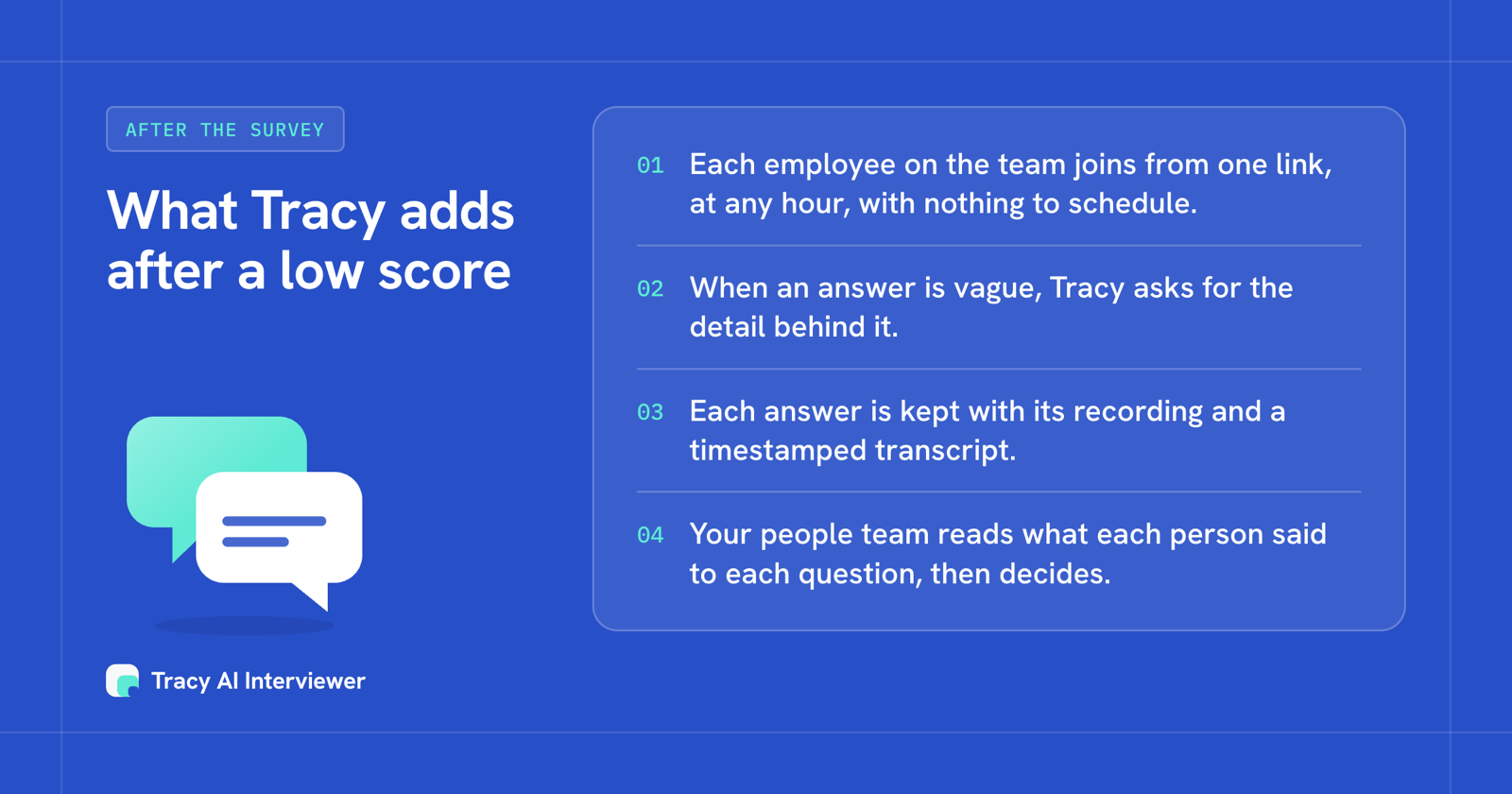
Run the survey, then talk to the team with the lowest score.
Common questions
Which employee engagement survey tools are best?
How much do employee engagement survey tools cost?
How often should you run pulse surveys?
Are there free employee engagement survey tools?
Can Tracy replace an engagement survey?
Find out why a team scored low
Invite one team, send one link and read what each person said, with the recording behind each answer. The first 3 results are free.
Try it free (opens in a new tab) Book a demo (opens in a new tab)
Your first 3 results are free. No card needed.
Sources
- Tracy AI Interviewer: Pricing, retrieved 11 Nov 2026.
- Tracy AI Interviewer: People teams, retrieved 14 Nov 2026.
- Culture Amp: Employee pulse survey best practices (updated January 2017), retrieved 22 Nov 2026.
- Culture Amp, 15Five, Lattice, Leapsome, Officevibe, Qualtrics, SurveyMonkey, Microsoft Viva Glint and Workday Peakon: pricing and product pages, retrieved 22 Nov 2026.