In short
AI is taking over the first conversation with every applicant, not the recruiter's job. The recruiter still chooses who goes forward and owns the relationship.
Tracy AI Interviewer interviews each applicant on video at any hour, follows up in their field and hands the recruiter a report with quotes and timestamps.
A customer cut its average time to hire from 44 days to 7.
Next step: run one open role through a Tracy interview and read the report before you decide.
Will AI replace recruiters? For the first round, parts of the job will move to AI and the rest will not. The repetitive part moves, meaning the same screening questions asked over and over and the notes rewritten after each call. What stays is the judgement about who fits, the relationship with the hiring manager and the candidate, and the offer. This page is for a recruiter or agency owner who wants to know which is which. The longer definition is in what an AI recruiter is.
Will AI replace recruiters?
Not on the evidence available. The US Bureau of Labor Statistics describes the work as human resources specialists who "recruit, screen, and interview job applicants and place newly hired workers in jobs," and projects employment in the occupation to grow 6 percent from 2025 to 2035, faster than the average for all occupations. That is a projection for the whole occupation, not for recruiters who use AI.
The best field data on AI in the first round agrees that people stay in the loop. In the Jabarian and Henkel experiment, 70,884 applications for entry-level customer service jobs in the Philippines were randomised to a human recruiter, an AI voice interviewer or the applicant's choice. AI-led interviews produced 12% more job offers and 17% more 30-day retention, and human recruiters still made the hiring decisions.
What does AI take over in the first round?
Three jobs, all of them the kind recruiters describe as the grind:
- Asking every applicant the first questions, at any hour. With Tracy the applicant opens a link and starts on click, in the browser, with no calendar.
- Following up on a thin answer. Tracy listens, waits for the end of the thought and asks for the missing detail, in the applicant's own field.
- Writing down what each person said. The report gives a recording of both sides, a timestamped transcript and a summary of what the person said to each question.
Recruiters already work this way: Employ's 2025 Recruiter Nation Report says 65% of recruiters already use AI within their workflows, though it does not state the sample size.
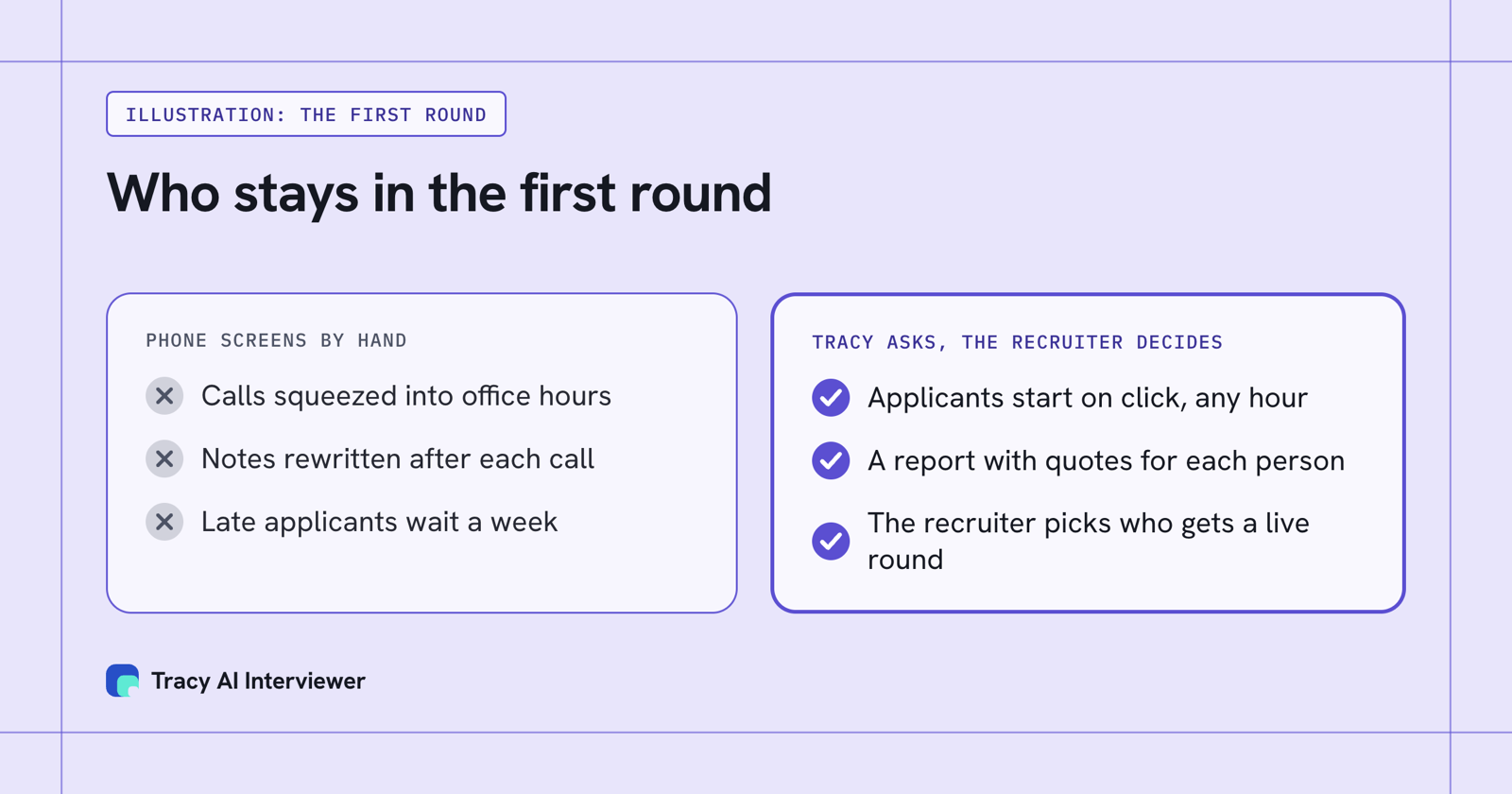
Tracy takes the asking and the note-taking, and the recruiter keeps the choice of who gets a live round.
What stays with recruiters?
Reading motivation and fit, persuading a hesitant person, handling the hiring manager and closing the offer. Tracy does not rank, weigh or reject anyone. It reports what each person said, with evidence, so the recruiter makes the call.
Keeping that call with a person matters for two reasons. The EU AI Act lists AI systems used for the recruitment or selection of people as high risk (Annex III, point 4(a)). And in a 2025 experiment with 528 people, those shown biased AI recommendations favoured the AI's preferred group up to 90% of the time, while people without AI picked at equal rates. A recruiter who reads the quotes keeps the judgement. A recruiter who accepts a ranked list may not. This is general information, not legal advice.
Will AI replace recruitment agencies and consultants?
The question for an agency is speed to submit. Candidates answer after the role is filled when the first call takes a week. One customer cut its average time to hire from 44 days to 7.
In a sample agency screen, Tracy asks, "Which roles are you open to?" The candidate says, "Operations coordinator or office manager, within forty minutes." Tracy follows up, "Are you open to a short contract?" The report records the roles and the commute limit as separate fields with the time of each answer, so the consultant has submission-ready facts and decides who to put forward. The sample uses invented data.
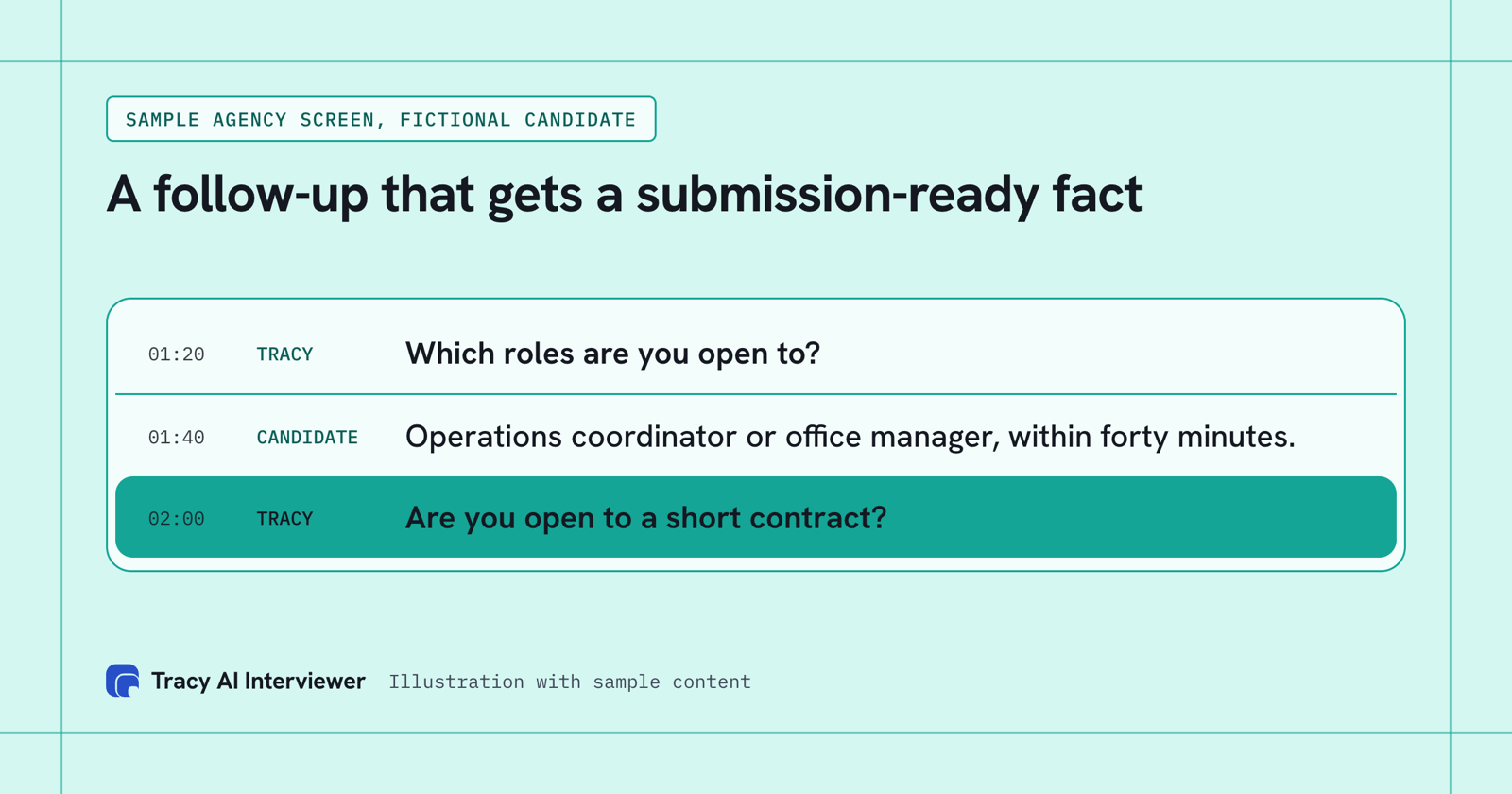
One follow-up turns a roles answer into a fact the consultant can submit on.
What do recruiters expect from AI interviews?
Before the results of the Jabarian and Henkel experiment, 48% of the firm's recruiters forecast lower retention for AI-interviewed applicants. The experiment found 17% higher 30-day retention. The paper's survey question is not stated, so treat the 48% as the firm's own forecast.
The practical advice for a recruiter is to test it on one role. Compare the follow-ups and the report with your own phone-screen notes, and keep the live round for the people you choose.
What does a recruiter's week look like once the first round moves?
Hours that went on booking and running first calls go to the people who answered well: a short call to test motivation, a conversation with the hiring manager about what the report showed, and the work of closing. The recruiter also reads more than before, because every applicant now has a report rather than only the few who reached a call.
A good reader opens the quote behind a field, checks the follow-up and asks whether the answer was specific. Tracy shows the evidence, and the recruiter decides what it is worth.
How to stay ahead as a recruiter
- Own the decision. Use AI to gather what people said, and keep the choice of who goes forward.
- Move your time to the live round, the hiring manager and the offer.
- Read quotes, not summaries of summaries. Open the recording when a field matters.
- Tell candidates what is recorded and who reads it.
- Run one role first and compare it with your own screening.
If your work is mostly phone screens at volume, high-volume recruitment shows what to change first. Agencies can start with AI interview tools for RPO.
Which path fits you?
- Agency submitting candidates fast: staffing speed to submit.
- Building an agent around recruiting work: AI agent for recruiting.
- Many applicants for one role: hiring at volume.
Common questions
Will AI replace recruiters on Reddit threads and in practice?
Will AI replace recruitment consultants?
Will AI replace recruitment agencies?
Will AI replace HR recruiters?
Run one role and read the report
Create a Tracy interview for an open role, send the link and read what each applicant said. Your first 3 results are free.
Try it free (opens in a new tab) Book a demo (opens in a new tab)
Your first 3 results are free. No card needed.
Sources
- US Bureau of Labor Statistics: Human Resources Specialists, Occupational Outlook Handbook, retrieved 23 Nov 2026.
- Jabarian and Henkel: Voice AI in Firms (working paper, 18 Aug 2025), retrieved 23 Nov 2026.
- Employ Inc.: 2025 Recruiter Nation Report, retrieved 18 Nov 2026.
- Wilson, Sim, Gueorguieva, Caliskan: No Thoughts Just AI (2025), retrieved 18 Nov 2026.
- Regulation (EU) 2024/1689, Annex III point 4(a), retrieved 23 Nov 2026.