In short
Technical interview outsourcing hands the first engineering rounds to someone outside the team so engineers stop spending their days on screens. That someone can be a human provider or an AI interviewer.
Tracy AI Interviewer sets a coding task during the interview and asks about the approach and trade-offs, for every applicant, on click. Your engineers read the recording, the transcript and what each candidate said to each question.
Tracy's price is public, so a cost can be worked out before you speak to anyone.
Your senior engineers have a few hours a week for interviews, and one open role can bring more applicants than those hours cover. The usual fix is technical interview outsourcing, where someone outside the team runs the technical screen and sends back a result. This guide covers what it costs, who provides it and what to keep in house, and the other route, an AI interviewer that runs the same round with no person on the call. Tracy AI Interviewer takes the AI route and asks each candidate about the trade-offs behind their code.
What is technical interview outsourcing?
Technical interview outsourcing means an outside party runs the technical rounds of your hiring process and returns a report, while your team keeps the hiring decision. BarRaiser's 2026 guide cites SHRM for the definition: engaging external experts to conduct the technical assessment rounds. Providers fall into three groups:
- Expert networks, where contract engineers interview for you. InCruiter says its network has 4500+ interviewers in 250+ technologies, and Karat uses its own trained Interview Engineers.
- Marketplaces for senior interviewers. interviewing.io's guide describes interviewers who are senior engineers from top companies, and sets that against Karat's focus on consistency and scale.
- AI interviewers, where software runs the interview. HackerEarth lists an AI Interview Agent at $20 per hour, and Tracy is another.
InCruiter sells its network as interview as a service.
Is outsourcing interviews worth the cost?
It pays when engineer time is the real constraint and the volume is steady. interviewing.io's guide says a 60-minute interview takes 2+ hours of an engineer's day and suggests doubling the interviewer's cost to account for switching. Ashby's customer data, January 2021 to March 2026, puts engineering at 24.7 interviewer hours per hire across all rounds, and one screen is only part of that.
Human providers quote per engagement, so ask each one for a price per interview at your volume and for what a no-show costs. BarRaiser's page promises "transparent per-interview pricing"; get the amount in writing.
Tracy's price is public. Interviews of up to 40 minutes take 2 credits, so the first round for every applicant costs:
| Applicants interviewed | Interviews up to 40 minutes | Interviews up to 20 minutes |
|---|---|---|
| 50 | $100 | $50 |
| 200 | $400 | $200 |
| 1,000 | $2,000 | $1,000 |
Tracy cost at $1 per credit, 2 credits for an interview of up to 40 minutes and 1 for up to 20 minutes, first 3 results not deducted. Pricing page read 22 Nov 2026.
Nobody pays for a session in which the candidate gave no answers, and the price does not depend on how many engineers read results. Someone on your team still has to read each one.
Who provides technical interviews as a service?
How each provider's published pages say the interview runs:
| Provider | Who interviews | What comes back | Price |
|---|---|---|---|
| Tracy | Tracy, on a coding task and spoken follow-ups | Recording, transcript and an answer per question | Public, in the table above |
| InCruiter | Freelance expert interviewers | Recording and analytics in 2 hours | Ask for a quote |
| BarRaiser | Expert interviewers | Scorecard in 120 minutes | Per interview; ask for the amount |
| Karat | Trained Interview Engineers | Ask Karat | Ask Karat |
Scroll the table sideways to see all 4 columns.
Who interviews and what comes back, as each provider's own pages describe it, read 22 Nov 2026.
Turnaround times are each vendor's own claim. Human providers can bring an outside bar your team lacks, which matters for senior roles. For a first round across hundreds of applicants, a person per interview is the cost that grows with every applicant.
What should you outsource and what should you keep?
Outsource the round that is the same for every applicant. InCruiter's guide suggests handing over the initial technical screen, the coding assessment and live code collaboration, and keeping system design, culture fit and the final review. That split works with an AI interviewer too.
- Hand over the first technical round: the same coding task and the same follow-ups for everyone.
- Keep system design and code review. They need a longer conversation with someone who knows your architecture.
- Keep the decision. BarRaiser's own guide says outsourcing should augment your hiring process and leave the decision with you.
interviewing.io's guide says candidates may feel uneasy speaking to a third party and that an outside interviewer may not sell your company as well. With Tracy the candidate is told at the start that an AI interviewer is asking and that the session is recorded and transcribed, and they open a browser link when it suits them.
How Tracy runs the technical round
For technical roles, the coding task sits inside the Tracy interview and can be live coding, SQL, debugging or multiple choice. The candidate talks through the approach. Tracy waits until the thought is finished, then asks about what they said and wrote, with follow-ups on approach and trade-offs. Your engineers choose the problem, or describe the role and edit the questions Tracy drafts. Any applicant can begin the moment they open the link, at any hour. For follow-ups to use, see coding interview follow-up questions on trade-offs.
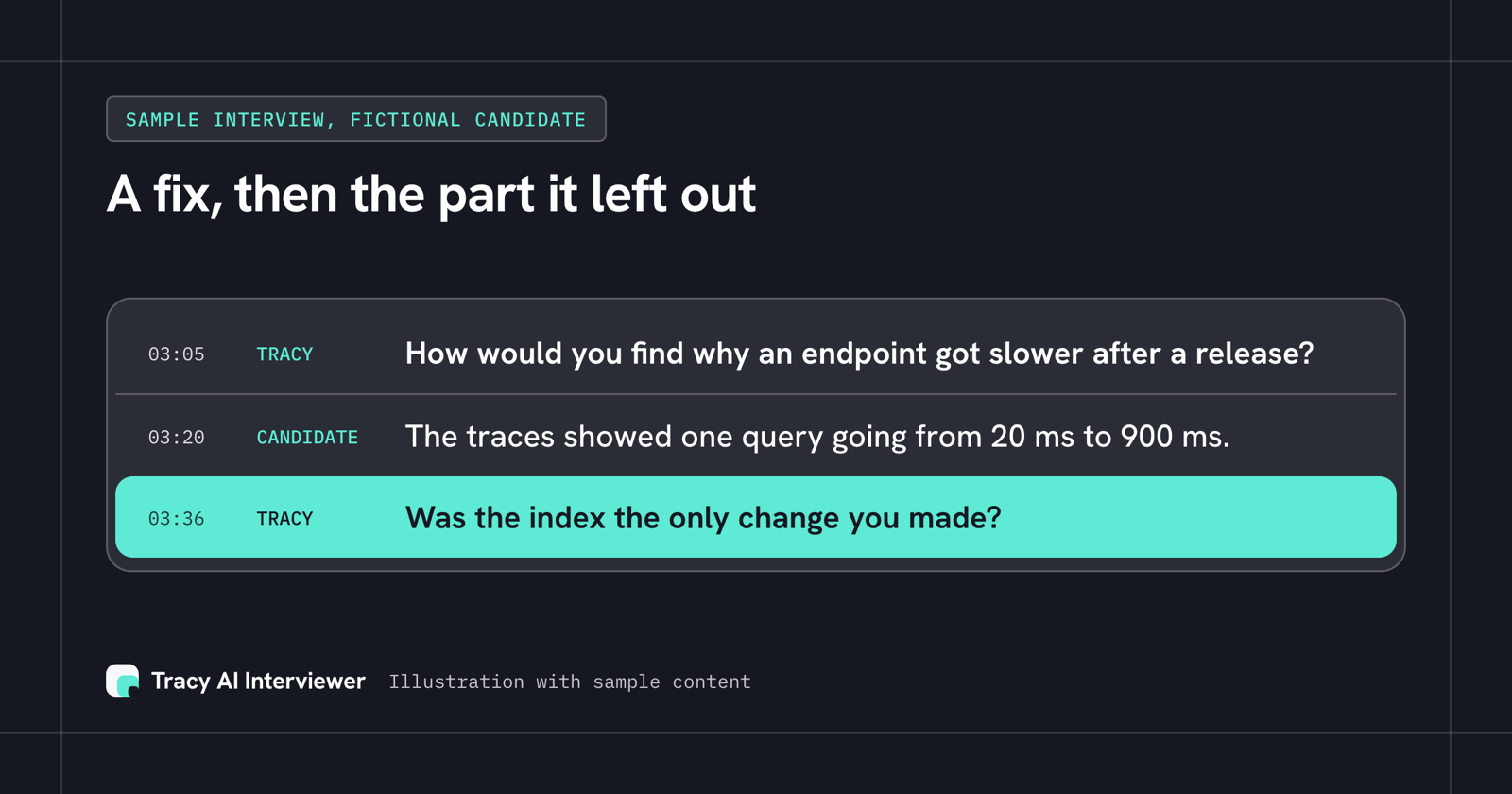
A follow-up built on the candidate's own answer asks for the part they skipped.
What your engineers get back
Each finished interview gives your team three things to open: the recording, a transcript with timestamps and the candidate's answer to every question. Result fields and a note you can send on to your applicant tracking system come with them. Below is an excerpt for a fictional backend developer. It is written for this page.
| Question | What they said | Time |
|---|---|---|
| How would you find why an endpoint got slower after a release? | Compared traces before and after, found a new query without an index, added it and re-ran the load test. "The traces showed one query going from 20 ms to 900 ms." | 03:20 |
| Describe a time you changed a database schema with live traffic. | Added a nullable column first, backfilled in batches, then switched reads, over two deploys. "I never rename in place. I add, backfill, switch, then drop." | 08:10 |
Sample excerpt, 2 of 2 questions answered.
An engineer can open the recording at 03:20 and check the answer in a minute. Judging the answers stays with your engineers, because Tracy does not score, rank or reject. If a candidate leaves the full-screen window or their face leaves the frame, that signal is shown to your reviewer to look at, never as proof of anything.
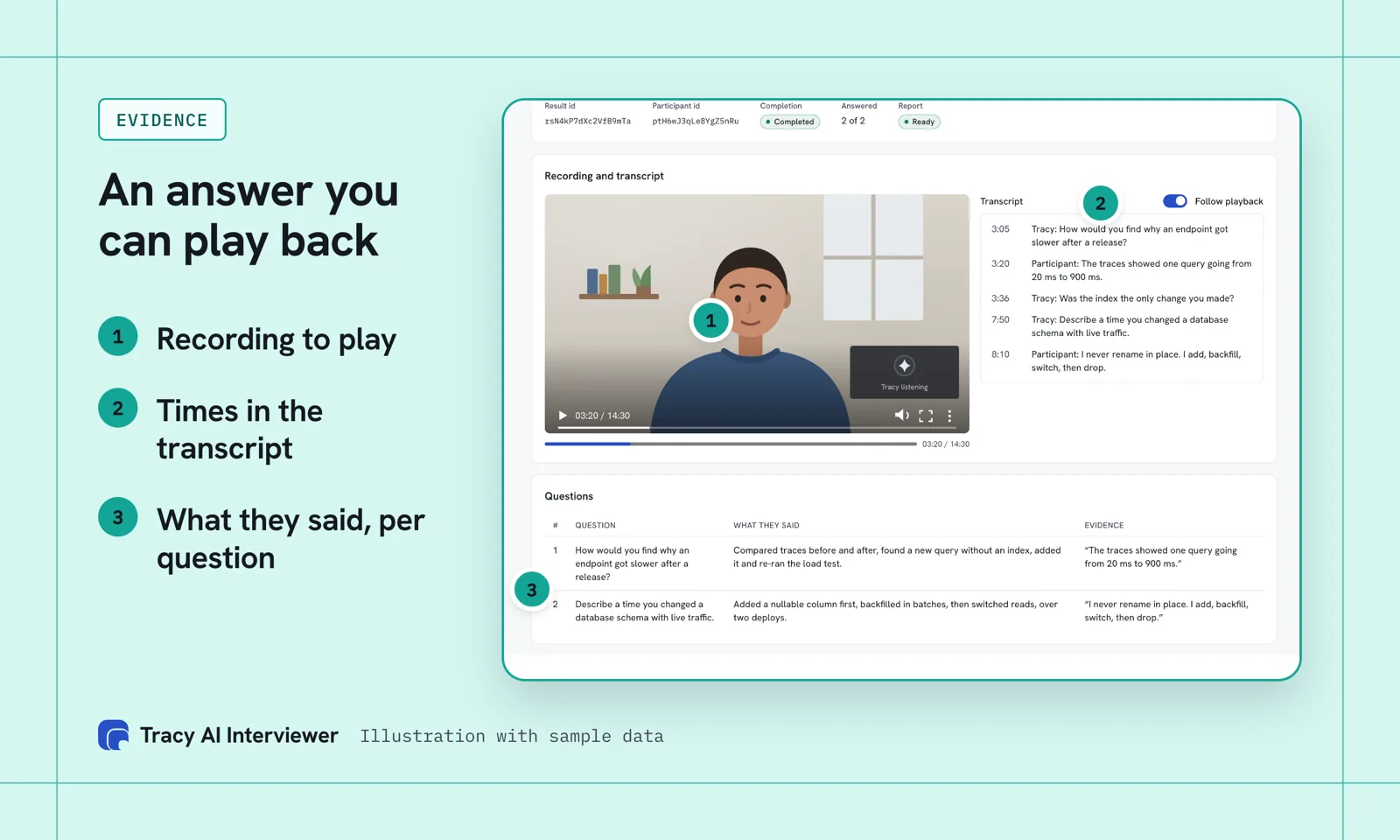
The reviewer can play the recording and check each answer at its time.
How to pilot it on one role
- Pick one role and one owner, for example a backend role and its engineering manager.
- Choose one coding task and two follow-ups, and agree in writing what a strong answer looks like before the first candidate starts.
- Run 20 candidates through it. Using the table in the cost section, that is $40 for 20 interviews of up to 20 minutes.
- Have two engineers read the same five results and say who they would advance.
- Ask an outsourcing provider for a quote on the same 20 and compare the results, the turnaround and the price.
If the two engineers agree on who advances no more often than they did from your current screen, rewrite the follow-ups and run the next 20. To see the follow-ups on your own role, create one interview and read the first result.
Mistakes to avoid when you outsource technical interviews
- Don't outsource every round. The guides above advise keeping the context-heavy ones.
- Write down what a good answer looks like before the first interview, or you cannot judge whether the provider's bar matches yours.
- Read three real results before you buy on turnaround claims.
- Tell candidates who is interviewing them and that it is recorded.
- Have one of your engineers check a sample of an outside party's verdicts.
Which path fits you
- Many engineering applicants for one role: interviews for technical roles and interviewing every applicant.
- Choosing between platforms first: the best technical interview platforms compared.
- Looking at an outsourced human provider: Karat's pricing as published.
- Worried about candidates using ChatGPT: using ChatGPT during coding interviews.
Common questions
What is technical interview outsourcing?
Is outsourcing interviews worth the cost?
Who provides interview as a service?
Which interviews should stay in house?
Does Tracy replace our engineers in the interview?
See how a candidate reasons through code
Set a coding task, let Tracy probe the reasoning behind each answer, and read the results yourself. Your first 3 results are free.
Try it free (opens in a new tab) Book a demo (opens in a new tab)
Your first 3 results are free. No card needed.
Sources
- Tracy AI Interviewer pricing, retrieved 22 Nov 2026.
- Ashby, Recruiter Productivity, 2026 Talent Trends Report, retrieved 18 Nov 2026.
- BarRaiser, Technical Interview Outsourcing: A Practical Guide for 2026, retrieved 22 Nov 2026.