In short
Meeting minutes are the official record of what a group decided and who will act; meeting notes are informal and written for whoever took them.
For an interview, the record that matters is what the candidate said. Tracy AI Interviewer runs the interview herself, so no one has to write it up afterwards.
Every result carries the recording, the timestamped transcript and the person's answer to each question.
Next step: try one role in Tracy and compare its result with your usual interview notes.
Meeting minutes record what the group decided and who owns each action, in a set format, so there is one agreed version. Meeting notes record whatever helps the person who wrote them, in any format, and usually stay with a person or a team.
The terms blur in practice, so notes sometimes get called minutes. The difference matters when someone later asks what was decided, or when a decision has to be shown to a board, an auditor or a candidate.
It is written for heads of talent and recruiting leads whose weeks fill with meetings and interviews. It ends with the case where neither minutes nor notes is the right record: the interview itself. For interview write-ups, see interview notes templates.
What is the difference between meeting minutes and meeting notes?
Wikipedia's entry on minutes describes them as the instant written record of a meeting or hearing, not a transcript of the proceedings. Under Robert's Rules of Order, which the entry cites, minutes should mainly record what was done at the meeting, not what was said by the members. Notes carry no such expectation.
Table 1: Meeting minutes and meeting notes compared on the points that decide which to write.
| Minutes | Notes | |
|---|---|---|
| Purpose | Official record of decisions and actions | Working memory for the writer or team |
| Format | Set structure: date, attendees, decisions, actions | Free: bullets, quotes, sketches |
| Audience | Everyone in the group, and later reviewers | The writer, sometimes the team |
| Approval | Usually read and approved at the next meeting | None |
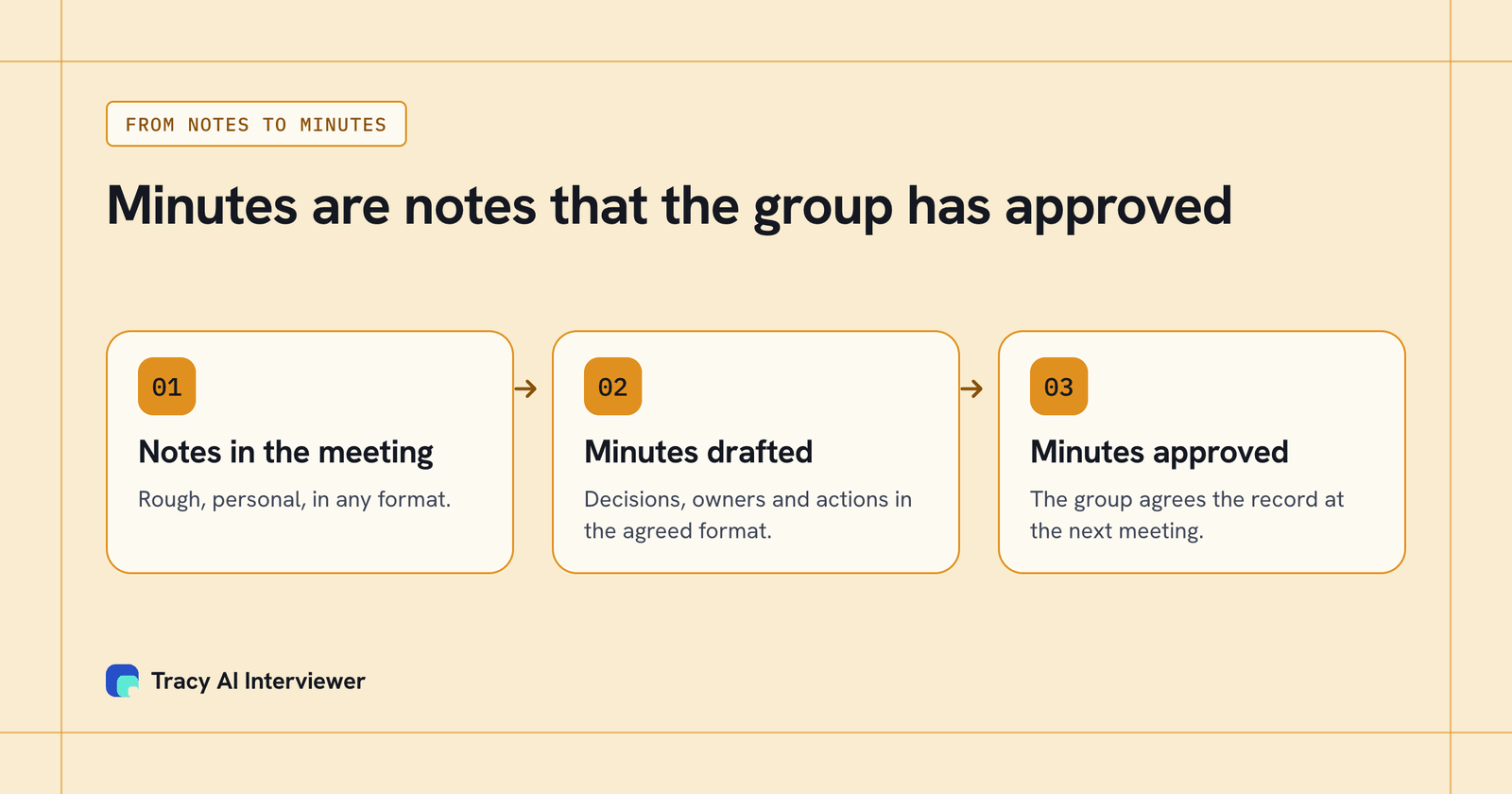
Notes become minutes only after someone shapes them into the agreed format and the group approves them.
When should you use minutes, and when notes?
Write minutes when the meeting makes decisions someone may need to prove later: board and committee meetings, steering groups and anything with a compliance duty. Write notes for working meetings, one-to-ones and brainstorms, where you only need to remember what you promised.
If a person who was not there might ask "what exactly was agreed?", you need minutes. If only you will read it, notes will do. A summary, the third term in the search, is in everyday use a shorter account of what was discussed, written for people who were not there. It carries no approval step.
Are meeting minutes legally binding?
Minutes record what a group decided, and whether they carry legal weight depends on the group. Wikipedia notes that the minutes of certain groups, such as a corporate board of directors, must be kept on file and are important legal documents. What a minute proves depends on the organisation's rules and on the law where you are, so ask your counsel; this is not legal advice.
To keep minutes useful, record the decision and the owner and keep the discussion short. Have the group approve them, so the record is the group's version and not one person's.
What if the meeting is an interview?
An interview is a meeting where the record decides who gets a job. Minutes do not fit, since nobody is deciding anything as a group during it. Notes are what interviewers write, each in their own format and on what struck them, so two interviewers can recall the same candidate differently a week later.
A recording and a transcript answer a different question from notes. They show what the person said, in order and with the time. A decision made from them can be checked by anyone on the hiring team, which an impression written in the margin cannot.
How does Tracy replace the notes on a first-round interview?
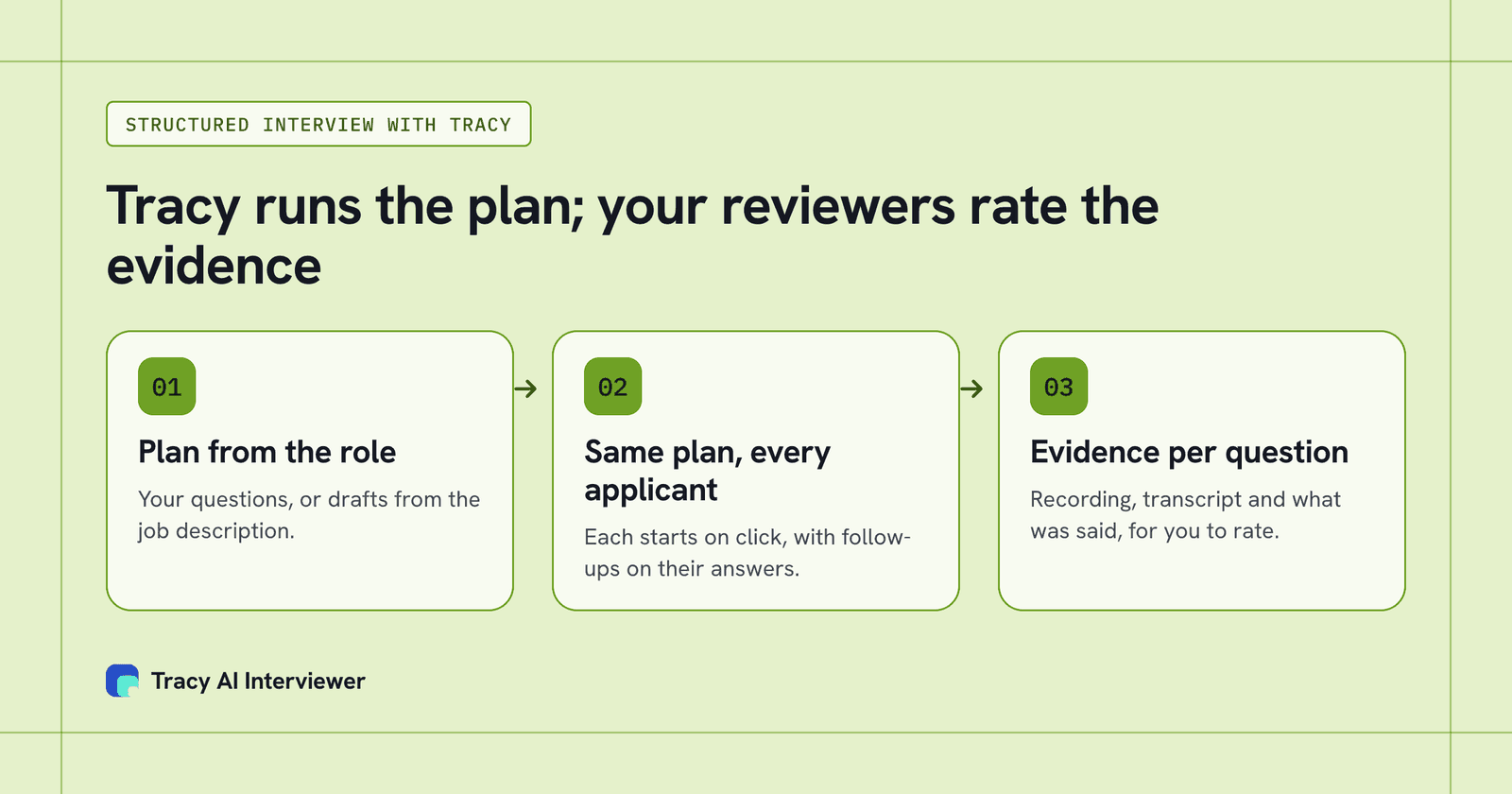
A recruiter has a fixed number of call slots, each ending in its own notes, so the applicants beyond those slots never get a conversation, and human-run calls do not scale past them. Tracy runs the interview herself. Each applicant starts on click, at any hour, with no calendar and no one on the call, and she follows up on what each person says.
Each interview closes with a recording that captures both speakers, plus a timestamped transcript and the person's answer to every question. Below is a sample note built on invented data, from a recruiter screen.
Question: How do you brief a hiring manager at the start of a search?
Summary: Asks for three must-haves and three things that can be taught, and agrees the interview steps in the first call.
In their words (02:30): "Three must-haves, three can-be-taught, and the steps agreed in call one."
Follow-up asked: What if the manager keeps changing the list?
Field: Intake method, 3 must-haves and 3 teachable. Evidence: question 1, at 02:30.
The report holds what was said and the evidence for it. Your team reads it and makes the call; the report carries no score and no ranking. On enterprise plans, she can also take notes on calls that your own people run.
One customer's average time to hire fell from 44 days to 7, and in a single month Tracy matched the output of 53 full-time recruiters. You pay as you go: a $1 credit covers each started 20 minutes of interview, and the first 3 results are free.
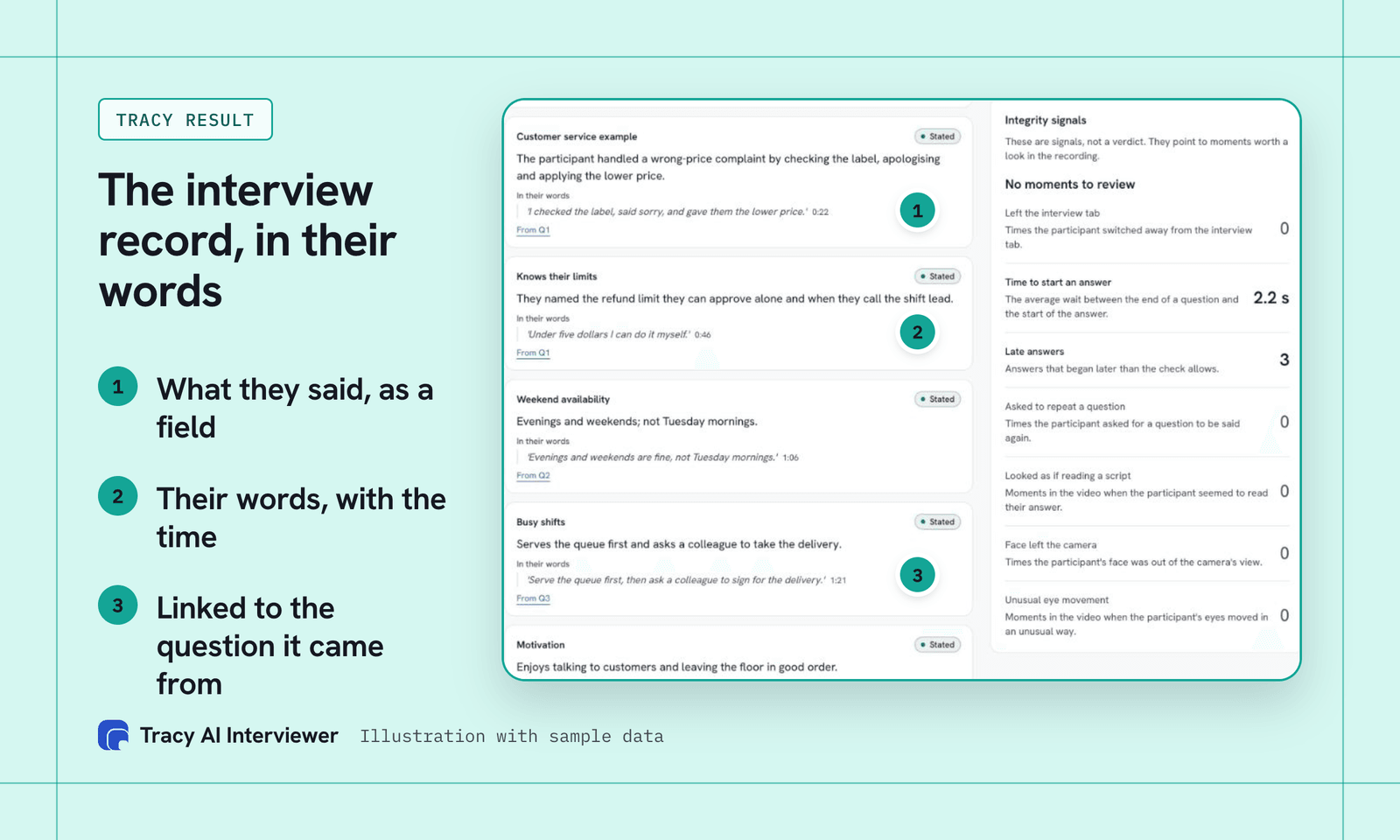
The record of an interview is the candidate's words with the time they said them.
Which path fits you?
- Writing up interviews yourself: interview notes template and interview debrief template.
- Comparing a transcript with a report: interview transcription software vs interview reports.
- Choosing a notetaker: best AI notetakers for recruiters.
- Interviewing many people for one role: how Tracy handles volume hiring.
Common questions
What is the difference between meeting minutes and meeting notes?
Are meeting minutes legally binding?
When should you use minutes instead of notes?
What is the difference between meeting minutes and a meeting summary?
Can Tracy take the notes for an interview?
Hand off the calls you keep repeating
Tracy can run the interview herself and return a report with each quote linked to the recording. Your first 3 results are free.
Try it free (opens in a new tab) Book a demo (opens in a new tab)
Your first 3 results are free. No card needed.
Sources
- Wikipedia: Minutes, retrieved 22 Nov 2026.
- Tracy AI Interviewer pricing, retrieved 22 Nov 2026.