
TLDR Tracy AI Interviewer interviews every security applicant on scenarios and follows up on how they would act, so your security lead reads judgement under pressure, not memorised acronyms.
Use the 15 cybersecurity interview questions below, each with a follow-up and what to listen for.
Each result keeps a recording, a timestamped transcript and an assessment per question, with integrity signals and their evidence for a person to review.
Next step: paste five of these questions into a Tracy interview.
We make Tracy AI Interviewer.
A security opening draws applicants who all list CISSP, Splunk and "incident response". Your security lead has a queue of alerts and a handful of hours. The CV shows certifications and tools. It does not show what someone does in the first ten minutes of an incident. Cybersecurity interview questions should test that.
These are for the security lead or hiring manager. They ask for scenarios and decisions across detection, response, access, cloud and communication, and each has a follow-up and a note on what a strong answer contains. For freshers, use groups 1 and 2 and accept lab or study examples. Candidates can use them to prepare.
Tracy AI Interviewer runs the part that does not scale. She asks each applicant in their own field, follows up on what they just said and waits for the end of the thought. For the wider process, see technical interviews and software engineer interview questions for the engineering side.
Fifteen cybersecurity interview questions, grouped by what they test
Pick one or two questions from each group. Ask the follow-up only after the first answer. Choose your opening questions for the role and write down what a strong answer contains before the first candidate joins. Keep every scenario defensive and invented: nobody should be asked to describe how to attack a real system.
Group 1: foundations
Table 1: Foundations, with follow-ups and what a strong answer contains.
| Ask | Follow up with | Listen for |
|---|---|---|
| 1. Explain the difference between authentication and authorisation with an example. | Where do systems confuse them? | Clear definitions, a concrete example, a real failure such as a user who can open another user's record. |
| 2. What happens when you visit an HTTPS site, in terms of trust? | What would a certificate warning tell you? | Certificate chain, identity, key exchange at a sensible depth. Does not claim encryption proves a site is safe. |
| 3. How would you explain phishing risk to a colleague who does not work in IT? | What would you ask them to do? | Plain words and one action: report it, do not click. Avoids blame. |
Group 2: detection and triage
Table 2: Detection and triage, with follow-ups and what a strong answer contains.
| Ask | Follow up with | Listen for |
|---|---|---|
| 4. An alert says a user logged in from two countries within an hour. What do you do? | What would make you escalate? | Checks travel, VPN, device and recent changes before assuming compromise. States the escalation trigger. |
| 5. You have fifty alerts and time for ten. How do you choose? | What do you do about the forty? | Ranks by asset value and confidence, documents the rest, tunes noisy rules. |
| 6. Tell me about a false positive you tuned. | What did you risk by tuning it? | A real rule, the change and the risk accepted. Reviews the result later. |
Group 3: response
Table 3: Response, with follow-ups and what a strong answer contains.
| Ask | Follow up with | Listen for |
|---|---|---|
| 7. You suspect a laptop is infected. What are your first three actions? | Who do you tell, and when? | Contain before wiping, preserve evidence, notify the right owner. Does not improvise alone. |
| 8. A colleague says they clicked a link and entered their password. How do you respond? | What do you say to them? | Reset credentials, check sessions and mail rules, thank them for reporting. Keeps the tone blame-free. |
| 9. Describe the last incident you worked on. | What would you do differently? | A specific timeline, their own role, a lesson and a change afterwards. |
Group 4: access and cloud
Table 4: Access and cloud, with follow-ups and what a strong answer contains.
| Ask | Follow up with | Listen for |
|---|---|---|
| 10. A storage bucket is public by mistake. What now? | How do you stop it happening again? | Closes access, checks logs for reads, then adds a guardrail or policy in the pipeline. |
| 11. How do you handle secrets in code and pipelines? | What would you do after a key leaks? | Secret stores, rotation, scanning. After a leak: revoke first, then investigate use. |
| 12. A team asks for admin rights for speed. What do you ask? | When would you say yes? | Asks what job needs it, offers narrower access, time-limited approval and a review. |
Group 5: communication and judgement
Table 5: Communication and judgement, with follow-ups and what a strong answer contains.
| Ask | Follow up with | Listen for |
|---|---|---|
| 13. Explain a vulnerability to a manager who must decide whether to delay a release. | What would you recommend? | Impact, likelihood and the fix cost in plain language, then one recommendation with a reason. |
| 14. You find a flaw outside your scope. What do you do? | What would you never do? | Reports it through the proper channel and never tests it further without permission. |
| 15. How do you stay current without chasing every headline? | What did you last change because of it? | A small routine, named sources and a concrete change. |
A strong answer says what it would check first, and a weak one names a tool
The difference shows up in the second answer. These pairs are written by us as examples of how it sounds, not quotes from real candidates.
Table 6: Weak and strong answers to the same questions, written as examples.
| Weak answer | Strong answer | |
|---|---|---|
| Question 4, two countries in an hour | "I would lock the account." | "I would check for a VPN or a known device first. If the device is new and a mail rule changed, I escalate and lock it." |
| Question 7, the suspect laptop | "I would wipe it and reinstall." | "I would isolate it from the network and keep it powered so we can collect evidence, then tell the owner and the incident lead." |
| Question 10, the public bucket | "I would make it private." | "I would make it private, then read the access logs to see who read it, then add a rule that blocks public buckets in the pipeline." |
Listen for ownership. "The SIEM flagged it" tells you about the tool. "I checked the device and the mail rules" tells you about the person.
One follow-up chain shows where the real answer starts
This is an illustration with sample data, not a real interview. The candidate is fictional and the scenario is invented. It shows the shape of what Tracy runs: an opening question from your list, the answer, and a follow-up built on it. It starts from question 4.
Tracy: An alert says a user logged in from two countries within an hour. What do you do?
Candidate (fictional): I check whether it is a VPN or a known device before I assume a compromise.
Tracy: The device is new and the VPN logs show nothing. What next?
Candidate: Look for mail rules, new app consents and password changes. If any of those exist I escalate.
Tracy: What do you tell the user while you wait?
Candidate: That I am checking the sign-in and may reset their password. I ask them to avoid logging in until I confirm.
The first answer is the textbook one. The second shows the order they would work in. The scenario changes with every answer, which a fixed question list cannot do.
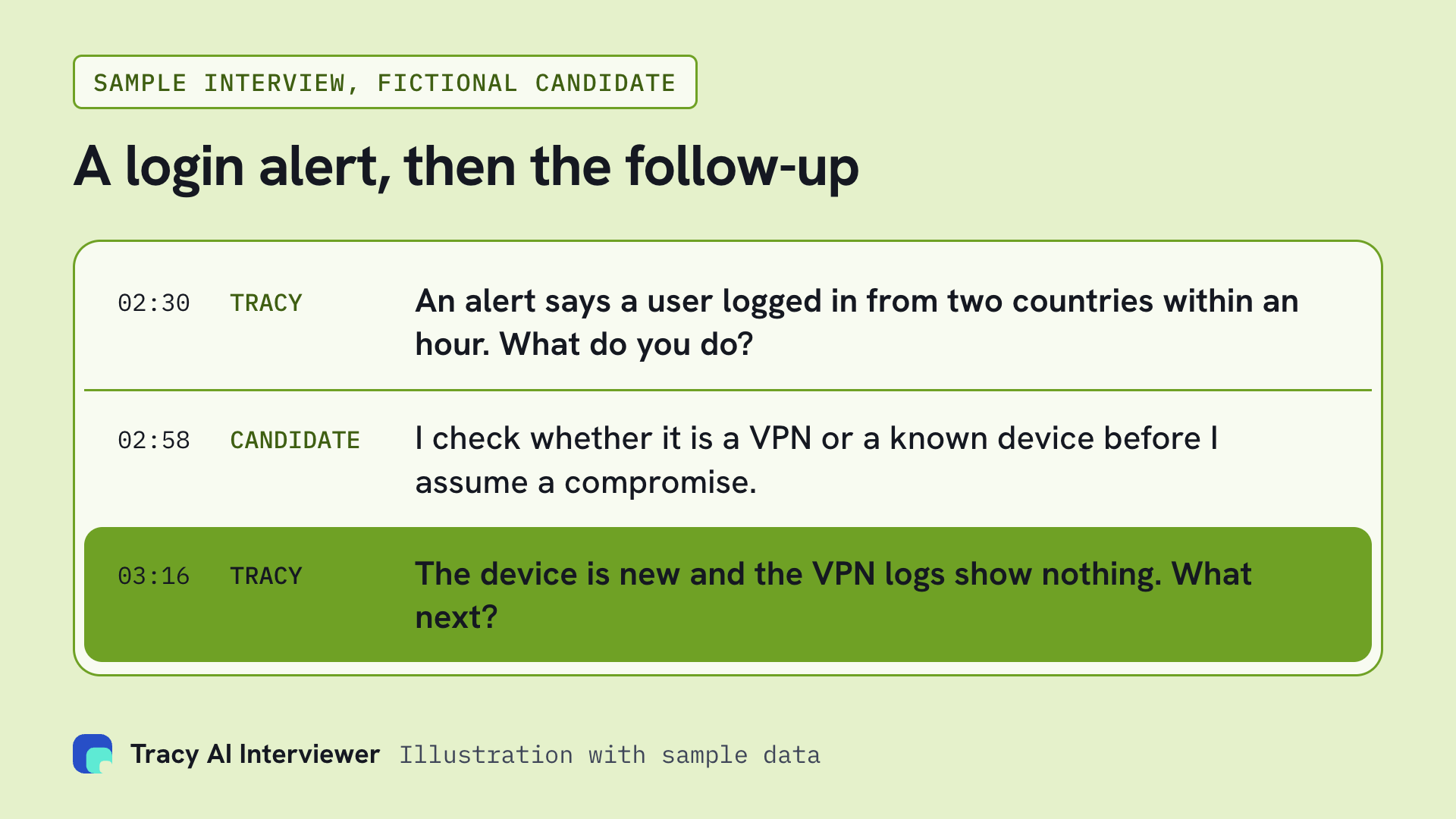
A follow-up built on the candidate's own answer shows how they would act, not what they memorised.
Run the interview for every applicant without losing the follow-up
A live call for every applicant does not survive a queue of them, and your security lead is also your incident responder.
- Your questions or ours. Describe the role and Tracy drafts questions from the job description, which you edit (see the product page).
- CV check, as a setting. With it on, Tracy can read the CV and ask about what it claims, so "incident response" becomes a question about one incident. See how the CV check works.
- Start on click. Each candidate opens a link in a browser, with no account and no calendar, at any hour, and is told on the join screen that the conversation is recorded and transcribed. See the participant experience.
- A result you can check. A recording, a timestamped transcript and a written assessment per question sit behind every result. See AI interview reports.
- Integrity signals, with the evidence. Tracy captures tab changes, gaze, face detection, delay before answers, fullscreen exits and external screens, and shows the evidence to a human reviewer. A signal is not proof, and your team decides. See AI interview cheating detection.
It is $1 per credit, one credit per started 20 minutes of an interview that produced a result, so a 34-minute interview costs $2. The first 3 results are free with no card, there are no seats, and a session with no answers is never charged. See pricing. Because your reviewers will ask about the vendor: Tracy is SOC 2 Type II attested, and the report is available on request at hello@tracyinterview.ai. Customisation takes days.
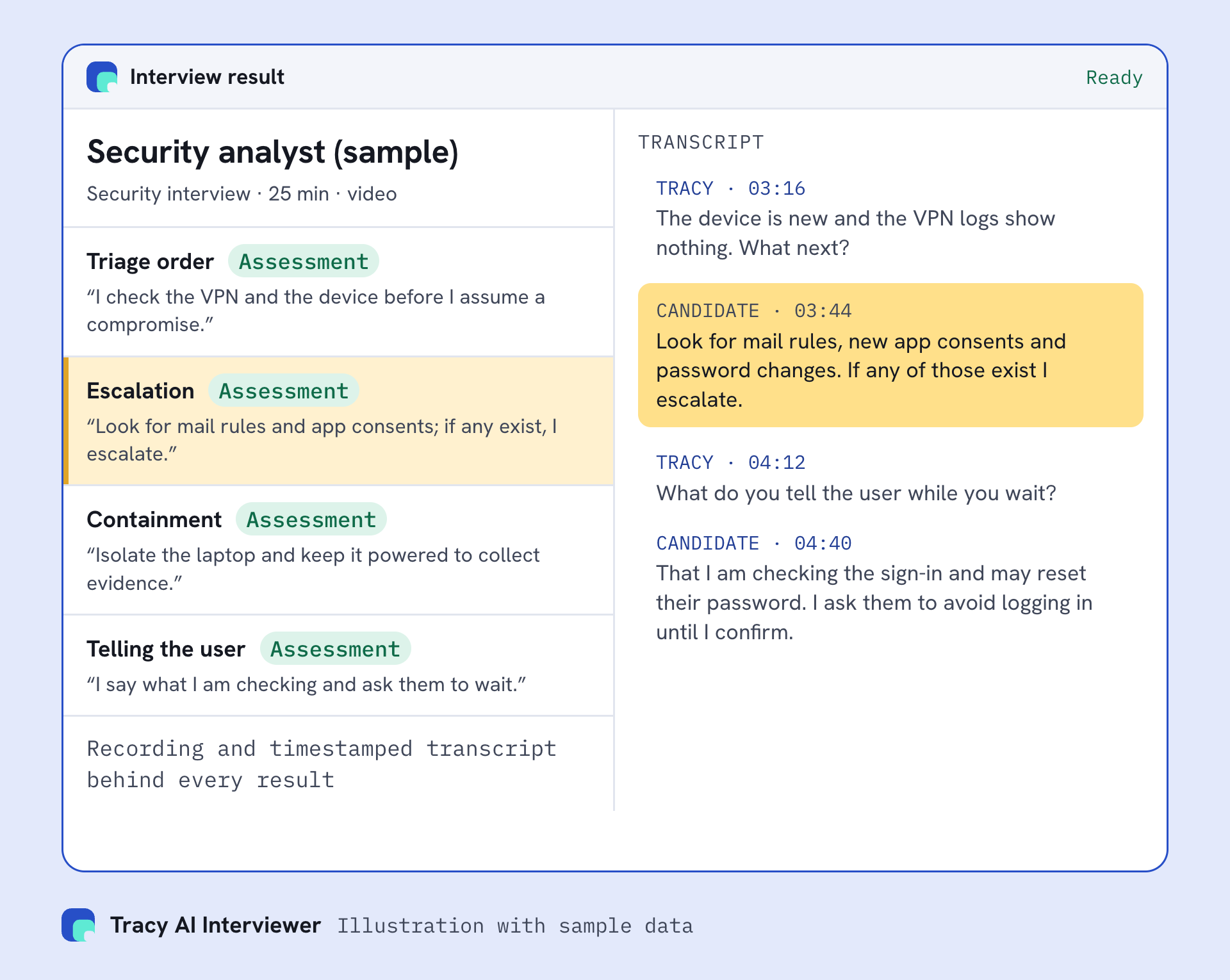
A reviewer can open the recording and transcript behind each assessment.
Keep four checks with people
- Your own security engineer. Have one score five or six transcripts blind. If they disagree with the written assessments, fix the questions before inviting the next hundred.
- Credentials. Verify certifications at the issuer. A Tracy result is the recording, transcript and assessment per question.
- Background and clearance. Whether a role needs screening beyond the interview is your call.
- The decision. A person decides from the evidence.
For ten applicants, a video call with one of your engineers is simple and works well; see AI interview vs human interview. The case for Tracy starts when applicants outnumber your team's hours. To try it, create a Tracy interview for this exact role from these questions and read the recording and report on three real applicants.
Questions
What are good cybersecurity interview questions?
What cybersecurity interview questions suit freshers?
How do you test a candidate's cybersecurity judgement without an exploit exercise?
Can an AI interviewer interview cybersecurity candidates?
Does Tracy verify a security certification?
Create a Tracy interview for this exact role from these questions, then read the recording and report; the button opens the Connect page. Or send us one role and we will build the interview plan, with a recording and report you can check. Try it free · Book a demo
Sources
- Tracy AI Interviewer home page, customer proof, retrieved 9 Nov 2026.
- Tracy AI Interviewer pricing, retrieved 9 Nov 2026.
- Tracy AI Interviewer Connect page, retrieved 9 Nov 2026.