In short
Read AI is a capable note taker for calls your people run: summary, action items, key questions and a transcript by speaker, in 16+ languages. It suits teams that keep a person on every call. Tracy AI Interviewer runs the first round itself, on video, for every applicant who clicks a link at any hour, and leaves a recording and what each person said to each question. Your team decides.
Read AI vs Tracy is a choice about who sits on the call. Read AI joins calls your people hold and returns a summary, action items and a report afterwards. Tracy AI Interviewer interviews the applicant itself, so a first round does not wait for an interviewer's free hour, and on enterprise plans it can also take notes on calls your team runs. Read AI is the stronger choice for teams that keep humans on the call; Read AI alternatives for interviews lists what else fits that job.
Notes can only record the questions an interviewer found time to ask. Tracy asks them of everyone who applies.
Choose Read AI when:
- your people run the calls on Zoom, Teams or Meet and want a recap of each;
- you want reports in 16+ languages, or audio and video playback on Enterprise;
- a few interviewers on a per-user price is the whole job.
Choose Tracy when:
- applicants outnumber interviewers and each one needs a real first-round interview;
- a reviewer should check each result against a recording and a timestamped transcript;
- you want to pay per result, with no seats.
What Read AI does well
Read AI adds its assistant to Zoom, Teams and Meet calls and returns a summary, topics, action items, key questions and a transcript by speaker. Enterprise plans add audio and video playback and video highlights. Reports come in 16+ languages. Paid plans list Notion, Salesforce, HubSpot, Jira, Confluence, Zapier and webhooks, and Read is available as a Claude connector, ChatGPT app and MCP server. Enterprise+ adds HIPAA support, SAML and SCIM, custom data retention and EU and CA hosting. There is a free plan.
For meetings your people already run, that covers a lot at a low price. Read AI's pricing page does not mention recruiting, hiring or interviews, so hiring teams adapt it. If that works for your volume, stay. A summary can only reflect the questions the interviewer chose to ask, so running the interview itself is the gap Tracy fills.
What Tracy adds to calls your team runs
01 Reach every applicant
Each applicant starts on click, at any hour, with no scheduling and no recruiter on the call. A first round no longer waits for an interviewer's free hour.
02 Ask the next question
Tracy follows the answer in the applicant's own field and waits for it. The detail comes from the interview, not from a fixed list.
03 Keep the evidence
A transcript by speaker records what was said on a call. Every Tracy result also has the recording of both sides, a timestamped transcript and a written assessment per question with its reasoning.
Read AI vs Tracy: buyer criteria side by side
Source: Read AI's pricing page read 14 Nov 2026 and approved Tracy product records. Not stated means the pages reviewed do not say.
| Criterion | Read AI | Tracy |
|---|---|---|
| Job | Notes on calls people run: summary, topics, action items, key questions | Runs the interview by two-way video and writes the report |
| Follow-ups | An AI that interviews the candidate is not stated on the pages reviewed | Asks about what was said, in the person's own field |
| Evidence | Transcript by speaker; audio and video playback on Enterprise | Recording of both sides, timestamped transcript, what each person said to each question |
| Volume | Assistant joins Zoom, Teams and Meet calls your people hold | Every applicant starts on click, any hour, no scheduling |
| Security | HIPAA support, SAML, SCIM, custom retention and EU and CA hosting on Enterprise+ | SOC 2 Type II attested; report on request |
| Stack | Notion, Salesforce, HubSpot, Jira, Zapier, MCP; ATS not named | API, MCP, Slack, WhatsApp, Workable, Breezy HR, Zapier |
| Price | $15 per user per month annual; $19.75 monthly | Per result, no seats; rates in the cost table below |
What happens to one applicant in each tool?
Say a backend role has 300 applicants. With Read AI, a recruiter books each shortlisted person, and the assistant joins that call as a participant; Read's help center lists settings for stopping it from joining meetings, and auto-join can cover all calendar events or only events you host. The summary reflects the questions the interviewer chose to ask. With Tracy, the applicant opens a link and is interviewed on video, in their own field, when they are ready. A reviewer reads the report and opens the recording behind any result. See how AI interviews work for the steps.
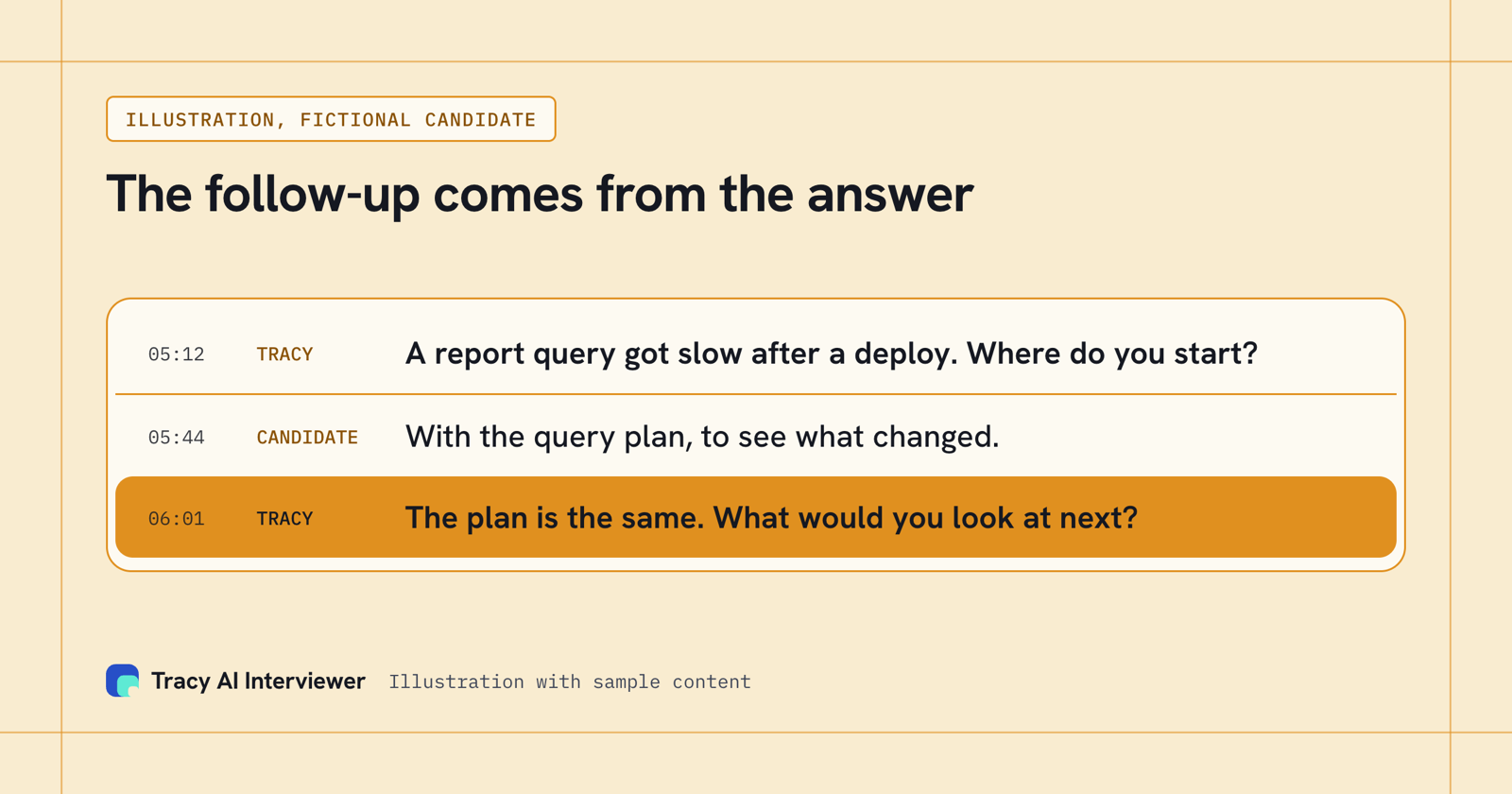
Tracy asks the next question itself, from what the applicant just said.
What does a summary leave out?
A summary compresses a call, and Read AI's summary lists topics, action items and key questions. What it cannot add is the question the interviewer never asked. Tracy asks the next question from what the applicant just said, so the detail comes from the interview and not from a fixed list. Bring your own questions or describe the role and let Tracy draft them; for technical roles a coding task can sit inside the interview (AI technical interviews). To see it on a real role, create one interview and read the second question.
What does a reviewer get from each?
Read AI gives a transcript by speaker, with audio and video playback on Enterprise, plus the report. Tracy gives a recording of both sides and a timestamped transcript, and shows integrity signals with their evidence to a person; signals are never proof, and a person decides. Applicants are told on the join screen that the conversation is recorded and transcribed. See what the interview report holds.
Why human-run calls cap your volume
Notes do not change who has to be on the call. Take the 300 applicants of a backend role and a 20-minute first round for each: that is 100 hours of calls, each one booked, attended and summarised afterwards, and a per-user price does not shorten any of them. Each Tracy applicant starts on click, at any hour, with no scheduling, so none of those hours are spent on the call.
In one customer's result, time to hire fell from 44 days to 7, and Tracy handled the work of 53 full-time recruiters in one month. Volume hiring covers applicant waves.
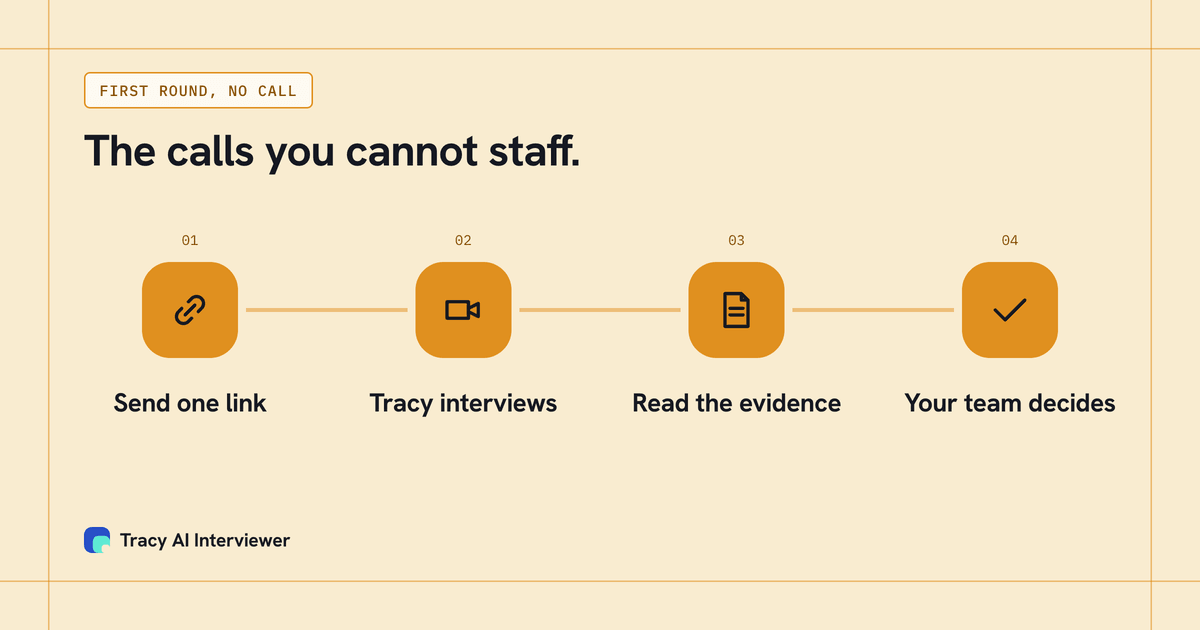
Read AI writes up the calls your people run; Tracy interviews the applicants no one had time to call.
What do Read AI and Tracy cost?
Read AI charges per user, so interview count does not change the bill; Pro lists $15 per user per month on annual billing and $19.75 monthly. Tracy charges per result: $1 per credit, one credit per started 20 minutes of an interview that produced a result, with the first 3 results free. Read AI is cheaper per month below because it does not run the interviews; compare Tracy with the recruiter hours of a first round. Enterprise is priced to your volume: book a demo for a figure. Read AI's Enterprise+ lists a 5-license minimum, and Read AI pricing explained covers its plans.
The sums assume each interviewer runs 20 interviews a month, so 3, 10 and 25 interviewers mean 60, 200 and 500 interviews of 20 minutes or less.
Monthly cost at 20 interviews per interviewer
Tracy at one credit per interview of 20 minutes or less; Read AI Pro at list price per interviewer, read 14 Nov 2026. Illustration, not a quote.
| Interviewers | Tracy | Read AI Pro, annual | Read AI Pro, monthly |
|---|---|---|---|
| 3 | 60 interviews: $60 | $45 | $59.25 |
| 10 | 200 interviews: $200 | $150 | $197.50 |
| 25 | 500 interviews: $500 | $375 | $493.75 |
Scroll the table sideways to see all 4 columns.
What should you run first?
Take one role you are hiring for now. Keep your Read AI notes from the next calls, create one interview for the same role in Tracy, and read the second question asked in each case. If the notes are enough at your volume, keep them. If the first round is where your hours go, try Tracy free. Reading before you commit: what buyers say in Read AI reviews.
Which path fits you?
- Technical hiring: technical interviews covers role-specific interviews with follow-ups.
- High-volume hiring: volume hiring covers applicant waves.
- Integrations: Connect lists what Tracy works with.
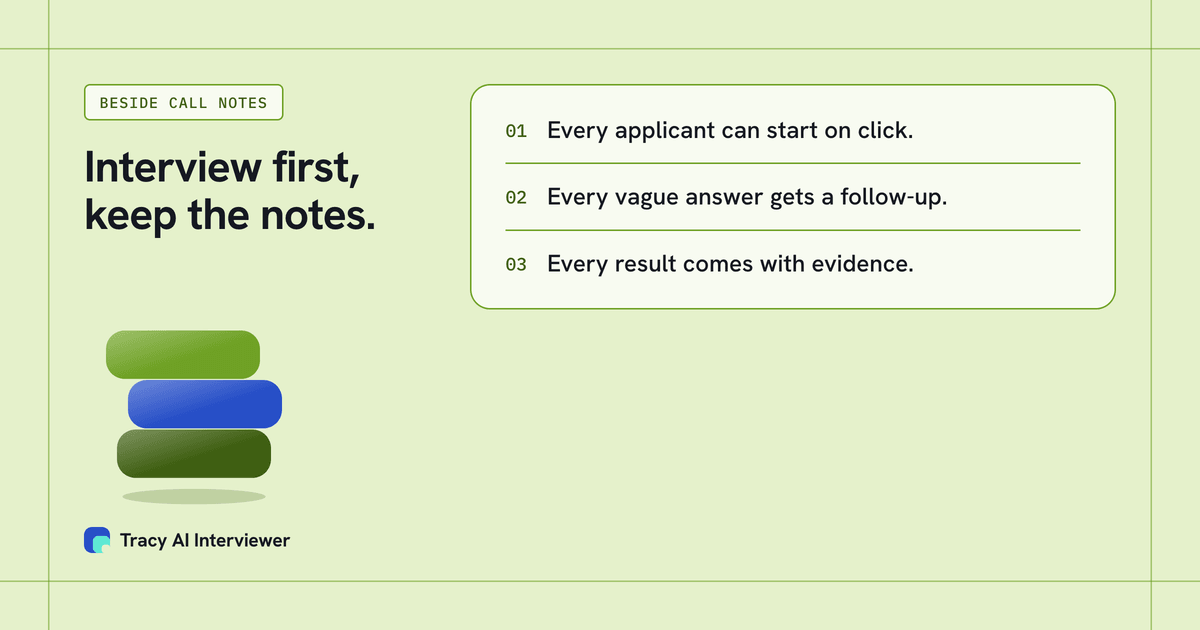
Beside call notes: a start on click, a follow-up and evidence.
Common questions
What is Read AI?
Is Read AI an AI interviewer?
Does Read AI join calls automatically?
Which languages does Read AI cover?
Can I use Read AI and Tracy together?
Is Read AI worth it for interviews?
Run one role in Tracy
Interview your next role in Tracy and compare the follow-ups and report with your Read AI notes. The first 3 results are free.
Book a demo (opens in a new tab) Try it free (opens in a new tab)
Your first 3 results are free. No card needed.
Sources
- Read AI, Pricing, retrieved 14 Nov 2026.
- Tracy AI Interviewer, Pricing, retrieved 14 Nov 2026.
- Tracy AI Interviewer, Connect, retrieved 14 Nov 2026.