In short
LeetCode is the larger practice bank, about 4,100 problems on its public profile count, and fits engineers who borrow problems for their own rounds. For screening, Tracy AI Interviewer runs the interview: follow-ups in the applicant's own field, a coding task inside it, and a recording with what each person said to each question. Your team decides.
LeetCode vs Tracy is a choice between a problem set and an interview. This comparison is for engineering and talent leads who screen technical people at volume. LeetCode is a problem set that candidates practise on; its Premium page lists mock assessments, company-specific questions and a coding agent at $39 a month or $299 a year, with $35 and $159 in its Black Friday sale. Tracy AI Interviewer runs a two-way video interview, asks the next question from what the person just said, and leaves evidence behind every result.
A problem bank holds the questions. The interview, the follow-up and the evidence behind each answer still have to come from somewhere, and that is the part Tracy supplies.
Choose LeetCode when:
- you or your candidates want to practise on a very large bank of problems;
- you borrow problems for interviews your own engineers run.
Choose Tracy when:
- you want the first round run for you, at any hour, with follow-ups on approach and trade-offs;
- you want a recording and a written assessment per question a reviewer can check.
What LeetCode does well
LeetCode's Premium page lists mock assessments where you choose a company and get a timed question, company-specific questions sorted by role and frequency, and a coding agent that brainstorms and debugs. Its library counts 4,109 problems, a count shown on a public profile page read on 9 Nov 2026. G2 describes a platform for individuals preparing for technical interviews, and its 15 reviews average 4.5 out of 5 (G2, read 14 Nov 2026). For practice it is the larger bank. Read the reviews in LeetCode reviews. A problem bank holds questions. It does not run the round, ask about the approach or return evidence, which is the gap Tracy fills.
What Tracy adds to a LeetCode-based process
01 Reach every applicant
Each applicant starts on click, at any hour, with no scheduling and no recruiter on the call. Everyone gets the same first round.
02 Ask the next question
Tracy follows the answer in the applicant's own field and waits for it. The coding task sits inside the interview, with follow-ups on approach and trade-offs.
03 Keep the evidence
Every result includes a recording, a timestamped transcript and a written assessment per question with its reasoning. A reviewer can open the moment behind a claim.
What a solved problem cannot show
Many engineering teams already borrow from LeetCode: an engineer picks a problem for a live round, or sends one as a take-home. LeetCode's pages describe a practice product, and its reviews on G2 are about preparing for interviews, so how a company uses it to screen is the team's own process. Candidates can practise on the same public bank, so a well-known problem tells you less than it once did. A passing solution shows the answer, not how the person reached it.
A live round would show the route, at a cost: 100 applicants at 20 minutes each is about 33 hours of engineer time, and 1,000 is about 333 hours. Tracy can take problems you already use into its interview and ask about the approach, the edge cases and what the person would change, for every applicant, with no engineer on the call. A reviewer has more to weigh when an answer sounds rehearsed.
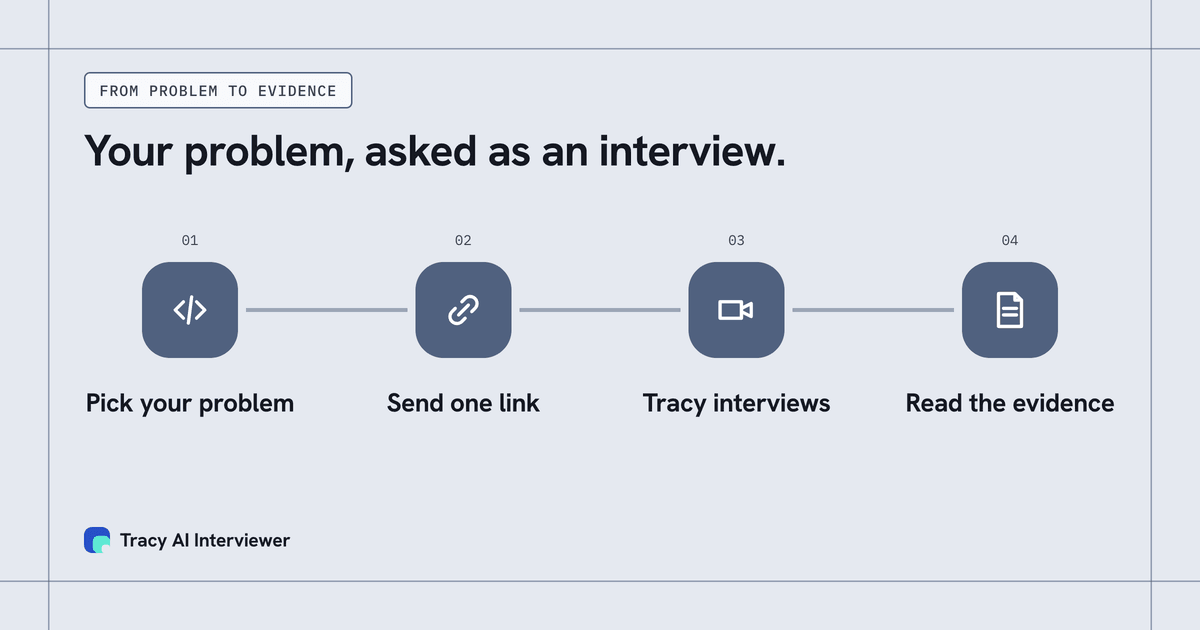
A problem you already use becomes an interview: Tracy asks, the transcript keeps the answers.
LeetCode vs Tracy: buyer criteria side by side
LeetCode column: leetcode.com pages read 9 and 14 Nov 2026. Tracy column: what Tracy publishes about itself. Where LeetCode says nothing the cell reads not stated, a gap in the page and not proof the feature is missing.
| Criterion | Tracy AI Interviewer | LeetCode | Who leads |
|---|---|---|---|
| Interview depth | Follow-ups in the person's own field; a coding task inside the interview. | Problems the candidate solves. Follow-ups: not stated on the pages reviewed. | Not compared |
| Question bank | Questions from the job description or your own list, edited freely. | About 4,100 problems and company-tagged questions on Premium. | LeetCode: bank size |
| Volume and start | Each applicant starts on a click, at any hour. Rejoin within 10 minutes, set per customer. | Individual accounts. Running applicants through it: not stated. | Not compared |
| Evidence per result | Recording of both sides, timestamped transcript, what was said per question. | Not stated on the pages reviewed. | Not compared |
| Integrity signals | Signals for a reviewer: tab changes, gaze, face detection, fullscreen exits. Never proof. | Not stated on the pages reviewed. | Not compared |
| Price | Charged per interview, with no seats. Amounts: see Tracy's pricing. | Premium is for individuals, not hiring. Company price: not stated on the pages reviewed. | Not compared |
| ATS and stack | API and MCP, Slack, WhatsApp, Zapier; beside the Workable and Breezy HR connectors. | Not stated on the pages reviewed. | Not compared |
| Security | SOC 2 Type II attested, report on request at hello@tracyinterview.ai. | Not verified. | Not compared |
Scroll the table sideways to see all 4 columns.
How the published workflows differ for the same technical role
The same imagined hire, a backend engineer on a payments team, seen both ways. LeetCode's side restates its published pages. Tracy's side is a labelled illustration built around a fictional applicant, and no real recording appears.
How the published workflows differ for the same role. The Tracy column is an illustration.
| Step | LeetCode (from its pages) | Tracy (illustration) |
|---|---|---|
| Setup | You or the candidate pick a problem, or a mock assessment for a company. | You describe the role and Tracy drafts questions; bring your own problems if you like. |
| Interview | The candidate solves a timed question. | A coding task sits in the interview; Tracy asks about the approach as the code appears. |
| Follow-up | Not stated on the pages reviewed. | After each answer Tracy asks the next question from what was said, not from a fixed list. |
| What you receive | A result on the problem. A reviewer report for a hiring team: not stated. | A recording of both sides, a timestamped transcript, and what was said to each question. |
Do Tracy's follow-ups show more than a solved problem?
A solved problem shows the answer. In Tracy, follow-ups ask what happens to memory when a client goes quiet, or what changes when two requests arrive in the same second, and the transcript keeps both question and answer. See coding interview follow-up questions and system design interview rubric.
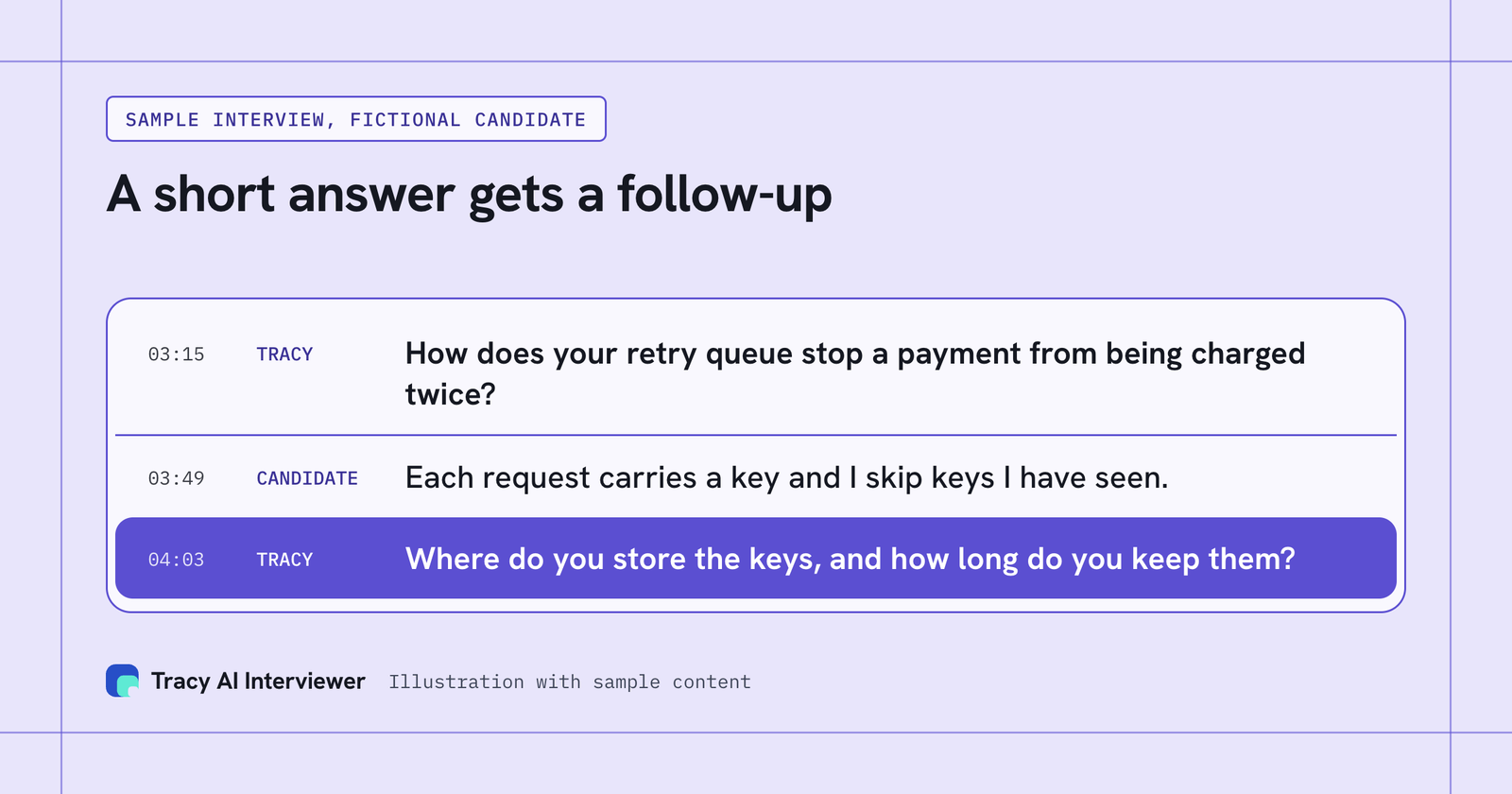
The second question builds on the first answer instead of moving down a list.
Can a reviewer check a Tracy result?
Video interviews run integrity signals unless you turn them off. They reach a person with the evidence attached, and they are prompts to look, not proof of cheating. The join screen tells the applicant that the conversation is recorded and transcribed. A person reads the recording and what was said to each question, and decides. See what is a technical screen.
How do LeetCode and Tracy compare on price?
LeetCode Premium is an individual practice plan, not a hiring product, so a price comparison with Tracy would not compare like with like. A company price is not stated on the pages reviewed; the company-side answer is on LeetCode pricing for companies. Tracy charges per interview, so a 45-minute interview costs $3; the rest is on Tracy's pricing.
How do you test both before you commit?
Some teams will use both: LeetCode for engineers who borrow problems for their own live rounds, Tracy for the first round every applicant gets. Tracy takes questions from the job description or your own list, so problems you already use can go into the interview, and you set the skills it covers for the role. The reviewer applies any weights; Tracy does not weigh, rate or rank.
Run one role, one team, two weeks. Pick a technical role with at least 20 expected applicants. Describe the role and Tracy drafts the questions; you edit them. Run it and compare the follow-ups and the report with the results you get from problems alone. Have one reviewer count the follow-ups that landed and the results checked from the recording in under a minute. In one customer's result, time to hire fell from 44 days to 7, and Tracy handled the work of 53 full-time recruiters in one month.
Which path fits you:
- Technical hiring: technical interviews.
- High-volume hiring: volume hiring.
- Your stack: Connect lists the integrations.
- Other tools: LeetCode alternatives.
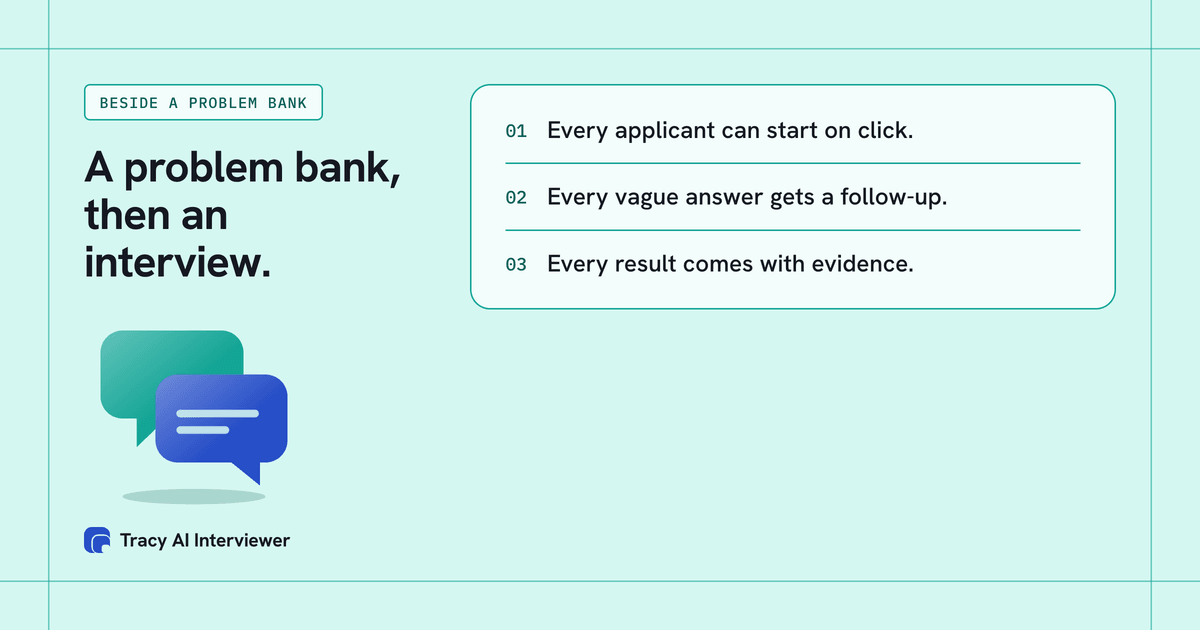
Beyond a problem bank: a start on click, a follow-up and evidence.
Common questions
Is LeetCode a hiring tool?
Does LeetCode have proctoring or integrity checks?
Does LeetCode ask follow-up questions?
Is Tracy better than LeetCode?
How much does LeetCode cost compared with Tracy?
Can I use LeetCode problems with Tracy?
Run one role through Tracy
Send your next technical role to Tracy and read the follow-ups and report beside what problems show. The first 3 results are free.
Book a demo (opens in a new tab) Try it free (opens in a new tab)
Your first 3 results are free. No card needed.
Sources
- LeetCode: Premium, retrieved 14 Nov 2026.
- Tracy AI Interviewer: Pricing, retrieved 14 Nov 2026.