In short
Surveys show what customers chose but not why. Tracy AI Interviewer sends a single link, interviews each customer in their browser at a time of their choosing, and asks for the reason behind each answer.
Every finding points to the customer's own words and the exact point in the recording, so the team can check what was said.
Tracy has completed 100K+ interviews, and a first study starts from a link with no sales call.
Conveo fits when an enterprise insights team wants research experts, screen-aware probing in UX studies and finished reports. Run one study in Tracy and read the quotes.
Tracy vs Conveo compares a managed research platform with a tool you run yourself. Conveo's own page calls it an AI-powered qualitative research platform built for enterprise teams, offering voice and video interviews, research experts working beside your team and stakeholder-ready reports. With Tracy you describe what you want to learn and send a link, and Tracy interviews each customer on video, follows up on what they say and returns what each person said to each question.
Which one should you choose?
The verdict: Conveo is the better pick for an enterprise insights team that wants a research partner and polished deliverables. how Tracy runs a study is the better pick when a product or research team wants to run its own discovery quickly, see the price up front and read the customer's own words behind every finding.
Choose Conveo when:
- marketing, product, CX or innovation teams at a large company want research experts to guide each study;
- you need reports produced for stakeholders;
- UX studies need a moderator that reacts to what the participant does on screen.
Choose Tracy when:
- you want to start with one link and no sales call, with the price visible first;
- each finding should link to the customer's words and the moment in the recording;
- you want the interview to ask for the reason behind an answer, in the customer's own context.
What Conveo does well
Conveo's pages show strengths that matter to a research lead:
- It is built for enterprise insights work and says it is trusted by 400+ enterprise teams.
- Research experts work beside your team on methodology and adoption.
- It says you can launch a study in minutes and have analyzed results within hours.
- It turns findings into stakeholder-ready reports.
- Its home page FAQ says it is built with enterprise-grade security and GDPR compliance in mind, and it offers an open platform with MCP and API.
If you want a research team beside yours and screen-aware probing in UX studies, Conveo is the stronger fit.
How the published workflows differ
Both tools run an AI interview instead of a calendar of calls. The difference is who runs the study. With Conveo, researchers work beside you inside a programme of studies and always-on tracking. With Tracy you run it yourself: a brief becomes an interview guide that you edit or replace with your own, customers join in the browser at any hour, and each finding points to the exact words and moment behind it.
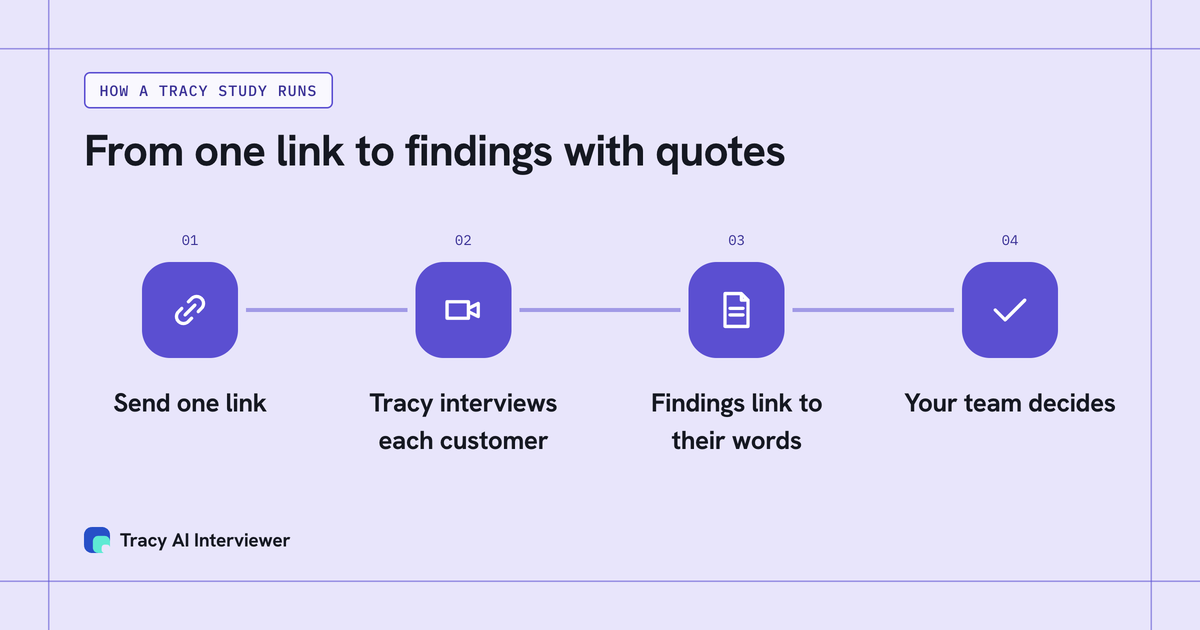
With Tracy, a study needs only a link, and every finding keeps its quote.
Does Conveo or Tracy ask better follow-ups?
Each probes something different. Conveo's pages say its moderator probes on actions it sees on screen in UX studies. Tracy follows up on what the customer says: it waits for the end of the thought and asks for the missing detail, such as who needed to know first when a report was wrong. In a win-loss interview, a discovery call or a concept test, the spoken follow-up is the real work, and the answer arrives in the customer's own words.
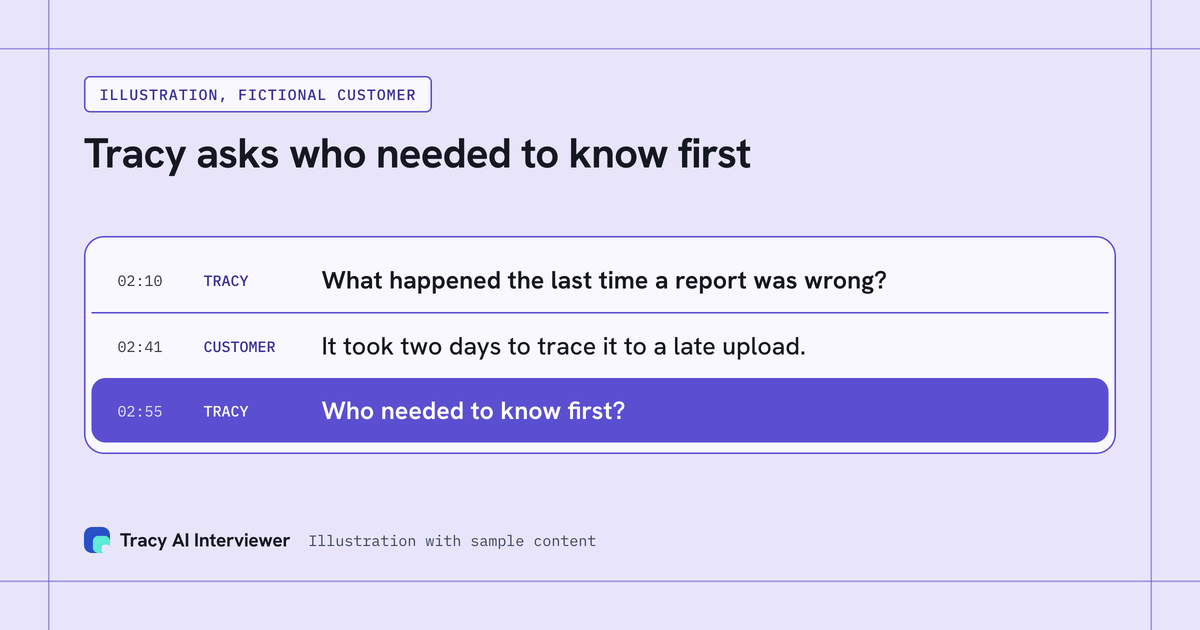
Tracy asks the next question from the customer's last answer.
Tracy vs Conveo: what a buyer weighs, criterion by criterion
Sources: Conveo's home and pricing pages (read 22 Nov 2026) and Tracy product documentation.
| Criterion | Tracy AI Interviewer | Conveo | Who leads |
|---|---|---|---|
| Job | Runs the interview and returns what each customer said. | Qualitative research platform with research experts. | Different scope. |
| Moderation | Follows up on what the customer says, in their context. | Voice and video; probes on screen actions in UX studies. | Conveo for screen-aware UX probing. |
| Evidence | Every finding is tied to the words and to the point in the recording. | Themes, quotes and insights extracted; stakeholder-ready reports. | Both. Conveo for finished reports. |
| Setup | Brief to guide, edit or bring your own; one link. | Launch in minutes; research team beside yours. | Even. |
| Stack | API and MCP for Claude, ChatGPT and others; Slack, WhatsApp, Zapier. | Open platform with MCP and API. | Even. |
| Security | Attested for SOC 2 Type II; the report can be requested. | GDPR compliance stated in its home page FAQ. | Tracy is SOC 2 Type II attested. |
| Price | Published per credit; no seats. | No plans or prices on the home page; Book a demo. | Tracy for a visible price. |
Scroll the table sideways to see all 4 columns.
What Tracy adds to customer research
- Customers open a link in their browser at a time that suits them; nobody books a calendar slot.
- Tracy turns what you want to learn into a draft interview guide, or runs yours, and asks the customer why behind each answer.
- Every finding points to the customer's exact words and the point in the recording where they said it. People are told about the recording before it starts, and your team decides what the findings mean.
Prices side by side
Conveo does not show prices on its home page, and its pricing page is a request for a demo. Tracy shows its price openly. One credit costs $1 and pays for each started 20 minutes of any interview that produced a result, which means 20 interviews of up to 20 minutes cost $20, 100 cost $100 and 500 cost $500. A session that produced no answers costs nothing, and a study needs no seats. For Enterprise, Tracy prices to your volume, and the pricing page explains how.
When Conveo quotes you, ask what a study costs at your volume, what the research team adds, whether seats or markets are billed on top and how long the minimum term runs. This is reasoning, not a quoted figure: a managed service staffed with research experts tends to cost more at small volume than a self-serve tool.
How to compare them on your own study
- Pick one question you need answered, such as why trial users stop after day three.
- In Tracy, describe what you want to learn, edit the guide Tracy drafts or bring your own, and send the link to five customers.
- Read what each person said to each question and open the moment behind each finding.
- Set it beside the notes and themes from your current process.
Set the first study up from the Connect page.
Which path fits you?
- Customer research teams: the customer research use case covers discovery and win-loss.
- Method: AI customer interviews without the calendar and how to run customer interviews.
- Shortlists: best user research tools and best AI-moderated interview platforms.
- Other tools: Tracy vs Listen Labs and Tracy vs dscout.
- Cost: Conveo pricing works through what a study costs.
Common questions
Tracy vs Conveo: which should a research team choose?
What does Conveo say about probing on screen?
Is there a Conveo alternative with a published price?
Can I run Tracy from Claude or ChatGPT?
Who decides what the findings mean?
Learn why customers answered as they did
Send one link; customers talk to Tracy whenever they like, and every finding stays tied to their words. Your first 3 results are free.
Try it free (opens in a new tab) Book a demo (opens in a new tab)
Your first 3 results are free. No card needed.
Sources
- Conveo, Home, retrieved 22 Nov 2026.
- Tracy AI Interviewer, Pricing, retrieved 11 Nov 2026.
- Tracy AI Interviewer, Connect, retrieved 11 Nov 2026.