In short
If no engineer can be spared for the first technical round, Tracy AI Interviewer interviews every applicant on video, starts on click at any hour, follows each answer in the applicant's own field and leaves a recording and what was said to each question. CoderPad fits better when engineers pair live in its shared multi-file pad in 40+ languages. Your team decides who moves on.
CoderPad vs Tracy depends on whether an engineer will be in the room. CoderPad's home page describes three products. Interview is live pairing in a shared editor. Screen is a coding assessment built on real-world engineering tasks. Qualify has applicants submit recorded video answers, which an AI reviewer ranks against a rubric. Tracy AI Interviewer holds a video conversation with each applicant and chooses every next question from the answer before it.
A pad moves at the speed of engineers' calendars. Tracy lets the whole applicant pool start round one at once, and your engineers read the results.
CoderPad fits when:
- an engineer will sit in every technical round and wants to code beside the candidate;
- you need a deep question library, proctoring, and ATS, SSO and API access, which CoderPad lists on Enterprise.
Tracy fits when:
- applicants outnumber the engineers you can spare, and each should get a first round at a time that suits them;
- you want questions that follow the person's own answers, and a recording a reviewer can open.
What CoderPad's live pad does well
A CoderPad Interview session puts interviewer and candidate in one multi-file editor, with real-work pads in 40+ languages and frameworks, interviewer scoring tools and code playback. Candidates can use AI in context, and the interviewer reviews prompt history, outputs and code edits. A G2 reviewer in October 2026 called the real-time collaborative editor the platform's best feature. The question library grows by plan, from 400+ on Starter to 1,400+ on Team and 4,000+ on Enterprise, and the ATS, SSO and API items are listed on Enterprise only. For the buyer reading reviews first, see CoderPad reviews. A pad assumes an engineer is free for each round. Running the round when nobody is free is the gap Tracy fills.
Is a pad a full IDE, and does Tracy's coding task replace it?
Neither is a full development environment. CoderPad describes a multi-file pad for real-work tasks, and one G2 reviewer wrote on 28 Aug 2026 that it is excellent for quick tests but does not replace a full IDE. Tracy goes smaller: the coding task is one part of a conversation, and Tracy asks about the approach as the work develops. If your round depends on running a service, wiring a framework or debugging beside the candidate, a pad is the right tool. If the round is about how a person reasons through a problem and what they would do differently, a conversation can carry it.
What Tracy adds to a CoderPad workflow
01 Reach every applicant
Each applicant starts on click, at any hour, with no scheduling and no engineer on the call. Everyone in the pool gets the same first technical round.
02 Ask the next question
Tracy follows the answer in the applicant's own field and waits for it. The coding task sits inside the conversation, and Tracy asks about the approach as the work develops.
03 Keep the evidence
Every result includes a recording, a timestamped transcript and a written assessment per question with its reasoning. An engineer who was not there can check it.
Why a live pad cannot hold a whole applicant pool
A pad session holds one engineer and one candidate at a time. Take 100 applicants and a 20-minute technical round for each: that is about 33 hours of live calls, booked one by one around engineers' calendars. At 1,000 applicants it is about 333 hours. If those hours cannot be spared, the pool is cut to a shortlist before anyone has spoken to the applicants.
In Tracy the 100 rounds start from a link and take no engineer hours on the call. Your engineers read the recordings and the answers for the people they want to meet.
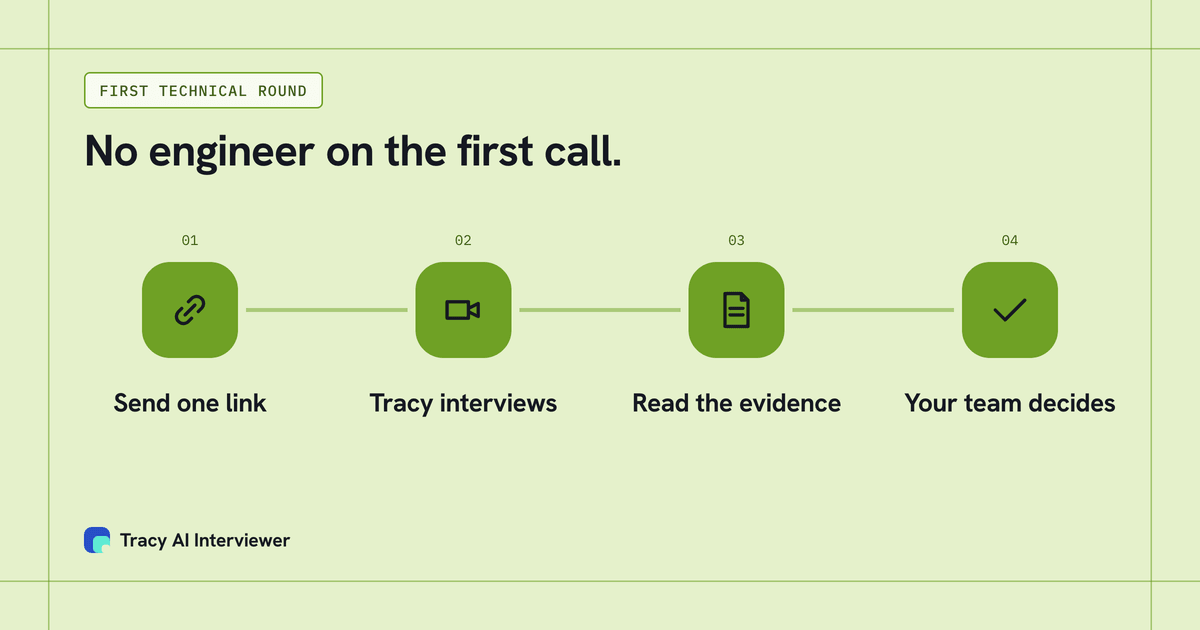
Tracy runs the first technical round; engineers read the result and decide.
CoderPad vs Tracy: buyer criteria side by side
CoderPad column: coderpad.io home and pricing pages, read 14 Nov 2026. Tracy column: Tracy's product pages. A cell reading not stated or not verified marks a gap in a page, not a missing feature.
| Criterion | Tracy AI Interviewer | CoderPad | Who leads |
|---|---|---|---|
| Who runs it | Tracy holds the interview; a person reads the result. | Your engineer pairs live in the pad. Qualify: recorded video, an AI reviewer ranks answers. | Tracy to take interviewers out; CoderPad for live pairing. |
| Interview depth | Questions that follow each answer; a coding task with questions on the approach. | Live pad, with the interviewer's own questions. Follow-ups in Qualify: not stated. | Level on coding. Tracy on questions from the person's answers. |
| Coding environment | One coding task within the conversation, not a full editor. | Multi-file pad, 40+ languages, playback. | CoderPad. |
| Question library | You describe the role and edit the questions Tracy drafts, or bring your own. | 400+ on Starter, 1,400+ on Team, 4,000+ on Enterprise. | CoderPad on library size. |
| Volume and start | Applicants begin from a link whenever they like; no yearly allowance. | 60 interviews a year on Starter, 360 on Team. | Tracy. |
| Evidence per result | Video of both sides, a timestamped transcript, the answer to each question. | Code playback and session recording; interviewer scoring tools. | Level on what is published. |
| Integrity | Signals shown to a reviewer, with evidence. Not proof. | Webcam proctoring and real-time alerts on Enterprise. | Level on integrity. |
| Price | $1 per credit per started 20 minutes; no seats. | Priced by plan tier, with an enterprise tier on request. Amounts: see CoderPad pricing. | Not compared |
| ATS and security | Beside Workable and Breezy HR; API and MCP. SOC 2 Type II attested. | Greenhouse, Lever, Ashby, Workday, SSO, API on Enterprise. SOC-2 Type 2 per CoderPad. | CoderPad on ATS depth. |
| Accessibility | Accessibility: not stated. | Not verified. | Not compared. |
Scroll the table sideways to see all 4 columns.
How the published workflows differ for the same technical role
Picture the same hire both ways: a senior backend engineer for a payments team. The CoderPad column restates how its pages describe a live session. The Tracy column is an illustration with a made-up applicant, so no real interview is shown.
One role, two workflows. CoderPad cells restate its pages; Tracy cells are an illustration.
| Step | CoderPad (from its pages) | Tracy (illustration) |
|---|---|---|
| Before | An engineer books the session and shares the pad link. | The applicant opens a link in a browser, needs no account, and is told the call is recorded. |
| Interview | Engineer and candidate write code together in the pad; the engineer sets the questions. | Tracy gives a coding task in the conversation and asks about trade-offs as the work develops. |
| Follow-up | The interviewer decides, in the room. | Nobody is in the room: Tracy picks the next question from the last answer. |
| What you receive | Playback, interviewer scoring, and prompt history where AI is used. | A recording, a timestamped transcript, the answer to each question and integrity signals with evidence. |
Do Tracy's follow-ups show more than a pad?
In a pad, the engineer in the room decides what to ask next, and a good one asks well. Tracy asks follow-ups inside the applicant's own field with no one in the room, for example why a retry queue needs a back-off, how a duplicate payment request gets caught, or what happens to in-flight work when a node restarts. The transcript sets each question beside the answer it came from. See coding interview follow-up questions and AI interviews for software engineers.
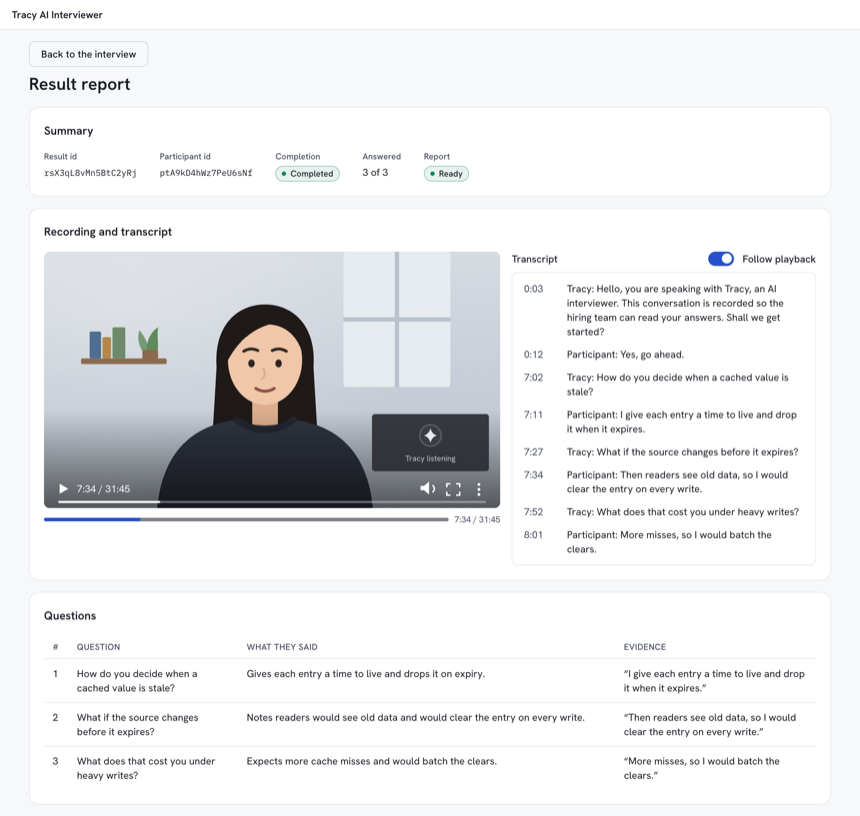
A recording and a timestamped transcript sit behind each result, with the follow-up after the answer it came from.
Can a reviewer check a CoderPad or a Tracy result?
Compare what a reviewer can open afterwards. A pad session leaves playback of the code as it was typed, and CoderPad lists webcam proctoring with real-time alerts on Enterprise. A Tracy video interview leaves the recording and, with integrity signals on, reports tab changes, gaze, face detection, answer delays, fullscreen exits and external screens, each with its evidence. In both, the output prompts a person to look. It is not proof of misconduct, and no decision is made inside the interview. Applicants see the recording notice on the join screen. See AI interview candidate experience.
What do CoderPad and Tracy cost?
CoderPad's plan prices and what extra interviews cost are on CoderPad pricing. Tracy charges $1 per credit, one credit per started 20 minutes, so a 45-minute interview costs $3 and a role with 20 applicants costs $60, with no seats. See also Tracy's pricing.
How do you test both before you commit?
Take one role with about 20 applicants. Ask CoderPad for its free trial and run the live rounds as you do now, noting engineer hours per applicant. In Tracy, say what the role needs, edit the questions Tracy drafts, and send the link to a second batch for the same role. Then compare three counts: engineer hours spent, follow-ups that brought out something new, and how quickly a reviewer could check a result against the recording. For the speed side, in one customer's result, time to hire fell from 44 days to 7, and Tracy handled the work of 53 full-time recruiters in one month.
Which path fits you:
- Technical hiring: technical interviews.
- High-volume hiring: volume hiring.
- Your stack: Connect lists the integrations.
- Other tools: best technical interview platforms.
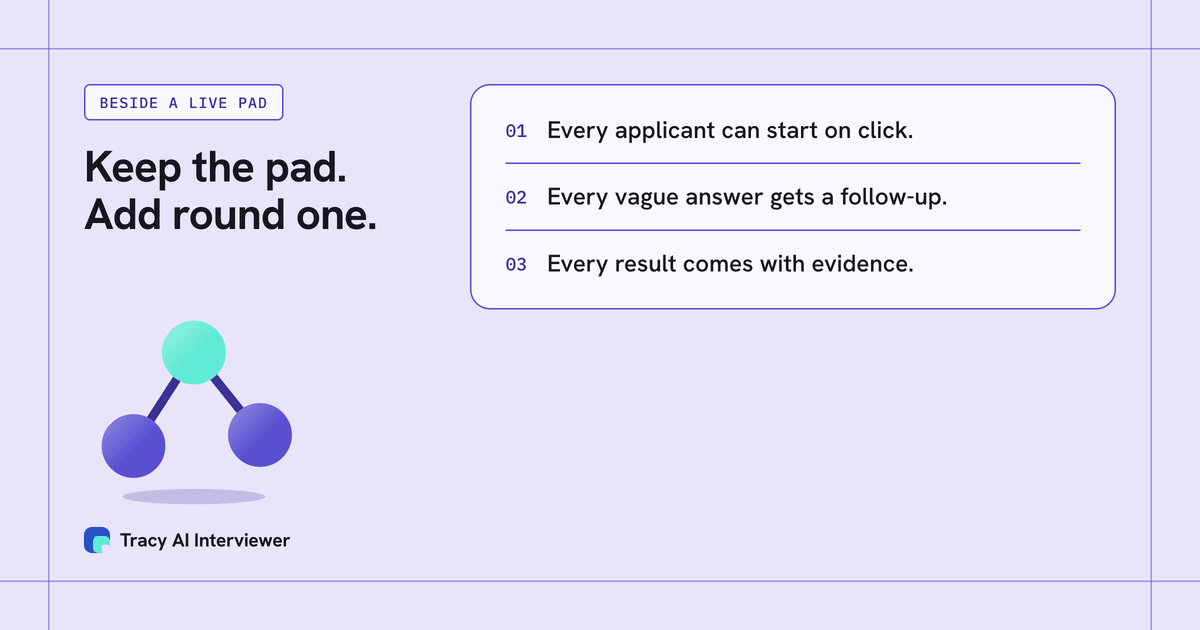
Three things Tracy adds beside a pad: a start on click, a follow-up, and evidence.
Common questions
Does CoderPad have an AI interviewer?
Who asks the follow-up questions in each tool?
Which CoderPad plan includes the ATS connectors?
Is Tracy better than CoderPad?
Can I use both?
Run one role through Tracy
Send your next technical role to Tracy, then read the follow-ups and report beside a pad session. The first 3 results are free.
Book a demo (opens in a new tab) Try it free (opens in a new tab)
Your first 3 results are free. No card needed.
Sources
- CoderPad: Pricing, retrieved 14 Nov 2026.
- Tracy AI Interviewer: Pricing, retrieved 14 Nov 2026.