In short
Granola's pricing is public and low: $0 for Basic, $14 for Business and $35 for Enterprise per user per month, which suits a team that takes its own calls. Tracy AI Interviewer runs the first-round interview for every applicant at $1 per credit, and each result comes with a recording, a timestamped transcript and a written assessment per question. Your team reads the evidence and decides.
What Granola's pricing does well
Granola pricing is public and per user, so a team sees the bill before it talks to anyone. Basic is $0 and includes AI notes, SOC 2 Type II and deletion of audio after transcription are listed on every plan, and Business adds MCP and API access. For one person's meetings that is good value.
A seat pays for the notes on a call. The hours of the calls themselves stay outside the bill, and that is where Tracy changes the sum: Tracy's bill follows how many interviews finish, and how Tracy's pricing works sets out the credit.
How much does Granola cost per month?
Granola costs $0 on Basic, $14 per user per month on Business and $35 on Enterprise, as listed on its pricing page on 14 Nov 2026. The page does not say whether the monthly figures assume annual billing.
Granola pricing by plan
Source: Granola pricing page, 14 Nov 2026. Prices are per user per month; the billing term is not stated.
| Plan | Price per user per month | What it lists |
|---|---|---|
| Basic | $0 | AI notes, AI chat, shared folders, templates |
| Business | $14 | Unlimited history, integrations, MCP and API access |
| Enterprise | $35 | Business plus SSO, admin controls, usage analytics, org-wide auto-deletion |
What limits and extras apply?
Basic keeps 30 days of meeting history; Business and Enterprise keep it unlimited. Integrations with Attio, Notion, HubSpot, Affinity and Zapier start on Business. SOC 2 Type II and deletion of audio after transcription are listed on every plan, so they add no cost.
The footer links Startup, Student and Nonprofit programs, but the pricing page does not state their terms, so ask before assuming a discount. Hiring features such as ATS sync or interview scorecards are not stated on the pricing page.
What does a team pay for Granola?
Granola charges per person who uses it, so count interviewers, not interviews. Take a team of five interviewers who hold 100 interviews a month between them. On Granola Business that is 5 seats at $14, or $70 a month and $840 over twelve months, if the $14 holds for a year, which the page does not state. Twenty interviewers would be $280 a month (our arithmetic at the listed $14).
That pays for notes on the calls your people still run. The Tracy side is in the table below, and the units differ, a seat against a finished interview, so compare them at your own count of people and interviews.
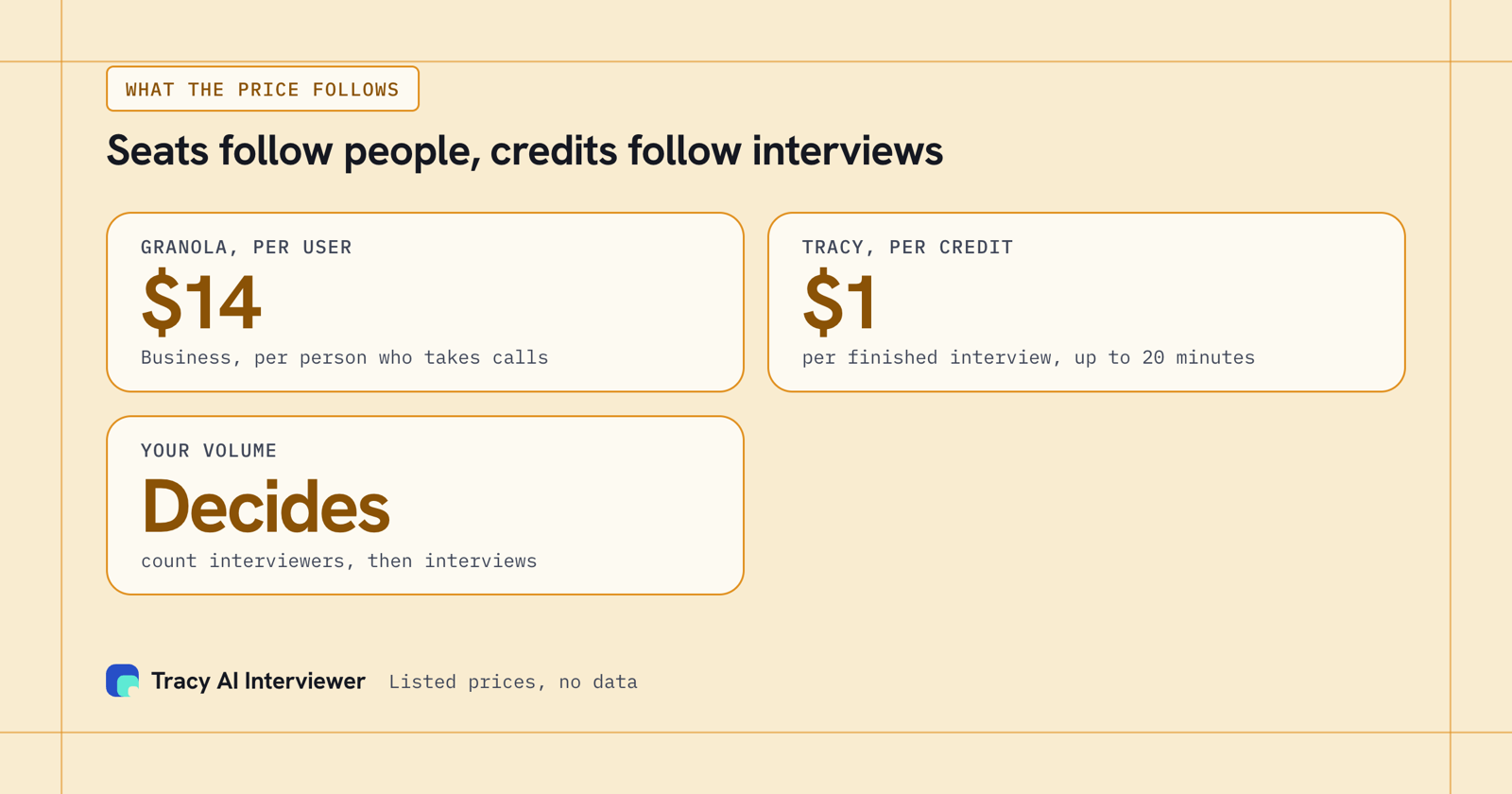
Granola's cost follows the people who take calls; Tracy's follows the interviews that finish.
What does Granola cost at 100, 500 and 1,000 interviews?
The number depends on how many people take the calls. This table makes one assumption of our own, so you can redo it: each interview lasts 20 minutes, and an interviewer spends 10 to 20 hours a month on interview calls, which gives a range of seats. Seats are rounded up. Granola's figures use the listed $14 for Business.
Monthly cost at three volumes
Our arithmetic, with the inputs shown. Interview hours are interviews times 20 minutes. Seats are those hours divided by 10 or 20 hours per interviewer, rounded up, at Business $14 per user per month. Tracy: $1 per credit, interviews of up to 20 minutes. Granola pricing page read 14 Nov 2026.
| Interviews per month | Hours of calls if people run them | Granola Business seats needed (our assumption) | Tracy |
|---|---|---|---|
| 100 | 33 hours | 2 to 4 seats, $28 to $56 | $100 |
| 500 | 167 hours | 9 to 17 seats, $126 to $238 | $500 |
| 1,000 | 333 hours | 17 to 34 seats, $238 to $476 | $1,000 |
Scroll the table sideways to see all 4 columns.
The hours the seat price leaves out
A seat price counts people, so the calls themselves never reach the bill. Take 1,000 interviews of 20 minutes: that is about 333 hours of live calls before scheduling and write-up, and a seat price does not change that figure. Granola's number is lower at every volume in the table because the plan buys notes, not interviews.
With Tracy the call runs without your team, so those hours come off the calendar, and each result arrives with a recording of both sides, a timestamped transcript and what each person said to each question. For a team that runs a few interviews itself, Granola at $14 is the sensible buy.
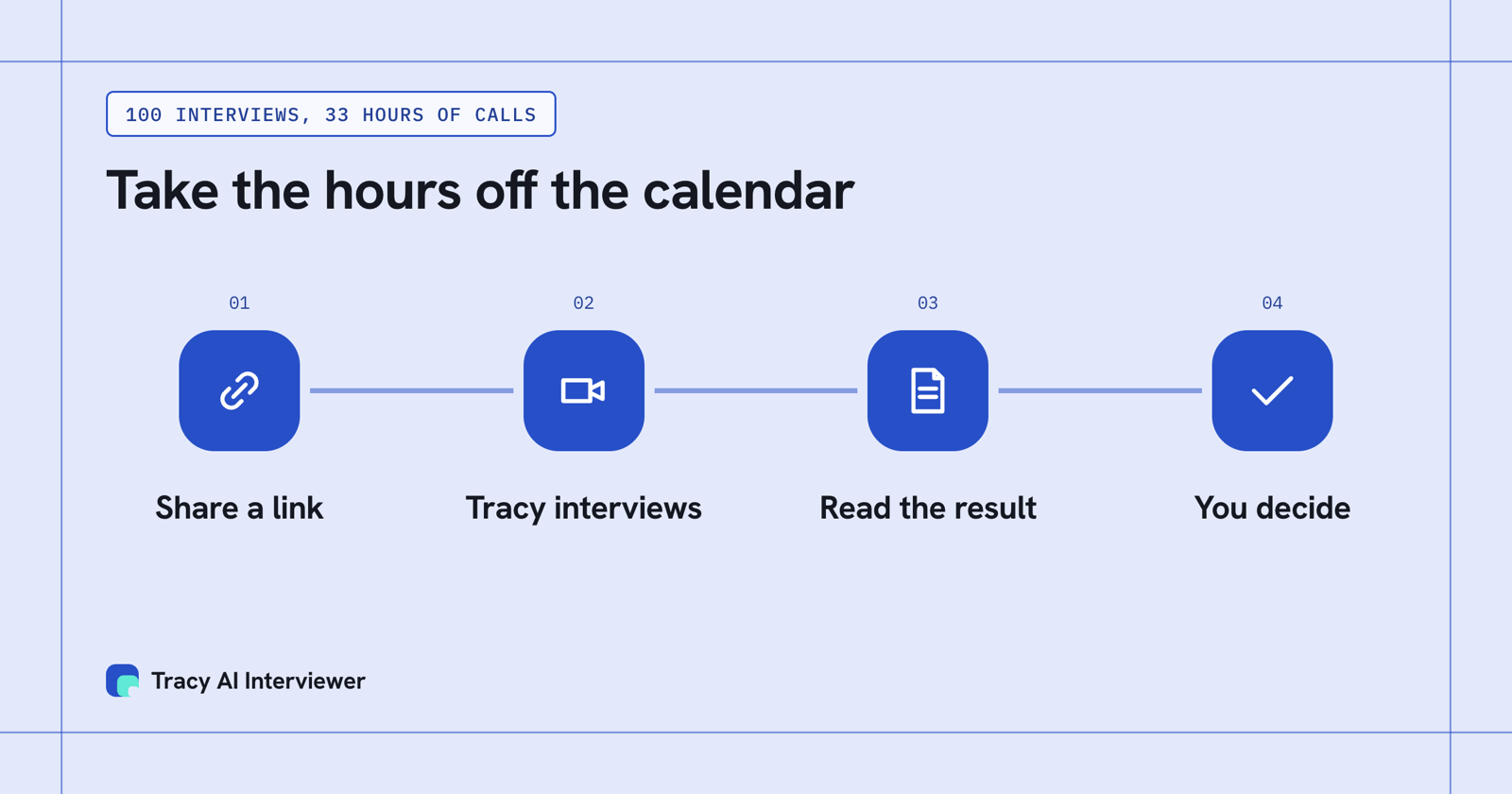
Tracy runs the call, so 100 interviews of 20 minutes take about 33 hours off the calendar.
What happens in a quiet month?
A per-seat price does not move with the number of interviews, so a team of five on Business pays the same in a month with ten interviews as in a month with a hundred. That is predictable, and it is wasteful in the quiet month. If only one recruiter needs notes, Basic at $0 keeps the cost flat at nothing, at the price of the 30-day history limit.
Tracy's bill follows finished interviews, so a month with few applicants costs little, and credits never expire. The trade runs the other way in a busy month: Granola's bill stays put while Tracy's grows with every interview that finishes.
Which five numbers settle the comparison?
Before you decide, count five things for one role: interviews per month, minutes per interview, how many people take the calls, minutes of write-up per call, and how many applicants wait for a slot.
The first two give the hours of calls. The third sets the seat count and so the Granola bill. The fourth shows what a notetaker saves, and the fifth shows what a notetaker leaves alone, because it does not add a single interview hour. If the fifth number is zero, Granola is the cheaper and simpler tool. If applicants wait weeks for a call, the seat price is not the cost that matters.
What Tracy adds to the first round
- Every applicant starts on click, at any hour, with no scheduling and no recruiter on the call. The 333 hours of live calls in 1,000 interviews come off your team's calendar.
- Tracy asks the next question in the applicant's own field and waits for the answer. A notetaker records what was said; Tracy shapes what gets said.
- Every result keeps a recording, a timestamped transcript and a written assessment per question with its reasoning. Your team reads it and decides.
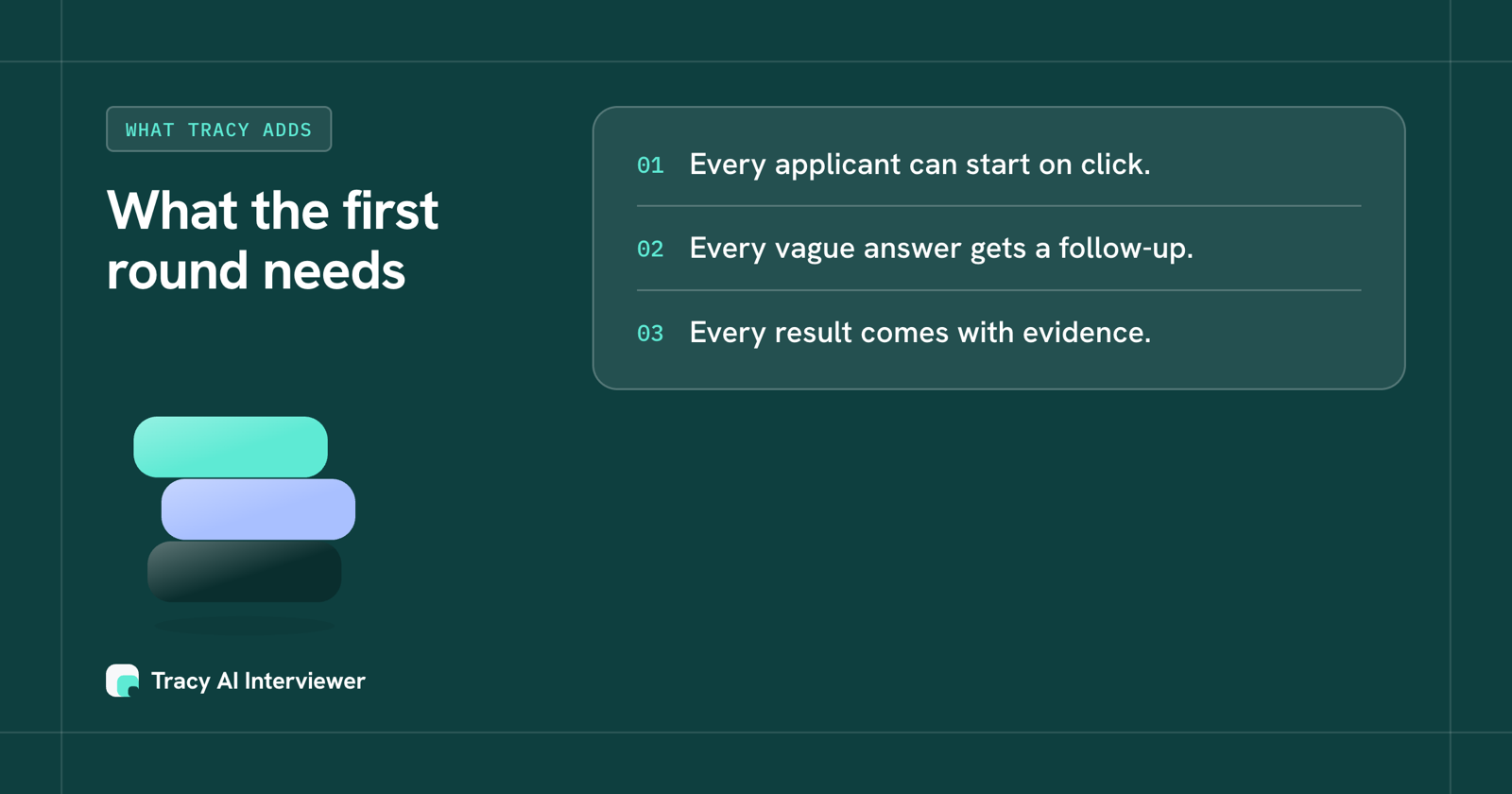
The first round needs reach, follow-up and evidence, not only notes.
What does Tracy cost?
A credit costs $1 and covers each started 20 minutes of an interview that produced a result. 15 minutes is one credit, $1; 34 minutes is two credits, $2. The first 3 results are free with no card, credits never expire, a session with no answers is never charged, and there are no seats or upfront cost. API and MCP access are included.
Enterprise is priced to your volume and adds a dedicated customer manager, a dedicated support channel and a setup customised to your workflow. Book a demo for a quote. See Tracy's pricing and AI interview cost.
What to ask Granola before you buy for interviews
If you are weighing Granola for interviews, ask these before you buy:
- Is the $14 billed monthly or annually, and what changes if the term changes?
- Can a panel share one interview's notes and transcript, and who sees them by default?
- Does an applicant tracking system connect? None is named on the pricing page.
- Do the Startup, Student or Nonprofit programs apply to your company, and on what terms?
For what users report, see Granola reviews.
Who should pay for Granola?
Granola suits one person's meetings, where a free plan and a $14 plan cost little; Granola reviews covers whether users find it worth it. If you want the first round to run for every applicant, price Tracy by interview. Tracy vs Granola compares them on depth, evidence and stack, and Read AI pricing does the same arithmetic for another notetaker.
Which path fits you?
- Technical hiring: technical interviews covers role-specific interviews with follow-ups.
- High-volume hiring: volume hiring covers applicant waves.
- Integrations: Connect lists what Tracy connects to.
Common questions
How much does Granola cost per month?
Is Granola free?
Does Granola have annual pricing?
How does Granola pricing compare with Tracy?
Is there a Granola price for teams?
Price one finished interview in Tracy
Describe a role and Tracy drafts the questions. The first 3 results are free, so you can work out your cost per finished interview.
Book a demo (opens in a new tab) Try it free (opens in a new tab)
Your first 3 results are free. No card needed.
Sources
- Granola, Pricing, retrieved 14 Nov 2026.
- Tracy AI Interviewer, Pricing, retrieved 14 Nov 2026.
- Tracy AI Interviewer, Connect, retrieved 14 Nov 2026.