In short
Granola's reviews are strong, 4.6 on G2 from 197, and they describe quiet notes on calls people run. Tracy AI Interviewer adds the first round for every applicant: a two-way video interview, follow-ups in their own field and a recording, a transcript and a written assessment per question. Your people keep Granola for the calls they hold, and your team decides who moves forward.
Granola's G2 reviews are strong, but they come from people who take notes on calls they run, not from teams running a first round for a larger applicant pool. G2 lists 197 reviews, 151 five-star, 39 four-star and 7 three-star, and none lower. The sample read here is the first 10 reviews G2 served, dated 13 to 30 October 2026; the counts below are ours. Granola helps the person on a call remember it. A first round for 200 applicants needs a call that nobody has to hold. For a direct comparison, see Tracy vs Granola.
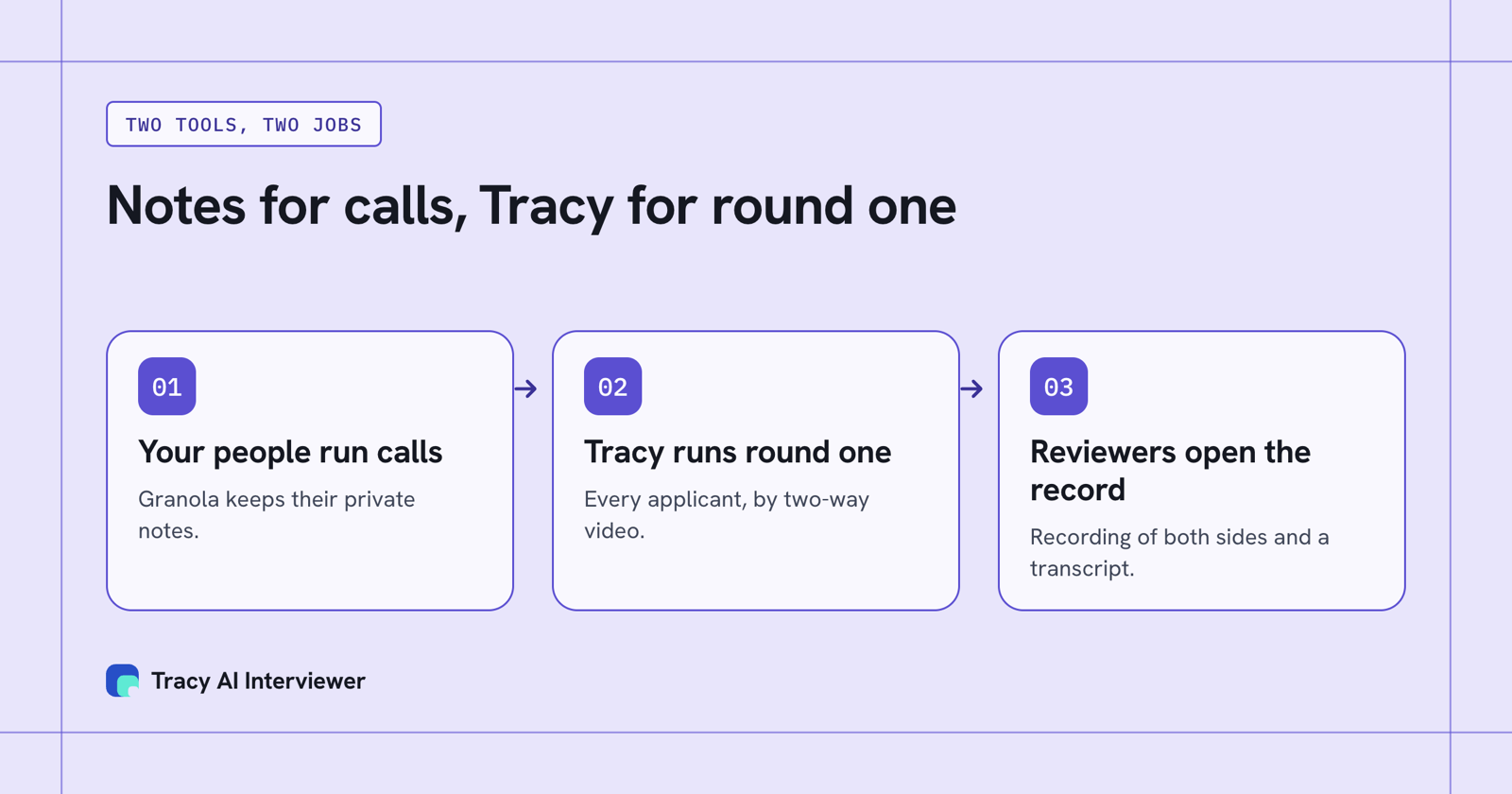
Your people keep the notes for their calls, and Tracy runs the first round.
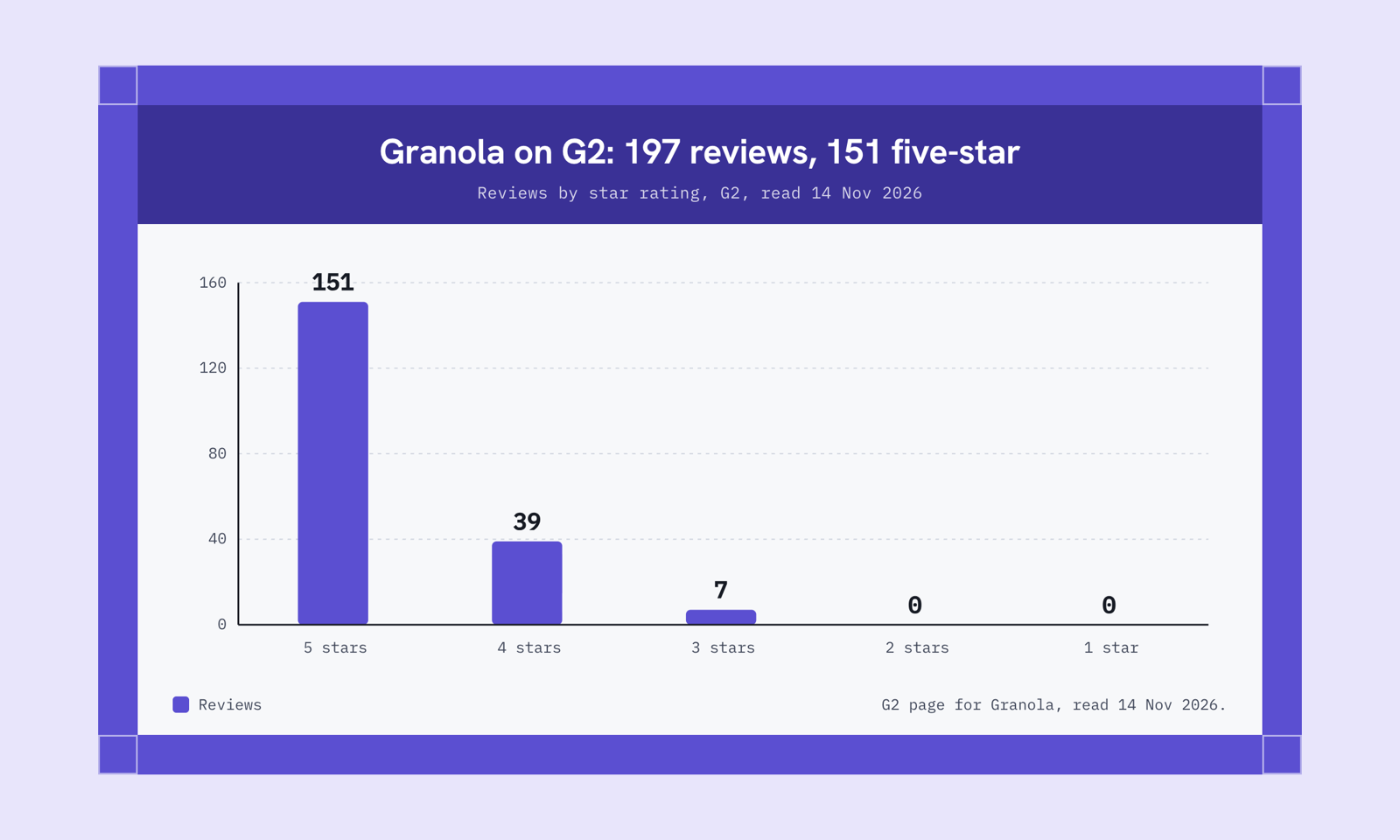
151 of Granola's 197 G2 reviews are five-star, and none is below three stars.
What do reviewers like about Granola?
Reviewers like how little Granola asks of them. Ease or simplicity comes up in 5 of the 10 reviews, and action items or decisions in 5. Summaries are praised in 4, and 2 like the templates, called Recipes. Two reviewers like that no bot joins the call: a software engineer writes that "the bot doesn't get added to our calls" (14 Oct 2026). A virtual assistant says the transcription in Canadian French is "good enough that I trust it for meeting minutes" (30 Oct 2026), and estimates the app saves 30 to 45 minutes per meeting on minutes and follow-ups. G2's own summary says users praise effortless note-taking and fit with meeting platforms. That praise is about notes on a call a person is already holding. A first round with no person on the call is a different job.
What do reviewers complain about in the first 10 G2 reviews?
Source: first 10 Granola reviews G2 served, dated 13 to 30 Oct 2026, read 14 Nov 2026, of 197. Counts are ours, and a review can name more than one issue. A count of 1 is one reviewer's view, not a pattern.
| Issue raised | Reviews (of 10) | One quote | Reviewer and date |
|---|---|---|---|
| Integrations | 5 | "deeper native integrations with project management tools and Slack" | Premium Resolution Partner, mid-market, 13 Oct |
| Missed detail or speakers | 4 | "may miss important details or misunderstand the context of a discussion" | Software developer, small business, 13 Oct |
| Mobile app | 3 | "The iPhone app also doesn't feel as good as the desktop version." | Business development rep, small business, 13 Oct |
| Transcript export | 1 | "I can't download a full transcript as is." | Virtual assistant, small business, 30 Oct |
| Model updates | 1 | "changes to the underlying models can make the output considerably different" | Non-profit president, 13 Oct |
Scroll the table sideways to see all 4 columns.
Two of these match Granola's own pages. Integrations with Notion, Zapier and HubSpot sit on the $14 Business plan, and Basic keeps 30 days of meeting history. One reviewer lists "Save to Notion is locked behind the paid plan" as a dislike. Speaker mix-ups appear too: a software engineer writes that "sometimes the AI mixes up who said what when multiple people are talking" (14 Oct 2026).
The mobile complaints are specific. An IT director says the app does not record the other side of a call for Android users on Bluetooth headsets (17 Oct 2026), and a business development rep cannot run Granola on two parallel meetings on the same laptop (13 Oct 2026). Each is one reviewer's experience.
Who does Granola suit?
Granola's reviewers are mostly individuals and small teams: 7 of the 10 work at small businesses with 50 or fewer employees, 2 at mid-market companies and 1 at a non-profit. One virtual assistant uses it for board and committee minutes and project follow-ups. The value reviewers describe is time saved on write-ups.
That is a clear fit: one person, many meetings, notes they keep. It is less clear for a hiring team that needs the same record in front of several reviewers, which is where the next sections turn.
What do the reviews mean for a hiring team?
None of the 10 reviews mentions interviews, hiring or candidates, and Granola's home and pricing pages do not state interview features either. The reviews say little about screening; reviewers describe quiet capture for the person on the call.
They also point to limits that matter for a panel. Audio is deleted after transcription, and notes are private until shared, so a reviewer who was not on the call has a transcript and notes but no recording. One reviewer wanted a full transcript to download for formal board minutes; a panel needs the same thing, a complete record each reviewer can open. Speaker mix-ups matter more when several people judge one conversation.
How should a hiring team read reviews of a notetaker?
Start with whether the reviewers do your job. Search the reviews for "interview", "candidate" and "recruiter"; in these ten there are no hits, so the praise tells you about meetings, not screening.
Next, look for sharing. A panel needs the same notes and transcript in front of several people, and a review that says notes are private until shared describes a design choice a panel has to work around. Then check dates and plan: a complaint about Basic may disappear on Business, as the Notion line does. A short sample of ten reviews can only suggest where to look, so check each point on the pricing page and in a trial.
What 200 applicants add to a notetaker's limits
The problem is a record that works for one person and thins out across a panel. Say a panel judges 200 applicants in first-round calls of 20 minutes. That is about 67 hours of live calls, and no reviewer can sit in all of them. What each reviewer can open is the record: with Granola's audio deleted after transcription, that is a transcript and notes, and speaker mix-ups appear in the reviews.
For that job these limits are gaps. That is our reading, not a reviewer's. Tracy's result puts a recording of both sides beside a timestamped transcript, so a reviewer who was never on the call can still check any answer.
Granola or Tracy: which fits?
Granola fits when your own people hold the calls and want quiet notes; its reviewers' praise is real. Tracy AI Interviewer fits when the first round has to run for every applicant. The applicant opens a link, Tracy interviews them by two-way video and asks about what they said, and the reviewer gets a recording of both sides, a timestamped transcript and what each person said to each question. For the side-by-side, see Tracy vs Granola.
The two can sit side by side. A team can keep Granola for the calls its people hold, such as later rounds and client meetings, and use Tracy for the first round. On Enterprise, Tracy can also take notes on calls your people run.
What Tracy adds to a first round
01
Reach every applicant
Each applicant can start on click, at any hour, with no scheduling and no recruiter on the call. Nobody has to hold the call for the first round.
02
Ask the next question
Tracy follows the answer in the applicant's own field and waits for the end of the thought. Each interview is Tracy and one applicant, so there are no speakers to untangle.
03
Keep the evidence
Each result comes with a recording of both sides, a timestamped transcript and a written assessment per question with its reasoning. A reviewer who was not there can check it.
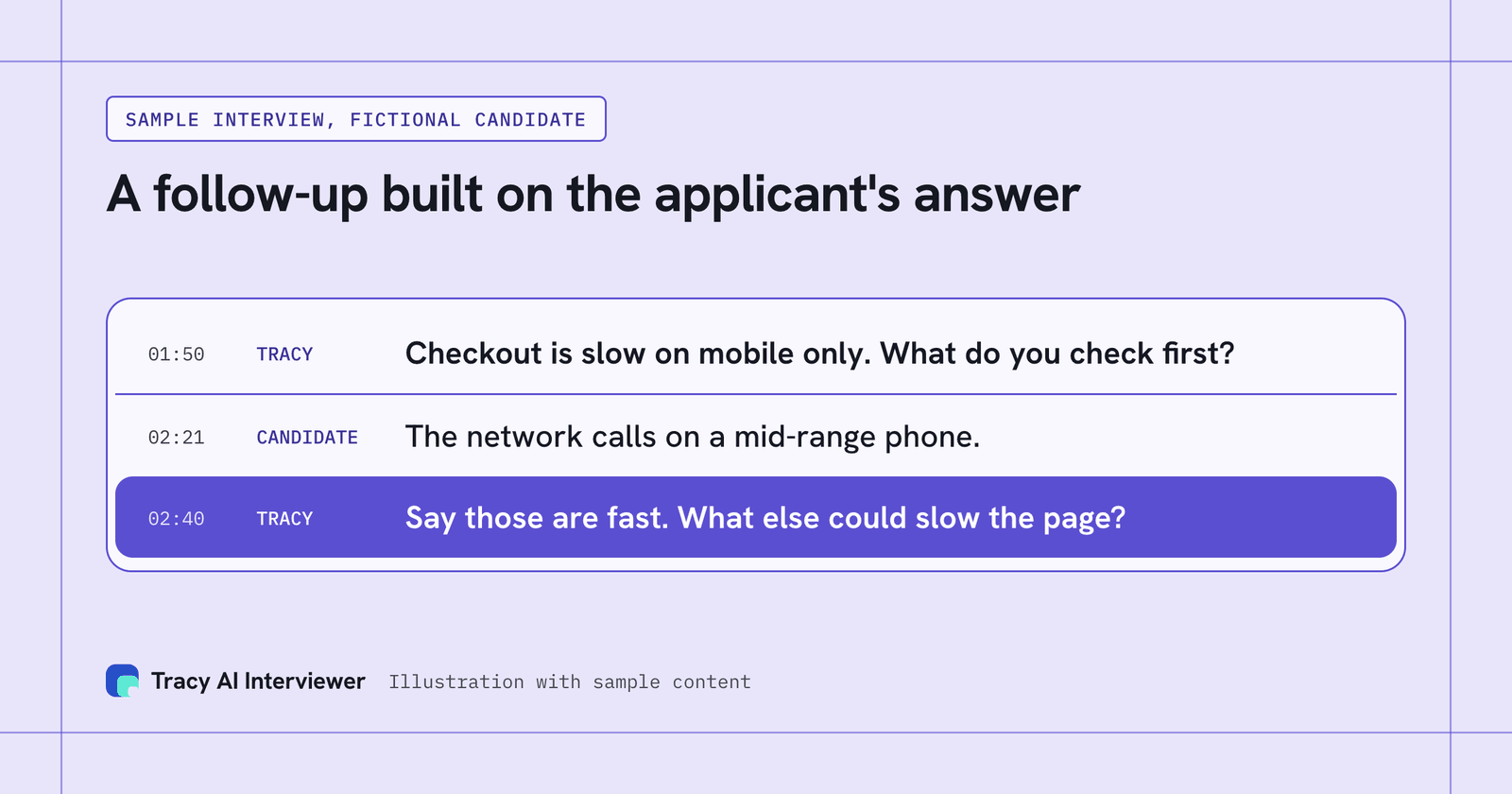
Tracy asks the next question from the applicant's own answer.
What a reviewer of a Tracy result gets
Sources: Granola reviews on G2, first 10 served, read 14 Nov 2026; approved Tracy product records.
| Point reviewers raise about notetakers | What a Tracy result gives |
|---|---|
| Speaker mix-ups | Each interview is Tracy and one applicant, with a timestamped transcript and a recording of both sides beside it. |
| Missed detail | A reviewer reads the timestamped transcript and recording behind each answer. |
| Integrations | API, MCP, Slack, WhatsApp, Workable, Breezy HR and Zapier. |
What does Granola cost, in brief?
Granola lists Basic at $0, Business at $14 and Enterprise at $35 per user per month, with the billing term not stated.
Which path fits you?
- Technical hiring: technical interviews covers role-specific interviews with follow-ups.
- High-volume hiring: volume hiring covers applicant waves.
- Applicant side: participant experience shows what the person interviewed sees.
- Other notetakers: Granola alternatives for interviews.
Common questions
What is Granola's rating on G2?
What do Granola reviews complain about most?
Are there Granola reviews from recruiters?
Is Granola good for interviews?
Does Granola record the call?
Are Granola notes private?
Run one role in Tracy
Describe the role and Tracy drafts the questions, then compare its report with your notes. The first 3 results are free.
Book a demo (opens in a new tab) Try it free (opens in a new tab)
Your first 3 results are free. No card needed.
Sources
- Granola reviews on G2, retrieved 14 Nov 2026.
- Granola, Pricing, retrieved 14 Nov 2026.
- Tracy AI Interviewer, Pricing, retrieved 14 Nov 2026.
- Tracy AI Interviewer, Connect, retrieved 14 Nov 2026.