TLDR Tracy AI Interviewer interviews every QA applicant from your job description and follows up on what each person says, so you see how they test, not what they memorised.
Use the 15 QA engineer interview questions below, grouped by what they test, each with a follow-up and what to listen for.
Every result keeps a recording, a timestamped transcript and a written assessment per question for a person to review.
Next step: paste these questions into a Tracy interview for one open role.
We make Tracy AI Interviewer.
Fifty QA applicants list Selenium, Cypress and test plans. The list does not say what they do when a test fails one run in twenty. QA engineer interview questions for a first round have to expose how someone tests, and a definition recited from a course will not.
These are for the hiring manager asking the questions. Each has a follow-up and a note on what a strong answer contains.
Tracy AI Interviewer runs the part that does not scale. She asks each applicant questions from your job description, follows up on what they just said and waits for the end of the thought. A recording, a timestamped transcript and a written assessment per question go to your team, who decide. For developers, see software engineer interview questions, and for the wider workflow, hiring at volume.
Fifteen QA engineer interview questions, grouped by what they test
Group 1: test design
| Ask | Follow up with | Listen for |
|---|---|---|
| 1. Here is a login form with email, password and "remember me". How would you test it? | Which three tests do you run first? | Covers boundaries, invalid input, state and security. Orders by risk. |
| 2. A feature has ten settings with two values each. How do you decide what to test? | What would you leave untested? | Risk-based thinking, combinations rather than all 1,024. Says what is left. |
| 3. How do you write a test case so someone else can run it? | Show me a bad one you rewrote. | Preconditions, steps, an expected result, one idea per case. |
Group 2: finding and reporting bugs
| Ask | Follow up with | Listen for |
|---|---|---|
| 4. Tell me about the best bug you found. | How did you know it was a bug and not a misunderstanding? | A real case, a reproduction, a check against the spec. |
| 5. A developer says "cannot reproduce". What now? | What do you attach next time? | Environment, build, data, logs, a recording. Stays calm. |
| 6. How do you decide a bug's severity? | When did you disagree with a product owner about one? | Impact and frequency in user terms. Argues with evidence. |
Group 3: automation
| Ask | Follow up with | Listen for |
|---|---|---|
| 7. What do you automate first, and what do you leave manual? | Tell me about a test you stopped automating. | Stable, repeated, high-value checks. Counts maintenance cost. |
| 8. A test fails one run in twenty. What do you do? | When do you delete it? | Treats it as a defect. Checks timing, shared data and order. Quarantines with a deadline. |
| 9. A check could be a unit, API or UI test. How do you choose? | Where does most of your automation sit? | The lowest layer that can catch the bug. Few UI tests. |
Group 4: release and risk
| Ask | Follow up with | Listen for |
|---|---|---|
| 10. A release is due tomorrow and testing is half done. What do you tell the team? | What would you ask them to decide? | Reports what is covered and what is not. Lets the owner choose. |
| 11. What do you check before release beyond the tests? | What did you miss once? | Rollback, monitoring, migrations. An honest miss. |
| 12. How do you test something with no specification? | Who do you ask first? | Explores, asks users and developers, writes assumptions down. |
Group 5: collaboration and judgement
| Ask | Follow up with | Listen for |
|---|---|---|
| 13. How do you work with developers before code is written? | Describe a requirement you questioned. | Raises ambiguity early. Uses examples. |
| 14. A teammate's tests all pass but customers report problems. What do you look at? | What would you change in the suite? | Asks what the tests miss. Checks user paths and production feedback. |
| 15. Tell me about a time you decided not to test something. | What happened? | A reasoned trade-off. Owns the result. |
Table 1. The 15 questions, each with a follow-up and what to listen for (written by us).
A strong answer names the risk, and a weak one names the tool
The difference shows up in the second answer. These pairs are written by us as examples of how it sounds, not quotes from real candidates.
| Weak answer | Strong answer | |
|---|---|---|
| Question 1, the login form | "I'd test valid and invalid logins." | "Lockout after repeated failures, reset links that expire, and what 'remember me' keeps after the browser closes. Those carry the most risk." |
| Question 8, a flaky test | "Rerun it until it passes." | "A test that fails one in twenty is a defect. I'd check timing and shared data, quarantine it and give it a deadline." |
| Question 10, half-finished testing | "We'll push the date." | "Here is what is covered and what is not. The untested part touches payments, so I'd ask the product owner to decide." |
Table 2. Example weak and strong answers (illustrative, not from real candidates).
Listen for how the person tests, not what they memorised. A definition of boundary value analysis tells you what they read. A boundary they found in your own form tells you how they work.
One follow-up chain shows where the real answer starts
This is an illustration with sample data, not a real interview. The candidate is fictional. It starts from question 8 and shows the shape of what Tracy runs.
Tracy: A test fails one run in twenty. What do you do?
Candidate (fictional): I rerun it and check whether it is flaky.
Tracy: What would you check if it keeps failing at that rate?
Candidate: Timing and shared data first. A wait that is too short, or tests that depend on order.
Tracy: Tell me about the last flaky test you fixed.
Candidate: A checkout test that read the cart before the API had answered. I replaced a fixed wait with a check on the response, and it stopped failing.
The first answer is a reflex. The third shows whether they found a cause.
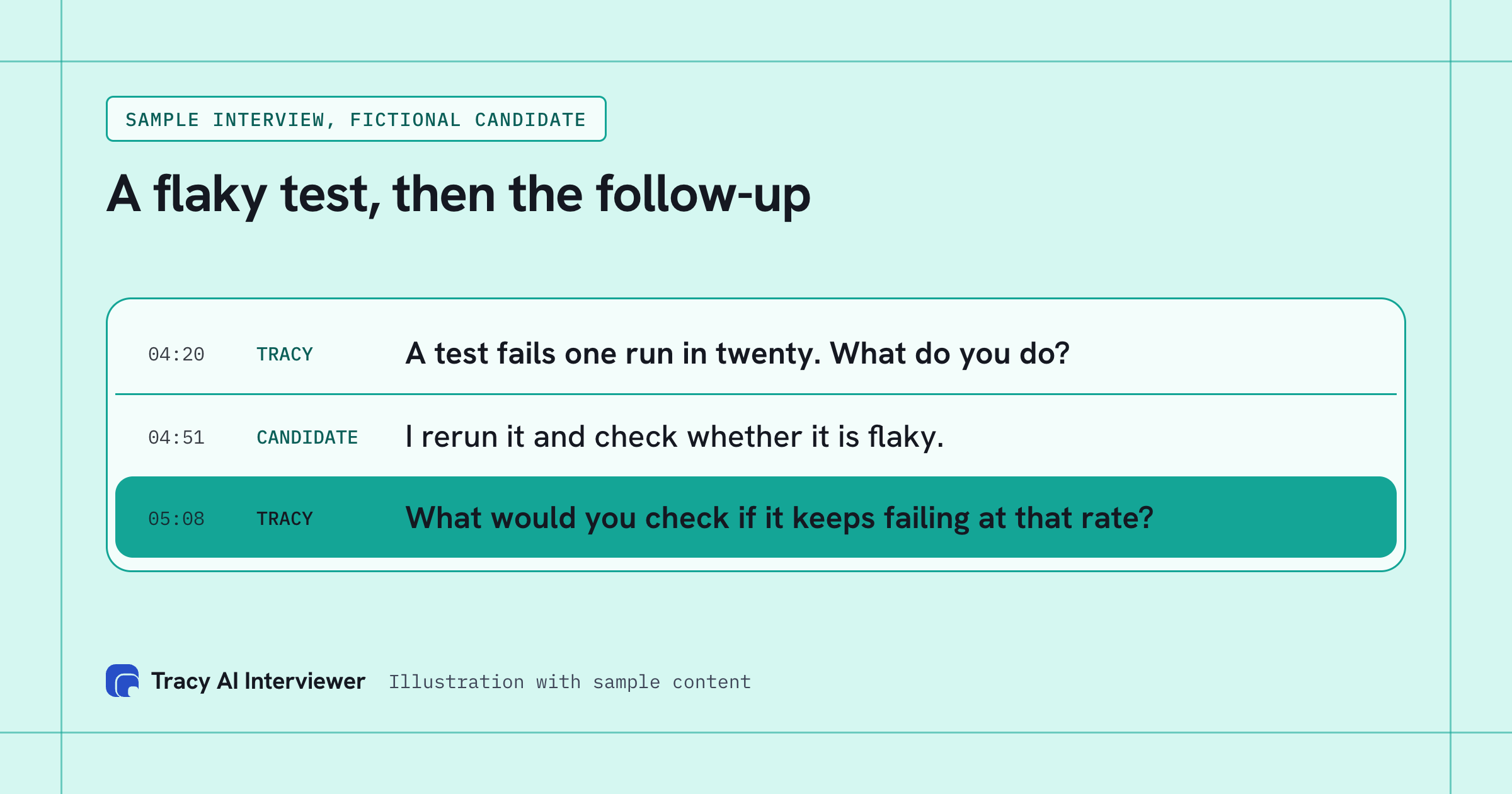
A follow-up built on the candidate's own answer shows whether they found a cause.
Run the interview for every applicant without losing the follow-up
A QA opening can draw hundreds of applicants, many early in their careers, and a live call for each does not fit your week.
- Questions from the role. Paste the job description and Tracy drafts questions, such as how to test a login form, that you edit or replace with your own. See the product page.
- No scheduling. Each applicant opens a link in a browser, at any hour, with no account. The join screen says the conversation is recorded and transcribed. Steven Perry, Account Executive at IT Resources, an IT staffing firm in Tampa, US, says "By the time they finish with this platform, they're even laughing and joking." See the participant experience.
- Evidence behind every result. Your lead gets a recording, a timestamped transcript and a written assessment per question, so a flaky-test answer can be checked against what was said.
Pricing is $1 per credit, one credit per started 20 minutes of an interview that produced a result, so a 34-minute interview costs $2. You pay nothing for the first 3 results (no card), there are no seats, and a session with no answers is never charged. See pricing. Send us one role and we will build the interview plan in days.
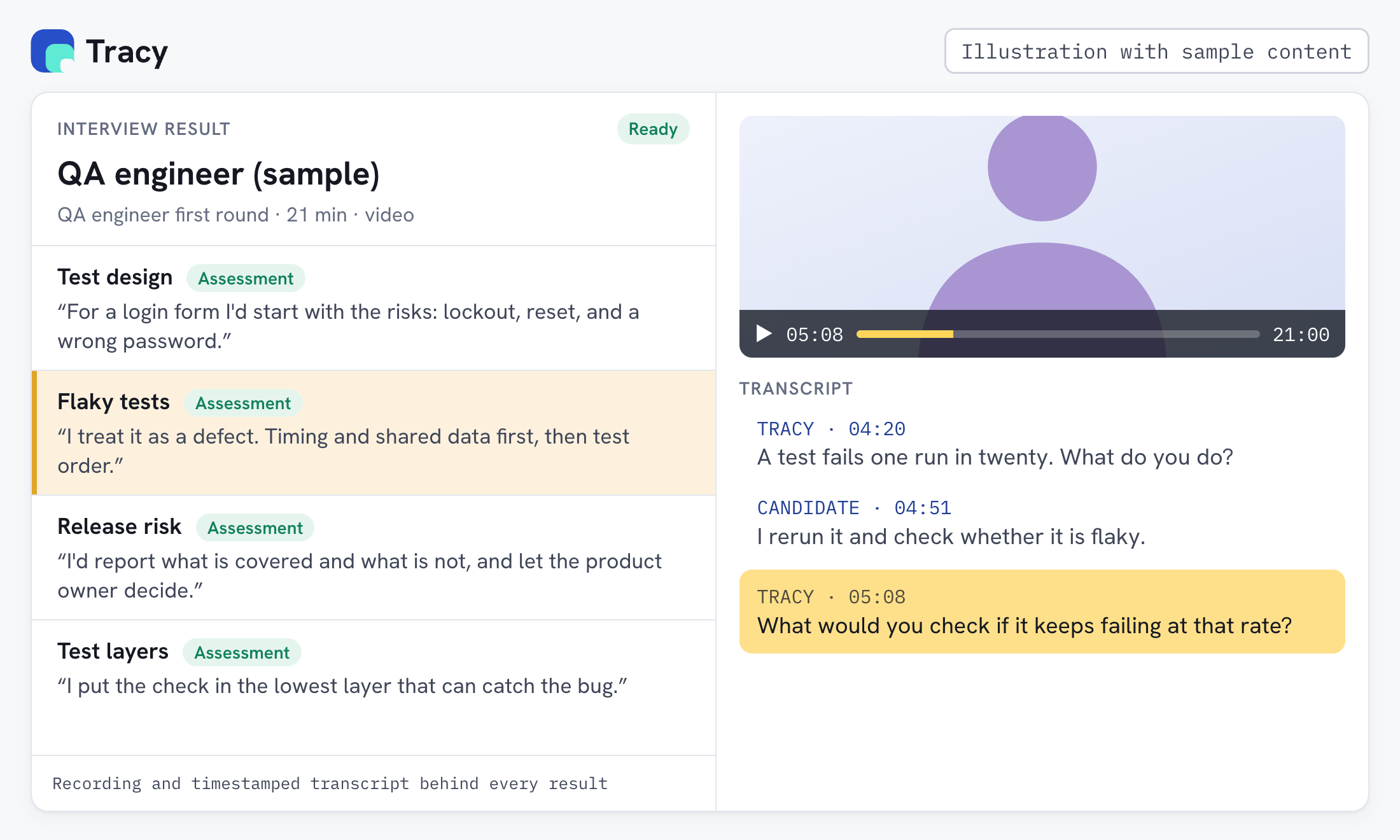
A reviewer can open the recording and transcript behind each assessment.
Keep three checks with people
- A senior tester reads five or six transcripts blind. If they disagree with the written assessments, fix the questions before you invite more people.
- A hands-on exercise for finalists. Give them a small feature to test on your own product. An interview shows how someone thinks, and the exercise shows how they find things.
- The decision. A person decides from the evidence.
For a handful of applicants, a call with your test lead is a reasonable choice; see AI interview vs human interview. The case for Tracy starts when applicants outnumber your testers' hours. Start with one role and 20 applicants, and have one tester read every result. Note how many finish, how long it takes from application to result, and how often the tester disagrees with an assessment. See AI interview reports.
Questions
What are good QA engineer interview questions?
What are good QA engineer interview questions for freshers?
How do you assess answers to QA engineer interview questions?
Can an AI interviewer interview QA engineers?
Create a Tracy interview for this exact role from these questions, then read the recording and report. Or send us one role and we will build the interview plan, with a recording and report you can check. Try it free · Book a demo
Sources
- Tracy AI Interviewer home page, retrieved 9 Nov 2026.
- Tracy AI Interviewer pricing, retrieved 9 Nov 2026.
- Tracy AI Interviewer Connect page, retrieved 9 Nov 2026.