
TLDR Tracy AI Interviewer interviews every analyst applicant, with a SQL or debugging task inside the interview and follow-ups on their approach, so your analytics lead sees how someone reasons from data.
Use the 15 data analyst interview questions below, each with a follow-up and what to listen for.
A recording, a timestamped transcript and a written assessment per question sit behind every result.
Next step: paste five of these questions into a Tracy interview.
We make Tracy AI Interviewer.
An analyst opening brings in two hundred applications with SQL, Excel and "storytelling with data" on every CV. Your analytics lead has an hour a day for screening. The CV shows which tools someone has used. It does not show whether they would question a number before presenting it. Data analyst interview questions should test that habit.
These are for the analytics lead or hiring manager. They ask for reasoning about messy data, metrics, queries and communication, and each has a follow-up and a note on what a strong answer contains. Most work as a spoken conversation, so they suit a first-round interview before any take-home. Candidates can use them to practise.
Tracy AI Interviewer runs the part that does not scale. She asks each applicant in their own field, follows up on what they just said and waits for the end of the thought, with a SQL or debugging task inside the same interview when you want one. For the adjacent role, see data scientist interview questions, and for the process, technical interviews.
Fifteen data analyst interview questions, grouped by what they test
Pick one or two questions from each group. Ask the follow-up only after the first answer, and write down what a strong answer contains before the first candidate joins. Use invented tables and numbers in every case, so nobody needs your data.
Group 1: questioning the data
| Ask | Follow up with | Listen for |
|---|---|---|
| 1. Weekly active users dropped 12 percent on a Monday. What do you check first? | What would make you say it is a tracking problem? | Checks the definition, tracking changes, a holiday or release, and segments before any story. Ranks by cost to check. |
| 2. You get a table with no documentation. How do you learn what it holds? | What would you ask its owner? | Row count, keys, null rates, date range, a spot check against a source, then a short list of questions. |
| 3. Tell me about a number you had to take back. | What check do you run now? | A real case, an owned mistake, a concrete habit. |
Group 2: SQL in conversation
| Ask | Follow up with | Listen for |
|---|---|---|
| 4. A join doubles your revenue total. What happened? | How would you prove it? | Fan-out from a one-to-many join. Compares row counts before and after, aggregates first or joins on a unique key. |
| 5. Find customers who bought in January but not in February. How would you write it? | What changes if there are ten million rows? | Anti-join or a left join with a null test, a clear date range. Thinks about indexes and sampling when asked. |
| 6. When would you use a window function instead of a group by? | Give a case from your work. | Running totals, rankings, previous-row comparisons, anything that keeps row detail. A real example. |
Group 3: metrics and causes
| Ask | Follow up with | Listen for |
|---|---|---|
| 7. Conversion rose after a redesign. Did the redesign cause it? | What else changed that week? | Asks about timing, traffic mix, seasonality and a control. Says what would change their mind. |
| 8. Pick a metric your team uses. How could it mislead? | How would you tell your manager? | A real failure mode such as averages hiding a skew. Proposes a second metric and says it plainly. |
| 9. An A/B test shows a 2 percent lift on a small sample. What do you say? | What would you want before acting? | Sample size, run time, interval or noise. Does not declare a winner from one number. |
Group 4: tools and quality
| Ask | Follow up with | Listen for |
|---|---|---|
| 10. How do you check a spreadsheet or query somebody else wrote? | What do you do when you cannot reproduce their total? | Reads the logic, recomputes a slice, traces to the source. Reports differences without blame. |
| 11. What would you automate in a weekly report, and what would you leave manual? | What breaks first when you automate it? | Names a specific step, a check that runs with it and a failure they have seen. |
| 12. How do you decide which chart to use? | When did a chart mislead you? | Starts from the question. Names a bad truncated axis, a pie with eleven slices or a dual axis. |
Group 5: working with the business
| Ask | Follow up with | Listen for |
|---|---|---|
| 13. A stakeholder asks for a dashboard. What do you ask before you build it? | What would make you say no? | Asks what decision it supports and who acts on it. Says no to a dashboard nobody opens. |
| 14. Explain a regression result to someone who has never taken statistics. | What would you leave out? | Plain words, one example, honest about uncertainty. |
| 15. Your analysis contradicts what the director believes. What do you do? | How do you know you are right? | Checks the work again, shows the evidence, stays open to a missing factor. |
Table 1. The 15 questions, each with a follow-up and what to listen for (written by us).
A strong answer questions the number, and a weak one explains it
The difference shows up in the second answer. These pairs are written by us as examples of how it sounds, not quotes from real candidates.
| Weak answer | Strong answer | |
|---|---|---|
| Question 1, the Monday drop | "Users lost interest after the weekend." | "I would check whether the tracking changed on Friday, then look by platform. A drop on one platform points at a release." |
| Question 4, the doubled total | "I would divide by two." | "A one-to-many join repeated each order. I would compare row counts and aggregate before joining." |
| Question 7, the redesign | "Yes, conversion went up after launch." | "It might be the redesign. I would check traffic mix and the week before, and ask for a holdout." |
Table 2. Example weak and strong answers (illustrative, not from real candidates).
Listen for ownership. "The dashboard showed it" tells you about the tool. "I checked the row counts and found the join" tells you about the person.
One follow-up chain shows where the real answer starts
This is an illustration with sample data, not a real interview. The candidate is fictional. It shows the shape of what Tracy runs: an opening question from your list, the answer, and a follow-up built on it. It starts from question 4.
Tracy: A join doubles your revenue total. What happened?
Candidate (fictional): Probably a one-to-many join. Each order repeated for each line item.
Tracy: How would you prove that and not guess?
Candidate: Count rows before and after the join, and count distinct order ids. If they differ, it is fan-out.
Tracy: Tell me about the last time you found that in real work.
Candidate: A returns table joined to orders. Refunds counted twice for two months until I compared row counts.
The first answer is the textbook one. The last shows whether it ever happened. Roy Junyoung Jang, Director, Residency & Investment at Antler Korea, says Tracy "sometimes brings up exactly those questions I might have forgotten to ask, which has been a pleasant surprise."
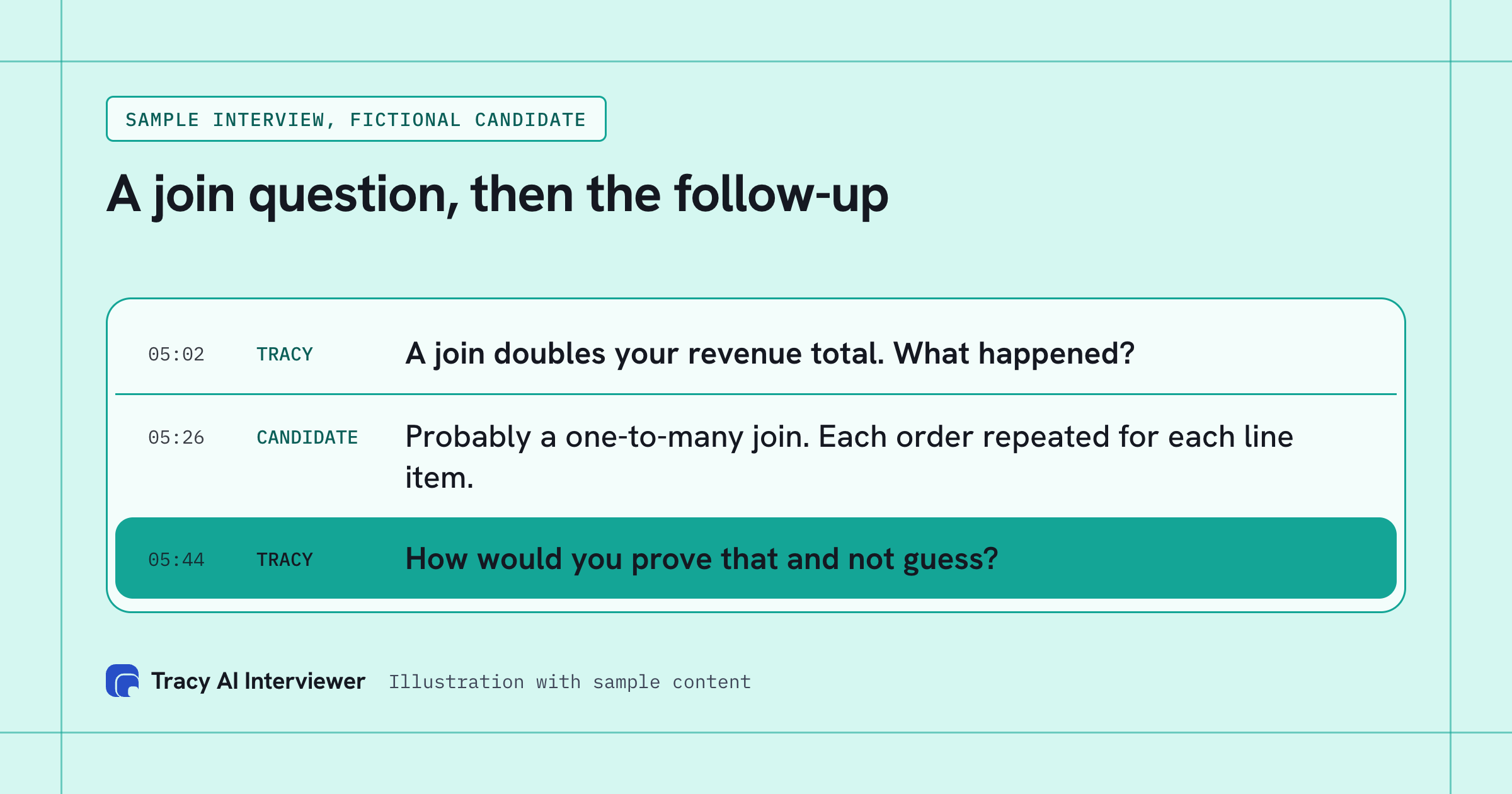
A follow-up built on the candidate's own answer shows whether they have done the work.
Run the interview for every applicant without losing the follow-up
A live screen for every applicant does not survive two hundred of them. Roy Junyoung Jang, Director, Residency & Investment at Antler Korea, reviewed founder interviews and says: "I was effectively spending around six hours a day on screening. With Tracy, I can now review and assess those candidates in approximately 1.5 hours."
- Questions from the role. Paste the analyst job description and Tracy drafts questions on metrics, SQL and communication that you edit or replace with your own. See the product page.
- A SQL or debugging task. It sits in the same interview, with follow-ups on approach and trade-offs, so a join question ends with how they would check the row counts.
- CV check, as a setting. With it on, Tracy can read the CV and ask about what it claims, so "built dashboards" becomes a question about one of them. See how the CV check works.
- No scheduling. Each candidate opens a link at any hour, with no account; the join screen says the conversation is recorded and transcribed. See the participant experience.
- Evidence per result. A recording, a timestamped transcript and a written assessment per question. See AI interview reports.
Pricing is $1 per credit, one credit per started 20 minutes of an interview that produced a result, so a 34-minute interview costs $2. The first 3 results are free with no card, there are no seats, and a session with no answers is never charged. See pricing. Send us one role and we will build the interview plan in days.
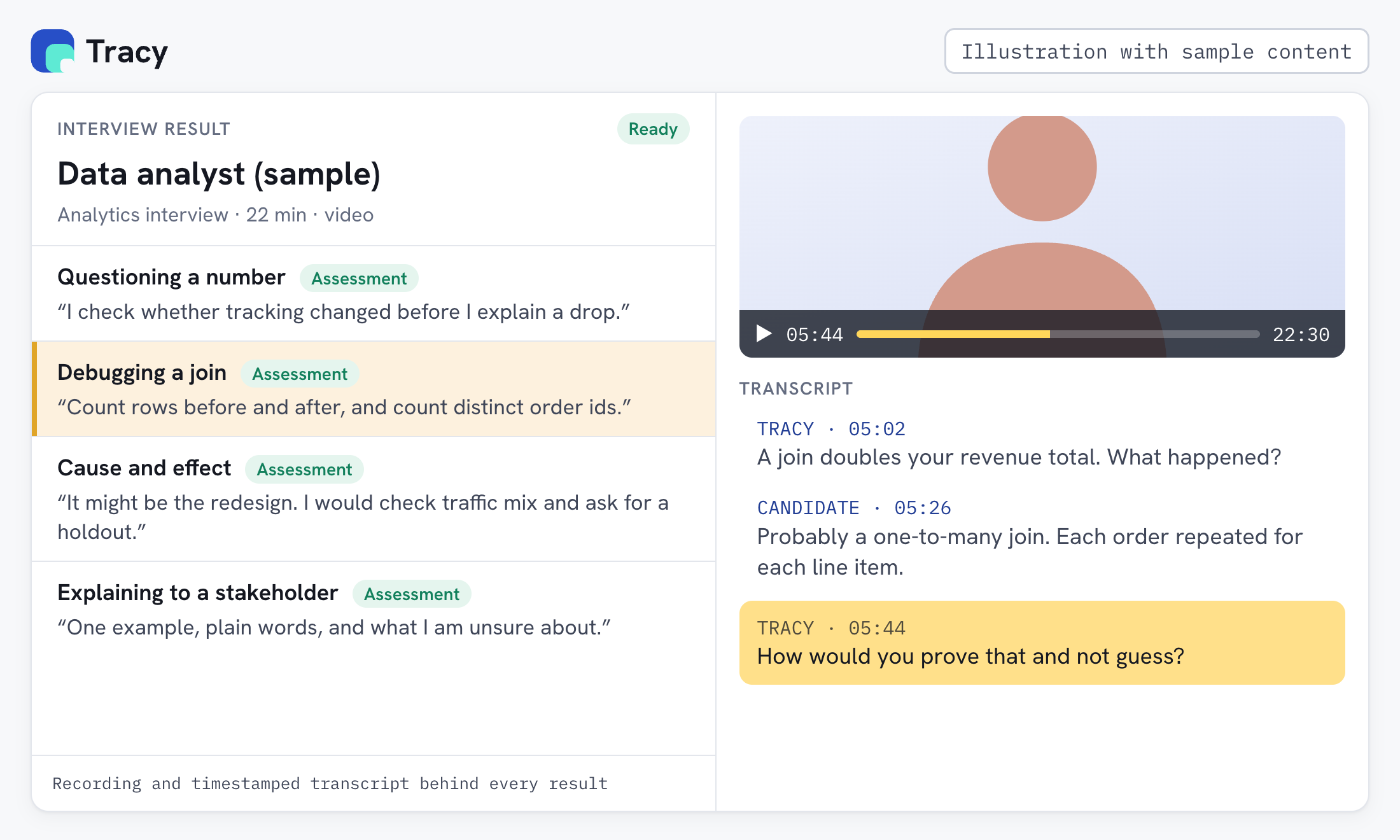
A reviewer can open the recording and transcript behind each assessment.
Keep four checks with people
- Your own analyst. Have one score five or six transcripts blind. If they disagree with the written assessments, fix the questions before inviting the next hundred.
- The query. Tracy asks about approach and trade-offs, such as how they would check row counts. Whether the final SQL meets your standard is a reviewer's call.
- Integrity signals. Tracy captures tab changes, gaze, face detection, delay before answers, fullscreen exits and external screens, and shows the evidence to a person. A signal is not proof.
- The decision. A person decides from the evidence.
For ten applicants, a call with one of your analysts is a reasonable choice; see AI interview vs human interview. When two hundred apply, screening hours are the limit; see how to screen hundreds of applicants. To try it, create a Tracy interview for this role from these questions and read the report on three applicants.
Questions
What are good data analyst interview questions?
What SQL interview questions should I ask a data analyst?
Where can candidates find data analyst interview questions and answers?
Can an AI interviewer interview data analysts?
Create a Tracy interview for this exact role from these questions, then read the recording and report; the button opens the Connect page. Or send us one role and we will build the interview plan, with a recording and report you can check. Try it free · Book a demo
Sources
- Tracy AI Interviewer home page, customer proof, retrieved 9 Nov 2026.
- Tracy AI Interviewer pricing, retrieved 9 Nov 2026.
- Tracy AI Interviewer Connect page, retrieved 9 Nov 2026.